
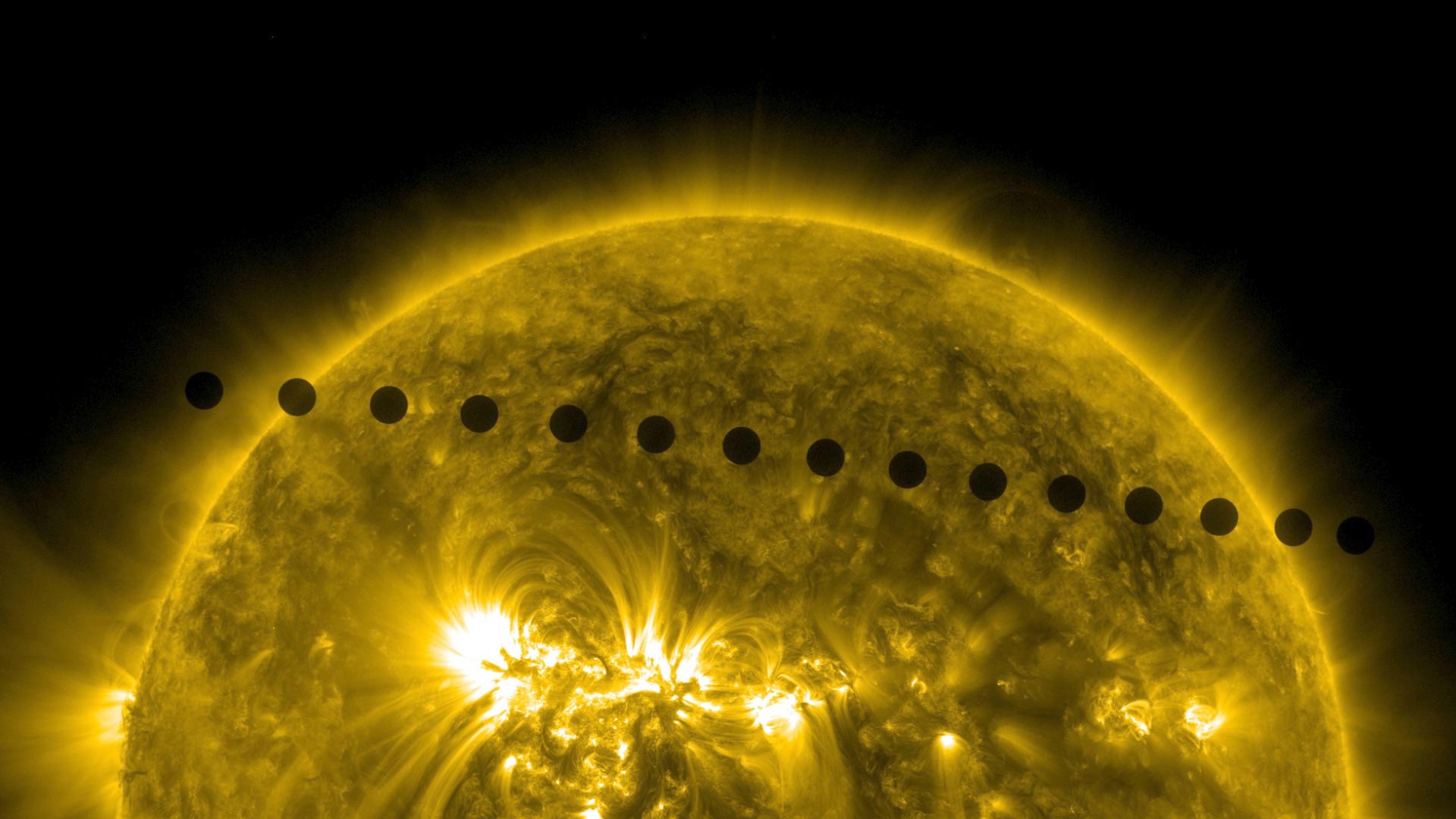
Venus’ thick atmosphere prevents tidal locking and influences the planet’s slow rotation, contributing to extreme heat.
Venus, Earth’s sister planet, would likely not rotate, if not for its soupy, fast-moving atmosphere. Instead, Venus would be fixed in place, always facing the sun the way the same side of the moon always faces Earth.
The gravity of a large object in space can keep a smaller object from spinning, a phenomenon called tidal locking (also known as gravitational locking and captured rotation). Because it prevents this locking, a University of California, Riverside (UCR) astrophysicist argues the atmosphere needs to be a more prominent factor in studies of Venus as well as other planets.
These arguments, as well as descriptions of Venus as a partially tidally locked planet, were published on April 22, 2022, in the journal Nature Astronomy.

“We think of the atmosphere as a thin, almost separate layer on top of a planet that has minimal interaction with the solid planet,” said Stephen Kane, UCR astrophysicist and lead paper author. “Venus’ powerful atmosphere teaches us that it’s a much more integrated part of the planet that affects absolutely everything, even how fast the planet rotates.”
Venus takes 243 Earth days to rotate one time, but its atmosphere circulates the planet every four days. Extremely fast winds cause the atmosphere to drag along the surface of the planet as it circulates, slowing its rotation while also loosening the grip of the sun’s gravity.
Slow rotation in turn has dramatic consequences for the sweltering Venusian climate, with average temperatures of up to 900 degrees Fahrenheit — hot enough to melt lead.
“It’s incredibly alien, a wildly different experience than being on Earth,” Kane said. “Standing on the surface of Venus would be like standing at the bottom of a very hot ocean. You couldn’t breathe on it.”
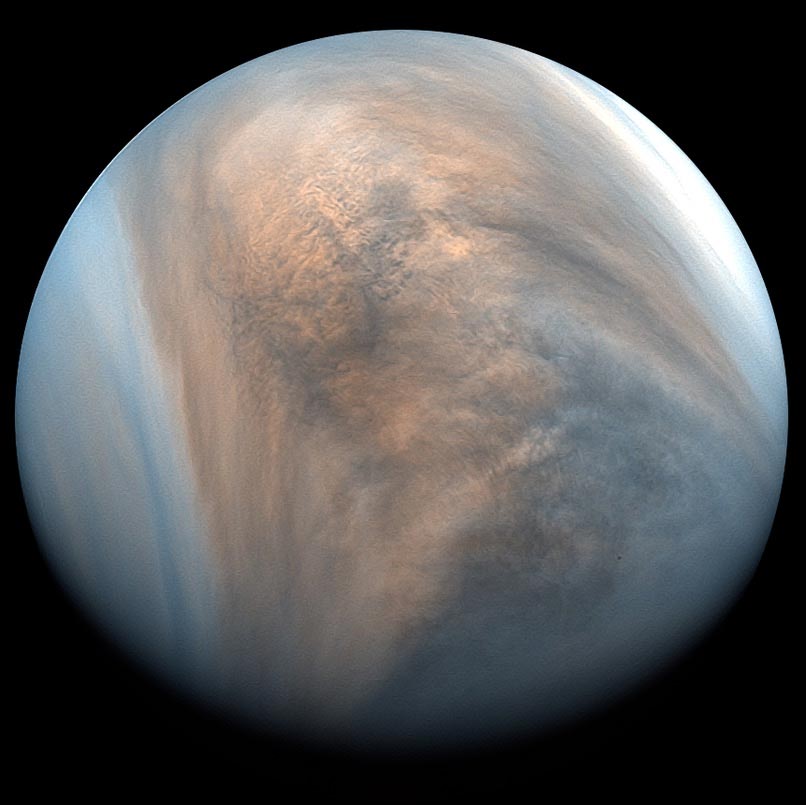
The Venusian Atmosphere: A Runaway Greenhouse Effect
One reason for the heat is that nearly all of the sun’s energy absorbed by the planet is soaked up by Venus’ atmosphere, never reaching the surface. This means that a rover with solar panels like the one NASA sent to Mars wouldn’t work.
The Venusian atmosphere also blocks the sun’s energy from leaving the planet, preventing cooling or liquid water on its surface, a state known as a runaway greenhouse effect.
It is unclear whether being partially tidally locked contributes to this runaway greenhouse state, a condition that ultimately renders a planet uninhabitable by life as we know it.
Not only is it important to gain clarity on this question to understand Venus, but it is also important for studying the exoplanets likely to be targeted for future NASA missions.
Most of the planets likely to be observed with the recently launched James Webb Space Telescope are very close to their stars, even closer than Venus is to the sun. Therefore, they’re also likely to be tidally locked.
Venus as a Model for Exoplanetary Research
Since humans may never be able to visit exoplanets in person, making sure computer models account for the effects of tidal locking is critical. “Venus is our opportunity to get these models correct, so we can properly understand the surface environments of planets around other stars,” Kane said.
“We aren’t doing a good job of considering this right now. We’re mostly using Earth-type models to interpret the properties of exoplanets. Venus is waving both arms around saying, ‘look over here!’”
Gaining clarity about the factors that contributed to a runaway greenhouse state on Venus, Earth’s closest planetary neighbor, can also help improve models of what could one day happen to Earth’s climate.
“Ultimately, my motivation in studying Venus is to better understand the Earth,” Kane said.
Reference: “Atmospheric dynamics of a near tidally locked Earth-sized planet” by Stephen R. Kane, 22 April 2022, Nature Astronomy.
DOI: 10.1038/s41550-022-01626-x
Never miss a breakthrough: Join the SciTechDaily newsletter.
Follow us on Google and Google News.
4 Comments
Mercury has a negligible atmosphere, but rotates.
I realise there is a locking effect there too, but…
Meanwhile, I do not deny the possibility that the Venusian atmosphere could be conserving the rotation, though I am not able to calculate the factors that influence the conservation of angular momentum, but if tidal locking is likely to have been effective by now in the absence of atmosphere, then I propose that the Venusian atmosphere is likely to have reached an equilibrium driven by solar power.
Imagine an earlier phase where Venus has a reasonable rotation rate, say comparable to Earth or Mars, only probably in the opposite sense. Now tidal locking reduces that rotation rate till it is close to tidal locking. Now any atmosphere that enters the illuminated side from the dark side will begin to expand, while the balancing hot gases entering the dark side cool off. The effect is asymmetrical, and accelerates the upper atmosphere like a thermally powered jet engine, preventing the final tidal locking. The equilibrium, once achieved, would have a long life with the upper atmosphere at the equator rotating much faster than the planet or the lower atmosphere.
If the planet did achieve tidal locking, possibly by collision with other massive bodies, the asymmetry would vanish, and the jet effect would vanish abruptly with the rotwtion, or never arise.
Just thinking…
Jon
Right, but how do you explain the rotation of Mercury, then?
No mention here of the bizarre tidal locking of Venus to EARTH such that the same side of Venus always faces the Earth when the two planets are closest, about every 19 months when Venus is at inferior conjunction (i.e., passes the Earth on its inside track). It is not an absolutely solid lock, but the drift from one conjunction to the next is well less than one part in a thousand. Nevertheless, those scientists who have even addressed the issue call it “coincidence.” Really?
Look to Dr. Donald Scott and his explanation of Birkeland currents. The universe is electric.