
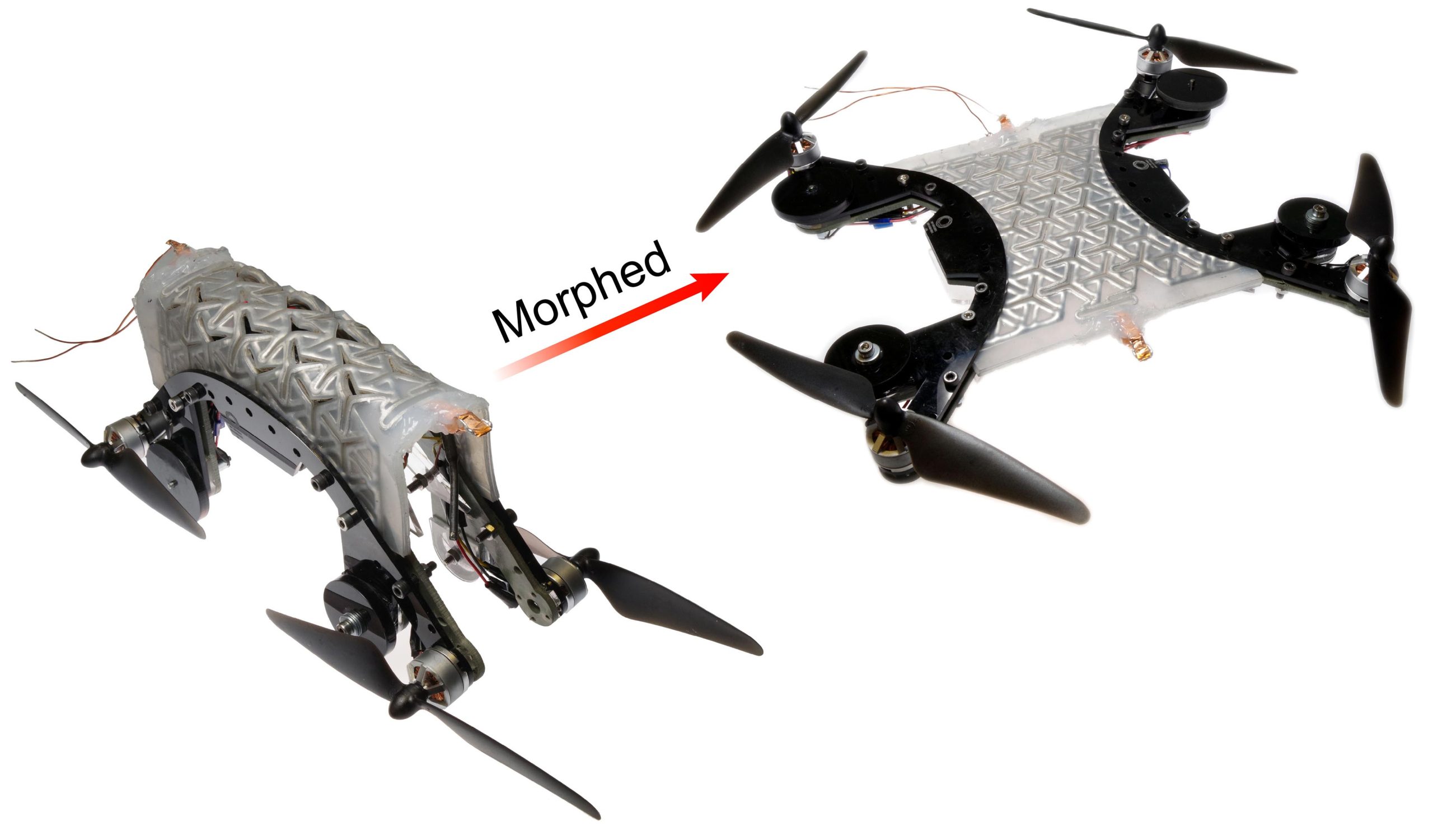
Virginia Tech researchers have introduced a kirigami-inspired morphing material promising transformative applications in robotics and material science.
Imagine a small autonomous vehicle that could drive over land, stop, and flatten itself into a quadcopter. The rotors start spinning, and the vehicle flies away. Looking at it more closely, what do you think you would see? What mechanisms have caused it to morph from a land vehicle into a flying quadcopter? You might imagine gears and belts, perhaps a series of tiny servo motors that pulled all its pieces into place.
If this mechanism was designed by a team at Virginia Tech led by Michael Bartlett, assistant professor in mechanical engineering, you would see a new approach for shape changing at the material level. These researchers use rubber, metal, and temperature to morph materials and fix them into place with no motors or pulleys. The team’s work has been published in Science Robotics. Co-authors of the paper include graduate students Dohgyu Hwang and Edward J. Barron III and postdoctoral researcher A. B. M. Tahidul Haque.
Getting Into Shape
Nature is rich with organisms that change shape to perform different functions. The octopus dramatically reshapes to move, eat, and interact with its environment; humans flex muscles to support loads and hold shape; and plants move to capture sunlight throughout the day. How do you create a material that achieves these functions to enable new types of multifunctional, morphing robots?
“When we started the project, we wanted a material that could do three things: change shape, hold that shape, and then return to the original configuration, and to do this over many cycles,” said Bartlett. “One of the challenges was to create a material that was soft enough to dramatically change shape, yet rigid enough to create adaptable machines that can perform different functions.”
To create a structure that could be morphed, the team turned to kirigami, the Japanese art of making shapes out of paper by cutting. (This method differs from origami, which uses folding.) By observing the strength of those kirigami patterns in rubbers and composites, the team was able to create a material architecture of a repeating geometric pattern.
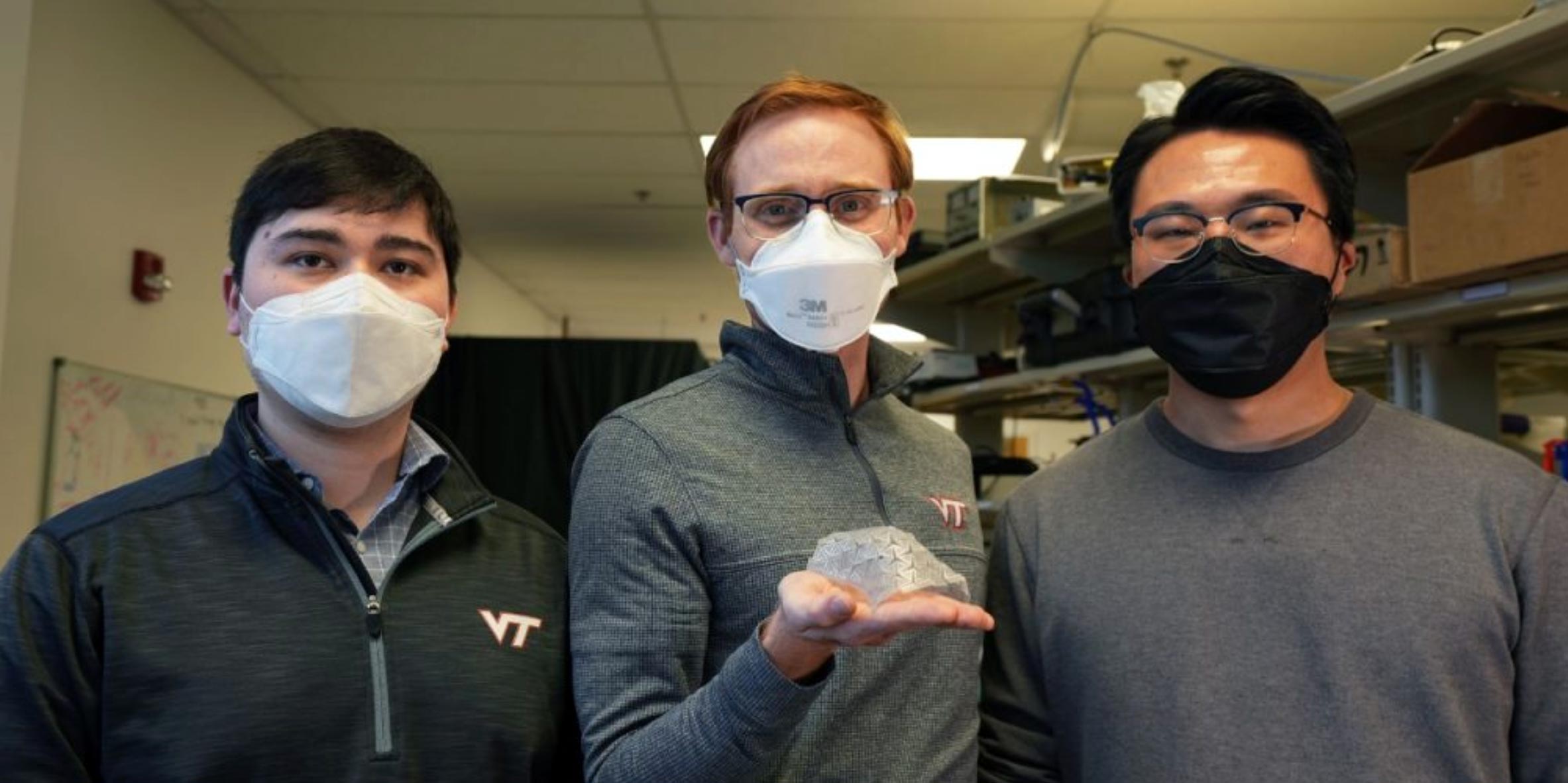
Next, they needed a material that would hold shape but allow for that shape to be erased on demand. Here they introduced an endoskeleton made of a low melting point alloy (LMPA) embedded inside a rubber skin. Normally, when a metal is stretched too far, the metal becomes permanently bent, cracked, or stretched into a fixed, unusable shape. However, with this special metal embedded in rubber, the researchers turned this typical failure mechanism into a strength. When stretched, this composite would now hold a desired shape rapidly, perfect for soft morphing materials that can become instantly load bearing.
Finally, the material had to return the structure back to its original shape. Here, the team incorporated soft, tendril-like heaters next to the LMPA mesh. The heaters cause the metal to be converted to a liquid at 60 degrees Celsius (140 degrees Fahrenheit), or 10 percent of the melting temperature of aluminum. The elastomer skin keeps the melted metal contained and in place, and then pulls the material back into the original shape, reversing the stretching, giving the composite what the researchers call “reversible plasticity.” After the metal cools, it again contributes to holding the structure’s shape.
“These composites have a metal endoskeleton embedded into a rubber with soft heaters, where the kirigami-inspired cuts define an array of metal beams. These cuts combined with the unique properties of the materials were really important to morph, fix into shape rapidly, then return to the original shape,” Hwang said.
The researchers found that this kirigami-inspired composite design could create complex shapes, from cylinders to balls to the bumpy shape of the bottom of a pepper. Shape change could also be achieved quickly: After impact with a ball, the shape changed and fixed into place in less than 1/10 of a second. Also, if the material broke, it could be healed multiple times by melting and reforming the metal endoskeleton.
One Drone for Land and Air, One for Sea
The applications for this technology are only starting to unfold. By combining this material with onboard power, control, and motors, the team created a functional drone that autonomously morphs from a ground to air vehicle. The team also created a small, deployable submarine, using the morphing and returning of the material to retrieve objects from an aquarium by scraping the belly of the sub along the bottom.
“We’re excited about the opportunities this material presents for multifunctional robots. These composites are strong enough to withstand the forces from motors or propulsion systems, yet can readily shape morph, which allows machines to adapt to their environment,” said Barron.
Looking forward, the researchers envision the morphing composites playing a role in the emerging field of soft robotics to create machines that can perform diverse functions, self-heal after being damaged to increase resilience, and spur different ideas in human-machine interfaces and wearable devices.
Reference: “Shape morphing mechanical metamaterials through reversible plasticity” by Dohgyu Hwang, Edward J. Barron III, A. B. M. Tahidul Haque and Michael D. Bartlett, 9 February 2022, Science Robotics.
DOI: 10.1126/scirobotics.abg2171
This project was funded through Bartlett’s DARPA Young Faculty Award and Director’s Fellowship.
Never miss a breakthrough: Join the SciTechDaily newsletter.
Follow us on Google and Google News.