
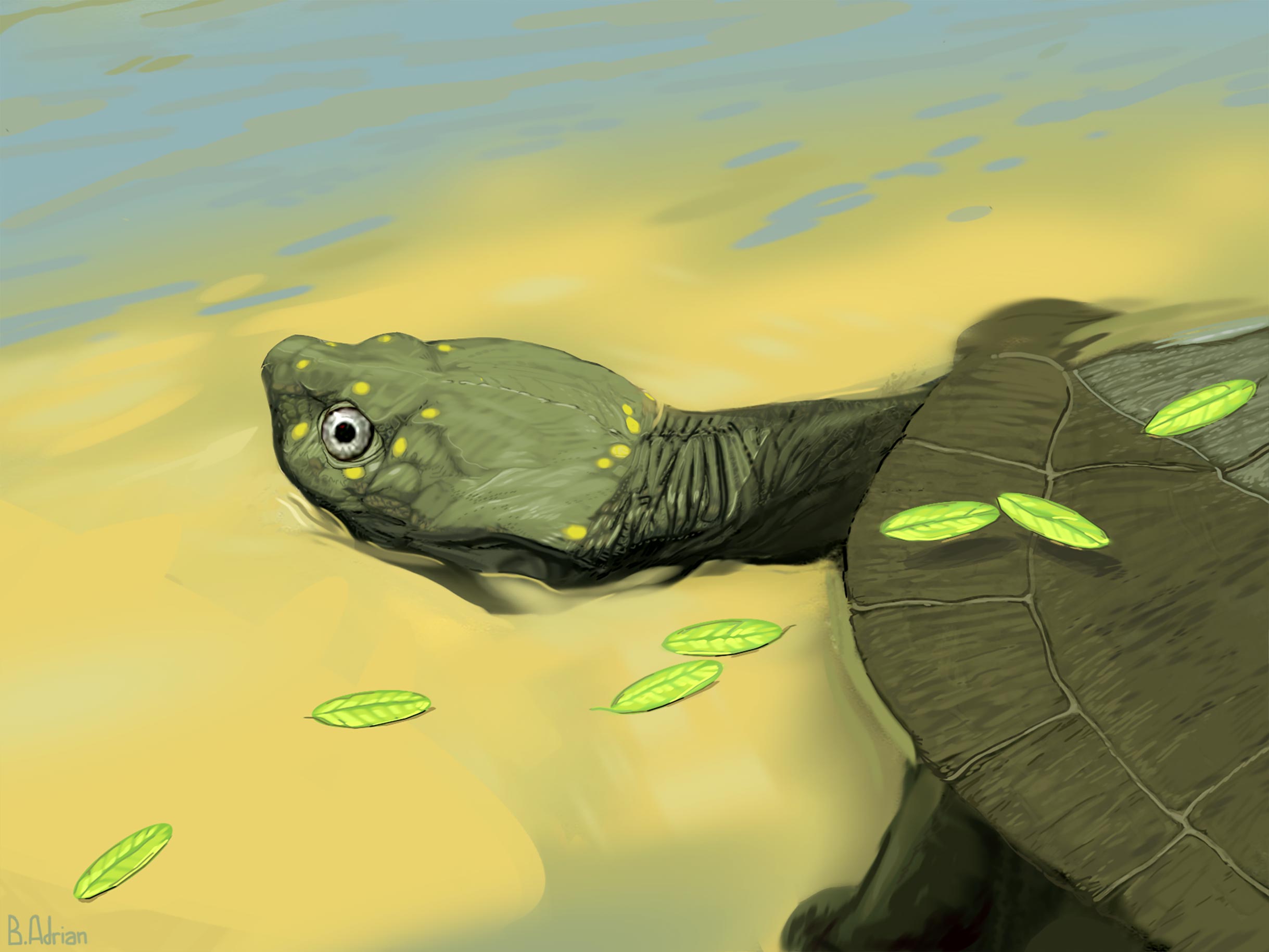
A fossil turtle from Texas reveals the earliest sidenecked turtle migration into North America 100 million years ago.
The discovery of a new species of ancient turtle is shedding light on hard-to-track reptile migrations about 100 million years ago. Pleurochayah appalachius, a bothremydid turtle adapted for coastal life, is described in a new paper published by a multi-institution research group in the journal Scientific Reports.
P. appalachius was discovered at the Arlington Archosaur Site (AAS) of Texas, which preserves the remnants of an ancient Late Cretaceous river delta that once existed in the Dallas-Fort Worth area and is also known for discoveries of fossil crocodyliformes and dinosaurs. P. appalachius belonged to an extinct lineage of pleurodiran (side-necked) turtles referred to as the Bothremydidae, a diverse and geographically widespread clade that occupied a wide range of ecological niches. The group originated in the southern continent of Gondwana, migrating to northern continents beginning in the Early Cretaceous. P. appalachius represents one of the earliest examples of intercontinental dispersals by the group and is the oldest bothremydid found in North America and Laurasian sediments. Its species name derives from the eastern North American subcontinent Appalachia, which was separated from Laramidia in the west by the Western Interior Seaway during the Late Cretaceous.
Adaptations for Aquatic Migration
Pleurochayah appalachius had an intriguing combination of morphological adaptations to a highly aquatic lifestyle that likely facilitated its long-distance migration. Its humerus (upper arm bone) shows large bony attachments for muscles that support a powerful recovery from swimming strokes. The functional morphology of the bone also indicates that P. appalachius likely utilized an aquatic rowing mode of swimming, as opposed to the flapping motion of modern sea turtles. The paleohistology (microanatomy) of its shell bone reveals a comparatively thick external compared to internal cortex, similar to later marine-adapted bothremydid species. However, its marine adaptations are not as derived as in later bothremydids, which are found throughout the fossil record of North American later in the Late Cretaceous.
The cranium of P. appalachius has a unique combination of primitive and derived traits that it shares with other bothremydid species. It shares most characteristics with two of the basal bothremydid clades, Cearachelyini and Kurmademydini. A phylogenetic analysis places P. appalachius as a basal member of the bothremydid clade, and an outgroup to the more derived Bothremydini and Taphrosphyini tribes.
“This discovery provides the earliest evidence of sidenecked turtles in North America and expands our understanding of the first migrations of the extinct bothremydids. It further establishes the Arlington Archosaur Site as an important fossil unit that is revealing the foundations of an endemic Appalachian fauna,” said Brent Adrian, Senior Research Specialist, Anatomy, at the Midwestern University College of Graduate Studies and the lead author of the study.
Reference: “An early bothremydid from the Arlington Archosaur Site of Texas” by Brent Adrian, Heather F. Smith, Christopher R. Noto and Aryeh Grossman, 20 May 2021, Scientific Reports.
DOI: 10.1038/s41598-021-88905-1
The AAS is a prolific fossil locality found in the middle of a suburban subdivision. The site preserves remnants of an ancient Late Cretaceous river delta around 96 million years ago in what is today the Dallas-Fort Worth area. It preserves a record of a freshwater wetland that sat near the shore of a large peninsula, including a diverse assemblage of crocodile relatives, dinosaurs, amphibians, mammals, fish, invertebrates, and plants, several of which are also new species awaiting description. The research team describing these discoveries includes Brent Adrian, Dr. Heather F. Smith, and Dr. Ari Grossman from Midwestern University in Glendale, Arizona, and Dr. Christopher Noto from University of Wisconsin-Parkside.
Work at the Arlington Archosaur Site is supported in part by the National Geographic Society, who provided a grant to complete field work at the site, and the Perot Museum of Nature and Science in Dallas, who curates the fossils found at the site. Scientific Reports is a member of the Nature Publishing Group.
Never miss a breakthrough: Join the SciTechDaily newsletter.
Follow us on Google and Google News.