
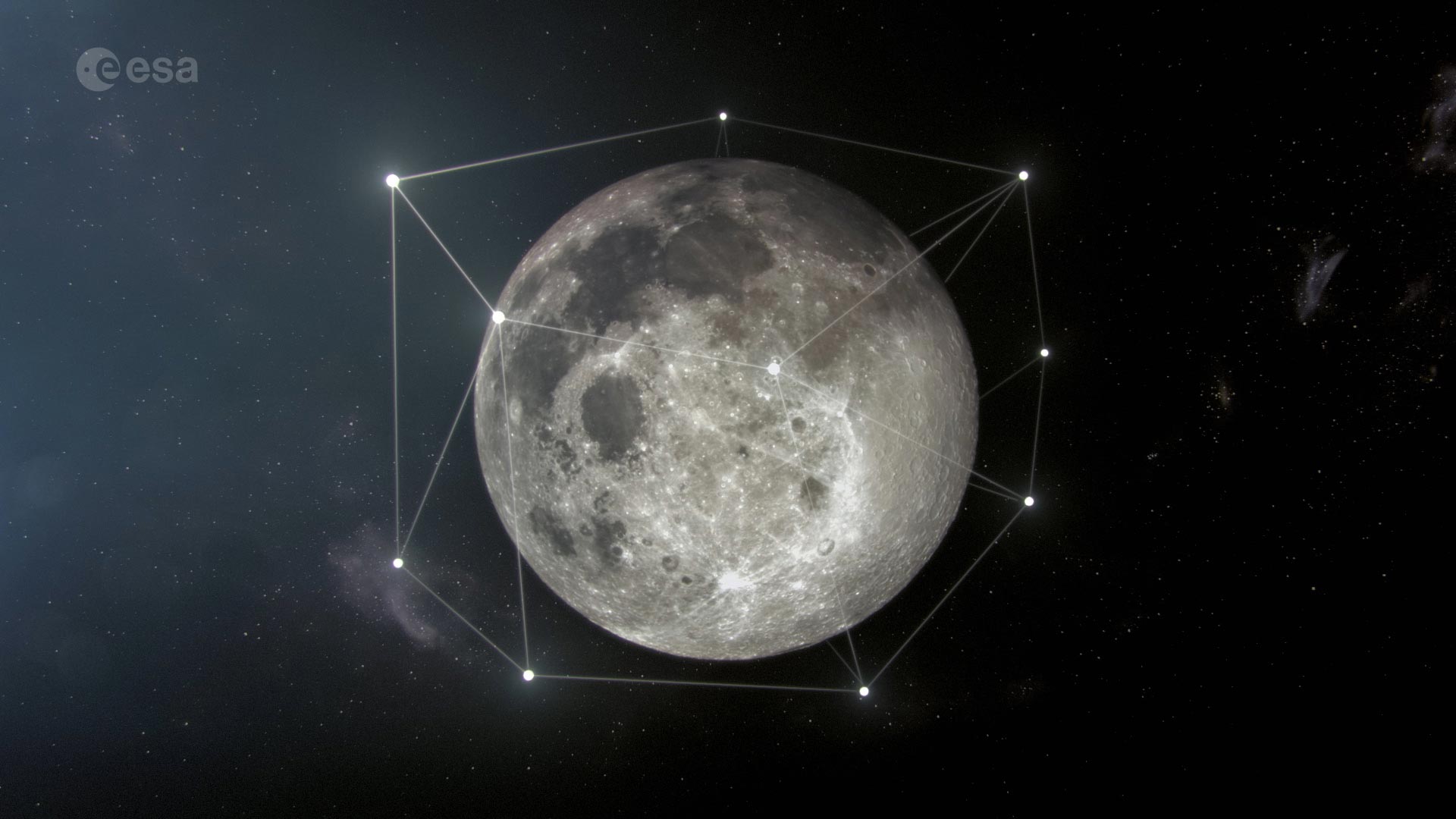
A bold proposal to create a commercially viable constellation of lunar satellites has taken a step closer.
Two consortia of companies will be supported by ESA to devise detailed definitions of how to provide telecommunications and navigation services for missions to the Moon, under the agency’s Moonlight initiative.
Such a lasting lunar link will enable sustainable space exploration.
ESA is going to the Moon together with its international partners including NASA.
Dozens of international, institutional, and commercial teams are sending missions to the Moon that envisage a permanent lunar presence. These will become regular trips to Earth’s natural satellite rather than one-off expeditions
Many of these initiatives come from the main space institutions in China, India, Japan, and Russia, alongside other spacefaring nations, as well as private entities across the globe.
A reliable and dedicated lunar communications and navigation service would allow missions to land wherever they wanted. Radio astronomers could set up observatories on the far side of the Moon. Rovers could trundle over the lunar surface more speedily. It could even enable the teleoperation of rovers and other equipment from Earth.
Using a shared telecommunications and navigation service would reduce the design complexity of future individual missions and make them lighter, freeing space for more scientific instruments or other cargo, making each individual mission more cost-efficient.
Opportunities for Nations and New Industries
Lowering the ticket price to lunar exploration could empower a wider group of ESA member states to launch their own national lunar missions. Even on a relatively low budget, an emerging space nation would be able to send a scientific CubeSat mission to the Moon, inspiring the next generation of scientists and engineers.
Commercial bodies could use innovative technologies developed for the Moon to create new services and products on Earth, which would create new jobs and boost prosperity. They could also identify new Moon-enabled services and products such as virtual reality games in which players manipulate lunar robots or see through the eyes of lunar astronauts.
Builds on Existing ESA Contributions
ESA is providing several service modules for NASA’s Artemis program to return humans to the Moon by 2024, including the ESPRIT communications module for the lunar Gateway’s living quarters for astronauts. With its European industrial partner, ESA is helping to build the Lunar Pathfinder, showcasing lunar communications service provision by providing initial services to early lunar missions, including a complete lunar navigation in-orbit demonstration.
The Moonlight initiative builds on both the ESPRIT communications module and the Lunar Pathfinder.
The two consortia will articulate exactly how to achieve a lasting link with the Moon.
Surrey Satellite Technology Limited will lead the first consortium, both in the service prime capacity through its lunar services brand SSTL Lunar and as the satellite manufacturer. The consortium also includes: satellite manufacturer Airbus; satellite network providers SES, based in Luxembourg, and Kongsberg Satellite Services, based in Norway; the Goonhilly Earth Station in the UK; and British satellite navigation company GMV-NSL.
The second consortium will be spearheaded by Telespazio, working with: satellite manufacturer Thales Alenia Space; satellite operator Inmarsat, based in the UK; Canadian space technology company MDA; Telespazio’s subsidiary in Germany and OHB Systems; Spanish satellite operator Hispasat; and the Italian Aerospace Logistics Technology Engineering Company (ALTEC), aerospace engineering company Argotec, Nanoracks Europe, the Politecnico Milano and the Università commerciale Luigi Bocconi.
The contracts were signed on behalf of ESA by Elodie Viau, Director of Telecommunications and Integrated Applications, in the presence of David Parker, ESA’s Director of Human and Robotic Exploration, and Paul Verhoef, ESA’s Director of Navigation.
Elodie Viau said: “A lasting link with the Moon enables sustainable space exploration for all our international partners, including commercial space companies. By using an ESA-backed telecommunications and navigation service for the Moon, explorers will be able to navigate smoothly and to relay to Earth all the knowledge gained from these lunar missions.
“A robust, reliable and efficient telecommunications and navigation system will make the dozens of individual missions planned for the Moon more cost-efficient and enable smaller countries to become space-faring nations, inspiring the next generation of scientists and engineers.”
Never miss a breakthrough: Join the SciTechDaily newsletter.
Follow us on Google and Google News.
1 Comment
The moon is turned to the Earth on one side because its center of mass is shifted towards the Earth. The radius of the satellite’s orbit should be on the left and right = R, the radius from the Earth = R + X, and the radius on the opposite side = R – X, where X is the value of the displacement of the center of mass of the Moon. I don’t know how many meters or kilometers it is. This should be set by the navigation satellite. Otherwise, all satellites, if not constantly adjusted, will fall in the center of the visible side of the moon.