
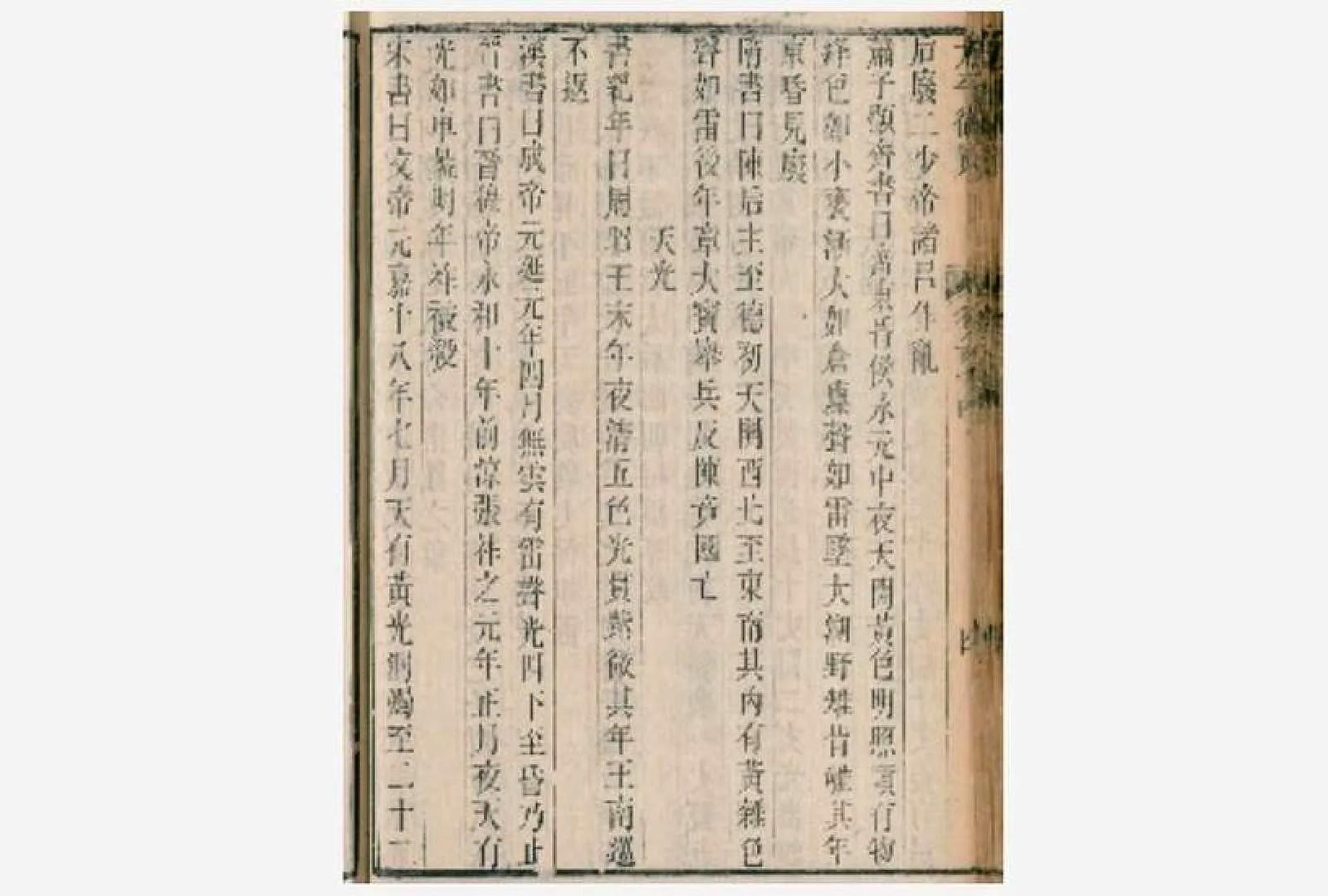
Ancient Chinese writing mentions a celestial phenomenon that turns out to be the oldest known reference to a potential aurora, predating the next oldest by about 300 years.
A celestial event mentioned in an ancient Chinese text turns out to be the oldest known reference to a candidate aurora, predating the next oldest one by some three centuries, according to a recent study by Marinus Anthony van der Sluijs, an independent researcher based in Canada, and Hisashi Hayakawa from Nagoya University. This discovery was published recently in the journal Advances in Space Research.
The Bamboo Annals, or Zhushu Jinian in Mandarin, chronicle the history of China from the earliest legendary time to the 4th century BCE, when they were most likely written. Aside from historical events, unusual sky observations appear on occasion in the text. Although historians have known about this chronicle for a long time, a fresh look at such old documents can sometimes provide surprising new insights. In this example, the authors looked into a mention of a “five-colored light” observed in the northern region of the sky on a night near the conclusion of King Zhao of the Zhou dynasty’s reign.
While the exact year is uncertain, they used up-to-date reconstructions of Chinese chronology to settle on 977 and 957 BCE as the two most likely years, depending on how Zhao’s reign is dated. They found the record of the “five-colored light” to be consistent with a large geomagnetic storm. When the mid-latitude aurora is sufficiently bright, it can present a spectacle of multiple colors. The researchers cite several examples of this from historical records much closer to our time. The earth’s north magnetic pole is known to have been inclined to the Eurasian side in the mid-10th century BCE, about 15° closer to central China than at present. Therefore, the auroral oval could have been visible to observers in central China at times of significant magnetic disturbance. The study estimates that the equatorward boundary of the auroral oval would have been located at a magnetic latitude of 40° or less on the occasion.
Historical Records of Aurorae and Magnetic Activity
This would be the earliest datable record of an aurora known from anywhere in the world. The finding comes barely two years after that of the previous holder of this distinction – several records of candidate aurorae inscribed on cuneiform tablets by Assyrian astronomers in the period 679-655 BCE. Some scientists have also associated Ezekiel’s vision, which is now dated to 594 or 593 BCE, with auroral visibility in the Middle East, but a caveat must be noted for its reliability. Otherwise, another datable record of an early candidate aurora has been found for 567 BCE in the astronomical diary of the Babylonian king Nebuchadnezzar II.
Why did it take so long for scientists to recognize the aurora in the five-colored light of this chronicle entry? One reason is that the Bamboo Annals had a chequered history. The original manuscript was lost, rediscovered in the 3rd century CE and lost again during the Song dynasty. In the 16th century, a variant text was printed in which the object in the sky was not a five-colored light, but a comet. Now the new study shows that this cannot have been the original reading.
It is fascinating in itself that popular accounts of the northern lights can be traced back this far. However, such historical information is useful for other purposes as well. It assists scientists in modeling long-term patterns in space weather variability and solar activity over timeframes ranging from decades to millennia. Understanding these variations can help society prepare for potential future large-scale solar eruptions and the disruption to technological infrastructure that they may bring.
This record is now the only known historical reference to a space weather event before the Homeric Grand (Solar) Minimum (810 – 740 BCE), which should preferably be called the Neo-Assyrian Grand Minimum owing to Homer’s controversial historicity and dates.
Reference: “A candidate auroral report in the Bamboo Annals, indicating a possible extreme space weather event in the early 10th century BCE” by Marinus Anthony van der Sluijs and Hisashi Hayakawa, 17 January 2022, Advances in Space Research.
DOI: 10.1016/j.asr.2022.01.010
Never miss a breakthrough: Join the SciTechDaily newsletter.
Follow us on Google and Google News.
1 Comment
40% Pink,
26% Blueish Purple,
24% of a slightly Blue tinted Green,
7% Yellow
3% fire Orange.
(Approximately)
Photo taken 11/8/21 Gisborne,NZ.
They are not an Aurora.