
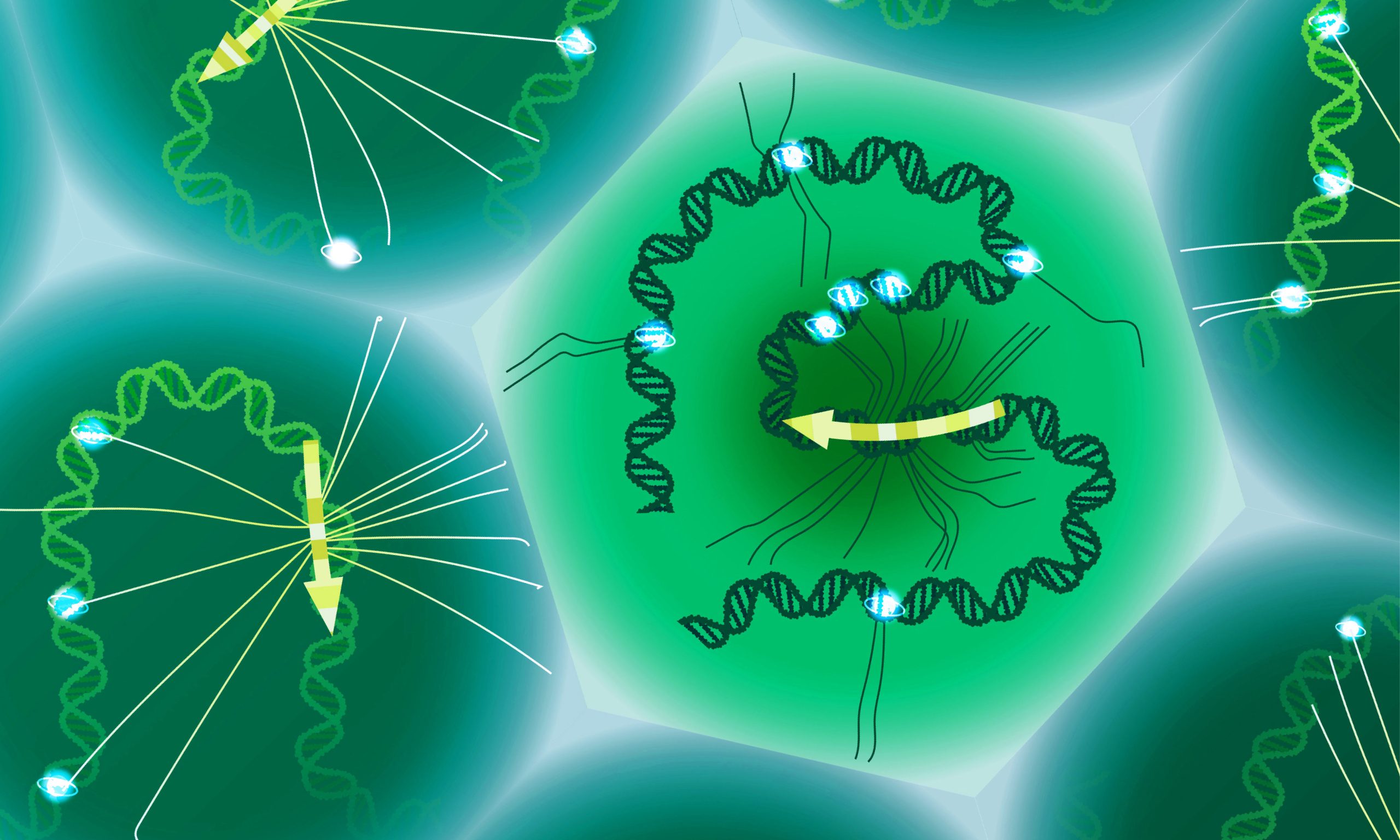
By examining genomic variation more closely, scientists can now identify new disease connections with greater speed and accuracy.
For centuries, scientists have recognized that certain illnesses can run in families, an idea that dates back to Hippocrates. Over time, researchers have become increasingly skilled at uncovering how these inherited patterns are rooted in our genetic makeup.
Now, researchers at EMBL and their collaborators have introduced a powerful new tool that advances single-cell technology by examining both genomic variations and RNA within the same cell. This approach delivers greater accuracy and scalability than earlier methods.
By detecting changes in the non-coding regions of DNA – areas where disease-related variations most often occur – the tool opens new possibilities for exploring how genetic differences influence health. With its ability to analyze large numbers of single cells in detail, this innovation marks a major step forward in connecting genetic variants to specific diseases.
“This has been a long-standing problem, as current single-cell methods to study DNA and RNA in the same cell have had limited throughput, lacked sensitivity, and are complicated,” said Dominik Lindenhofer, the lead author on a new paper about SDR-Seq published in Nature Methods and a postdoctoral fellow in EMBL’s Steinmetz Group. “On a single-cell level, you could read out variants in thousands of cells, but only if they had been expressed – so only from coded regions. Our tool works, irrespective of where variants are located, yielding single-cell numbers that enable analysis of complex samples.”
The important difference between coding and non-coding regions
The genome, which is made up of DNA, has both coding and non-coding parts. Genes in coding regions have been compared to instruction manuals or recipes, since those genes are expressed into RNA, essentially telling the cell how to make proteins, the building blocks of life.
Non-coding sections contain many regulatory elements important to cellular development and function. More than 95% of disease-associated variants that occur in DNA do so in these non-coding regions, yet current single-cell tools haven’t provided the throughput and sensitivity to understand these large regions better. Up to now, scientists couldn’t simultaneously observe DNA and RNA from the same cell at scale to determine DNA code variants’ functions and their consequences.
“In this non-coding space, we know there are variants related to things like congenital heart disease, autism, and schizophrenia that are vastly unexplored, but these are certainly not the only diseases like this,” Lindenhofer said. “We needed a tool to do that exploration to understand which variants are functional in their endogenous genomic context and understand how they contribute to disease progression.”
Deciphering barcodes that track single cells
For single-cell DNA-RNA sequencing (SDR-seq), the scientists employed oil-water emulsion droplets, with each drop containing a single cell, to analyze both DNA and RNA. The scientists could actually study thousands of cells simultaneously in a given test tube and directly connect genetic changes to gene activity. But this kind of technology development required overcoming several limitations and ended up involving collaborators from EMBL’s Genome Biology and Structural and Computational Biology units, the Stanford University School of Medicine, and Heidelberg University Hospital.
Initially, collaborators from the EMBL research groups of Judith Zaugg and Kyung-Min Noh developed a way to ‘fix’ cells to protect fragile RNA. Additionally, computational biologists from Oliver Stegle’s EMBL research group built a customized tool to deconvolute and decode the complex DNA barcoding system needed to build this technology and enable further downstream data analysis. And though this decoder was built for this project specifically, the scientists expect it can be applied to other research.
Researchers from Wolfgang Huber’s and Sasha Dietrich’s research groups at EMBL and Universitätsklinikum Heidelberg, respectively, were already screening B-cell lymphoma cells for other research projects. Consequently, they provided primary patient samples with high numbers of genomic variants to help test the tool. Lindenhofer then used these samples to observe connections between variants and disease. He found that cancer cells with more variants had increased activated signals that helped cancer grow.
“We are using these small reaction chambers to read out DNA and RNA in the same single cell,” Lindenhofer said. “This lets us accurately tell whether a variant is on one or both copies of a gene and measure its effects on gene expression in the same single cells. With the B-cell lymphoma cells, we were able to show that depending on the variant makeup of cells, they had different propensities to belong to distinct cellular states. We could also see that increasing variants in a cell actually were associated with a more malignant B-cell lymphoma state.”
The many opportunities from a single-cell sequencing tool
The SDR-seq tool now offers genomic biologists scale, precision, and speed to help better understand genetic variants. While it could eventually play a role in treating a broad range of complex diseases, it may first help in developing better screening tools for diagnosis.
“We have a tool that can link variants to disease,” said Lars Steinmetz, a senior author on the paper, an EMBL group leader, and a genetics professor at Stanford University School of Medicine. “This capability opens up a wide range of biology that we can now discover. If we can discern how variants actually regulate disease and understand that disease process better, it means we have a better opportunity to intervene and treat it.”
Reference: “Functional phenotyping of genomic variants using joint multiomic single-cell DNA–RNA sequencing” by Dominik Lindenhofer, Julia R. Bauman, John A. Hawkins, Donnacha Fitzgerald, Umut Yildiz, Haeyeon Jung, Anastasiia Korosteleva, Mikael Marttinen, Moritz Kueblbeck, Judith B. Zaugg, Kyung-Min Noh, Sascha Dietrich, Wolfgang Huber, Oliver Stegle and Lars M. Steinmetz, 32 August 2025, Nature Methods.
DOI: 10.1038/s41592-025-02805-0
Never miss a breakthrough: Join the SciTechDaily newsletter.
Follow us on Google and Google News.
3 Comments
Yes pl send such type s of articals
So, I take it that the ‘tool’, is some kind of a reaction chamber used in multiples, and not an automated machine. Congratulations to the Europien Molecular Biology Laboratories in helping develope this technology. It has great promise for proactive disease analysis, prevention, and detailed treatments.
Respected sir ASK it is private and only for up grading the genomic knowledge other wise nothing sir.if practically isolate DNA and RNA in a single cell to identify mutation and point mutation I have doubts.1. same mutations in both 2.at what base pairs.3.clearity in unloking both.4 same tools we can use for both.5.Easy to identify mutation and point mutation.