
Close Menu
    Facebook X (Twitter) Instagram
    SciTechDaily
    • Biology
    • Chemistry
    • Earth
    • Health
    • Physics
    • Science
    • Space
    • Technology
    Facebook X (Twitter) Pinterest YouTube RSS
    SciTechDaily
    Home»Space»Next-Generation Heavy-Lift Launcher: Trial by Fire for Ariane 6 Rocket’s Upper Stage
    Space

    Next-Generation Heavy-Lift Launcher: Trial by Fire for Ariane 6 Rocket’s Upper Stage

    By European Space Agency (ESA)September 6, 2023No Comments2 Mins Read
    Facebook Twitter Pinterest Telegram LinkedIn WhatsApp Email Reddit
    Share
    Facebook Twitter LinkedIn Pinterest Telegram Email Reddit
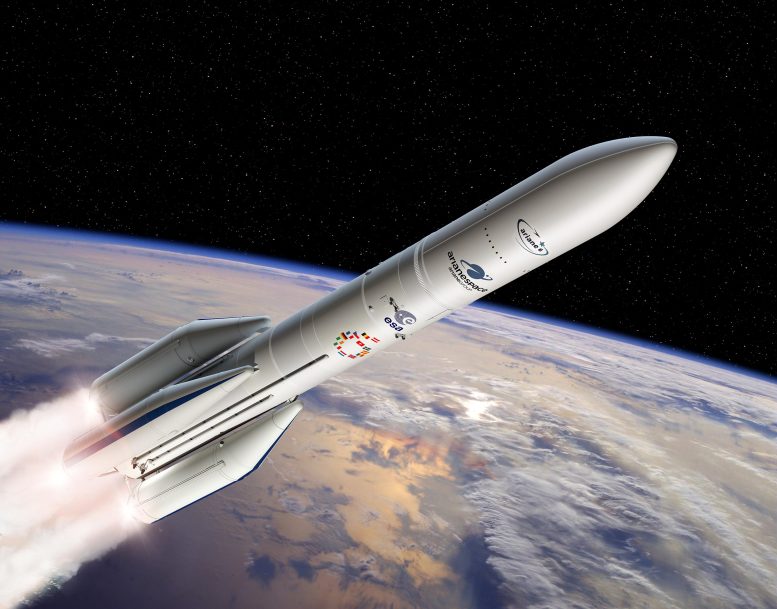
    Ariane 6 Rocket Using Four Boosters
    Artist’s view of the configuration of Ariane 6 using four boosters (A64). Credit: ESA – D. Ducros

    ESA’s Ariane 6 vehicle tested its Vinci and APU engines in Germany, marking a step forward in Europe’s space technology and collaboration efforts.

    On September 1, 2023, ESA’s all-new Ariane 6 launch vehicle fired its two upper-stage engines to simulate the way they will have to operate together at German aerospace agency DLR’s engine test center in Lampoldshausen, Germany. The test – of the new Vinci engine and a smaller Auxiliary Power Unit (APU) – took place on a purpose-built test bench.

    Innovative Features of Ariane 6

    Vinci, the upper stage engine of Ariane 6 fed by liquid hydrogen and oxygen, can be stopped and restarted multiple times – to place satellites into different orbits and then de-orbit the upper stage, so it is not left behind as hazardous debris in space.

    The APU makes it possible for Vinci to restart in space, by maintaining adequate pressure in the fuel tanks and preventing bubbles in the fuel lines. The power unit uses small amounts of liquid hydrogen and oxygen from the main tanks – replacing a system that relied on large quantities of tanked helium.

    Ariane 6: Europe’s Next-Generation Heavy-Lift Launcher

    Ariane 6 is an all-new design, created to succeed Ariane 5 as Europe’s heavy-lift launch system. This autonomous capability to reach Earth orbit and deep space is the foundation of Europe’s vision of space-enabled navigation, Earth observation, scientific, and security services. This vision is a reality thanks to the sustained dedication of thousands of talented people working in ESA’s 22 Member States who call themselves #SpaceTeamEurope.

    ESA owns and manages the Ariane 6 program and defines its performance objectives; ArianeGroup is the prime contractor, and the launch operator is Arianespace. France’s space agency, CNES, operates Europe’s Spaceport in French Guiana – the home of Ariane launchers since the first liftoff in 1979.

    Never miss a breakthrough: Join the SciTechDaily newsletter.
    Follow us on Google and Google News.

    European Space Agency Rocket
    Share. Facebook Twitter Pinterest LinkedIn Email Reddit

    Related Articles

    Ariane 6 Main Engine Ignition: Rocket Hot Fire Test Highlight Video

    Prometheus Full Ignition: Progress for Ultra-Low Cost Reusable Rocket Engine

    Igniting Ariane 6: Europe’s Spaceport Tests the Next Big Thing in Rockets

    Prometheus Ignites: Future of Space Travel With Reusable Rockets

    Blasting Off to Jupiter’s Moons: Ariane 5 Sends JUICE on a Chilling Expedition

    Standing Tall: Massive Moon Rocket Milestone for Artemis

    Webb Space Telescope’s Ariane 5 Rocket Core Stage Ready

    Rocket Tanks Made of Lightweight Carbon Fiber Proven Possible

    ESA’s Vega Rocket Has Launched on Its Maiden Voyage, Carries 9 Satellites

    Leave A Reply Cancel Reply

    • Facebook
    • Twitter
    • Pinterest
    • YouTube

    Don't Miss a Discovery

    Subscribe for the Latest in Science & Tech!

    Trending News

    The Strange “Spacetime Crystal” That Can Suddenly Turn Into a Black Hole

    The Surprising Way Asteroids May Have Helped Life Begin on Earth

    Vast Hidden Structure Discovered Under Miles of Ice in East Antarctica

    A Surprising Discovery Suggests Autism Is Not One Condition

    New Alzheimer’s Discovery Could Change How Scientists Fight the Disease

    Yale Discovery Overturns Long-Held “Evolutionary Dead End” Theory

    UCLA Scientists Uncover a “Hidden Weakness” in Some of the World’s Deadliest Cancers

    Humpback Whale Stuns Scientists With 15,000 Kilometer Journey Across Oceans

    Follow SciTechDaily
    • Facebook
    • Twitter
    • YouTube
    • Pinterest
    • Newsletter
    • RSS
    SciTech News
    • Biology News
    • Chemistry News
    • Earth News
    • Health News
    • Physics News
    • Science News
    • Space News
    • Technology News
    Recent Posts
    • Meet the Artemis III Astronauts Preparing for NASA’s Boldest Moon Mission Yet
    • Scientists Develop a New Way To Measure Gravitational Waves in the Expanding Universe
    • MIT’s New Dual-Mode Rocket System Could Send Tiny Satellites to Mars
    • Scientists Discover a Biological Clock Unlike Anything Seen Before
    • This “Zombie” Sea Creature Keeps Growing After Being Cut Apart
    Copyright © 1998 - 2026 SciTechDaily. All Rights Reserved.
    • Science News
    • About
    • Contact
    • Editorial Board
    • Privacy Policy
    • Terms of Use

    Type above and press Enter to search. Press Esc to cancel.