
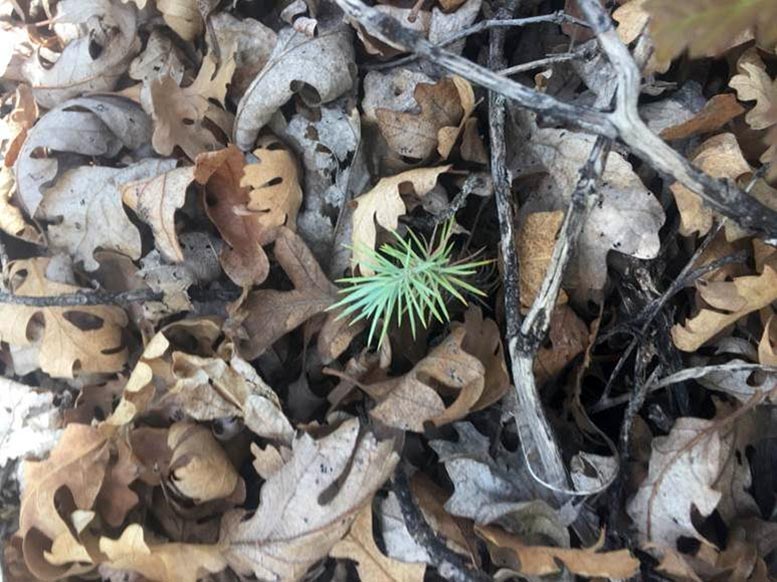
Though noise may change moment by moment for humans, it has a more lasting effect on trees and plants.
A new Cal Poly study reveals that human noise pollution affects the diversity of plant life in an ecosystem even after the noise has been removed. This is the first study that explores the long-term effects of noise on plant communities. It was published in the Proceedings of the Royal Society B.
In a study conducted twelve years ago near natural gas wells in New Mexico, researchers found that there were 75% fewer piñon pine seedlings in noisy sites as in quiet ones. This was most likely due to the noise driving away the Woodhouse’s scrub jay, which plants thousands of pine seeds while storing them to eat during the winter months.
A research team recently returned to the sites to find out whether the piñon pine had recovered over time.
Because companies change the sites where they use noisy compressors to help produce natural gas, some of the previously noisy sites had become quiet. In these areas, there were fewer seedlings and saplings compared to sites that didn’t have compressors added to the wellpad to speed up gas extraction. The decrease in saplings results from the time when the site was noisy, but the decrease in seedlings shows that piñon pine seeds still weren’t sprouting once the noise was removed.
Noise History Alters Ecological Function
“The effects of human noise pollution are growing into the structure of these woodland communities,” said biology professor and senior author Clint Francis. “What we’re seeing is that removal of the noise doesn’t necessarily immediately result in a recovery of ecological function.”
While it’s possible that the piñon pine has decreased because of a lack of opportunities to produce, it’s more likely that the Woodhouse’s scrub jay hasn’t returned to the formerly noisy area and so isn’t planting seeds.
“Some animals, like scrub-jays, have episodic memory,” said Jennifer Phillips, the lead author who worked on the project while a postdoc at Cal Poly and who is now a professor at Texas A&M-San Antonio. “Animals like the scrub-jay that are sensitive to noise learn to avoid particular areas. It may take time for animals to rediscover these previously noisy areas, and we don’t know how long that might take.”
Researchers also found differences in juniper seedlings and communities of flowering plants depending on current noise levels and whether noise levels had recently changed because noisy compressors were moved. Sites with greater noise had fewer juniper seedlings and different types of plants than quiet sites. Because of the complexity of ecosystems, the cause of these changes is still unknown.
Noise Disrupts Complex Plant-Animal Interactions
“Our results reveal that plant communities change in lots of ways with noise exposure,” Francis said. “We have a decent understanding of how and why foundational trees like piñon pine are affected by noise from our previous work with jays, but we are also seeing large changes in plant communities through changes in the abundance of shrubs and annual plants. These changes likely reflect impacts of noise on animals that eat plants, such as deer, elk, and various insects, plus the many pollinators that are important for plant reproduction. In essence, our research indicates that the consequences of noise are far-reaching and reverberate throughout the ecosystem through lots of species.”
Future studies can offer a more fine-tuned look at how noise is causing these ecosystem changes. Researchers want to know more about which herbivores, seed dispersers, and pollinators avoid or are attracted to noise and how changes in insect and animal behavior combine to affect plant communities.
Long-Term Recovery May Be Elusive
Based on patterns from over a decade of an ecosystem experiencing noise pollution, evidence suggests that plant communities may take a long time to recover from the effects of human noise. Still, co-author and lead botanist Sarah Termondt, a Cal Poly research affiliate, emphasizes the need to understand the full and lasting costs of noise. “Continuing to look at long-term changes in floristic inventories over time will elucidate whether communities do eventually recover after long periods of noise pollution, even once it is removed from the landscape,” she said.
When changes to plant communities are viewed alongside the growing evidence for the problems that noise creates for animals, it is increasingly difficult to ignore the near absence of noise regulations across the U.S.
Reference: “Long-term noise pollution affects seedling recruitment and community composition, with negative effects persisting after removal” by Jennifer N. Phillips, Sarah E. Termondt and Clinton D. Francis, 13 April 2021, Proceedings of the Royal Society B.
DOI: 10.1098/rspb.2020.2906
Funding: National Park Service Division of Natural Sounds and Night Skies, National Science Foundation, William and Linda Frost Fund in the Cal Poly College of Science and Mathematics
Editor’s Note: “Affects” in the title was corrected to “Effects.”
Never miss a breakthrough: Join the SciTechDaily newsletter.
Follow us on Google and Google News.
10 Comments
The word is “Effects”. who writes this garbage?
Apologies for the mistake. It has been corrected.
I was going to offer a kinder correction:
`Affects or even effects persist…’
>who writes this garbage?
Same `writer’ who will confuse complement with compliment or principle with principal.
All this article could have been summarized in one sentence about birds being scared away from trees.
Many of us can know the difference, use these words correctly almost every time, and still make the occasional mistake. Often, as in this case, you may start with something like “noise affects plants” and then after various revisions end up retaining “affects” even though you now mean “effects.”
Not an excuse – it should have been corrected before publication – but just an explanation.
Mike
What has happened to the comment I left yesterday?
Its ezier too tawk abot spellng an grammer then Thu subjct ov Thu artcle.
“… researchers found that there were 75% fewer piñon pine seedlings in noisy sites as in quiet ones. This was MOST LIKELY due to the noise driving away the Woodhouse’s scrub jay, which plants thousands of pine seeds while storing them to eat during the winter months.”
This strikes me as being a spurious correlation being used to come to an unjustified conclusion. It has been my experience that Jays are aggressive, fearless birds. It is difficult to deter them when food is available. Also, they prefer to ‘plant’ the seeds in cracks and holes in trees, where they are accessible when the ground is covered with snow.
There are other possible explanations, such as increased methane in the air, or foot traffic trampling seedlings, that need to be considered. I have observed deer, within a hundred yards of a rifle being discharged, continue to browse, totally oblivious to the loud sound. Yet, a foot-fall, or snapped twig, will cause them to flee.
Lacking from this hypothesis is a reasonable explanation for why other plants should be affected, or have a ‘memory.’
It would appear that these researchers were never exposed to T. C. Chamberlain’s “Method of Multiple Working Hypotheses.”
Gardners’ have known for years that sound affects plants.
Yes, I remember reading the paper by Mulder and Scully.
Just because a word got confused with another one , does not mean that this is garbage. Whoever you are, this is a petty observation.