
Close Menu
    Facebook X (Twitter) Instagram
    SciTechDaily
    • Biology
    • Chemistry
    • Earth
    • Health
    • Physics
    • Science
    • Space
    • Technology
    Facebook X (Twitter) Pinterest YouTube RSS
    SciTechDaily
    Home»Earth»North Korean Nuke Equivalent to ‘17 Hiroshimas’ According to Space-Based Radar
    Earth

    North Korean Nuke Equivalent to ‘17 Hiroshimas’ According to Space-Based Radar

    By Royal Astronomical SocietyNovember 15, 2019No Comments4 Mins Read
    Facebook Twitter Pinterest Telegram LinkedIn WhatsApp Email Reddit
    Share
    Facebook Twitter LinkedIn Pinterest Telegram Email Reddit
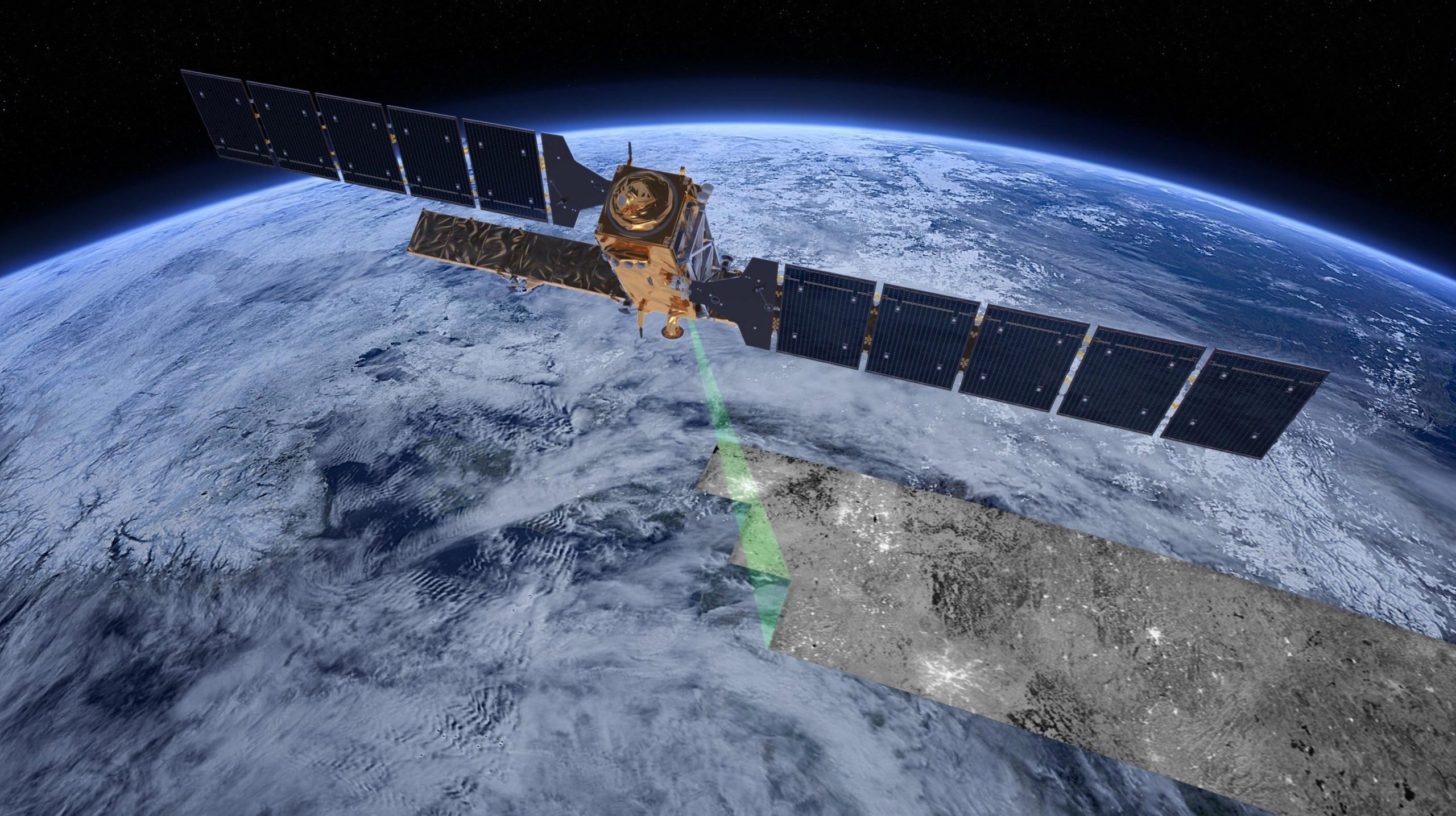
    Earth Observation Satellite Sentinel-1
    Satellites such as Sentinel-1 and ALOS-2 carry advanced synthetic aperture radars that can provide data to map changing land cover, ground deformation, ice shelves, and glaciers, and can be used to help emergency response when disasters such as floods strike, and to support humanitarian relief efforts at times of crisis. Credit: ESA / ATG medialab

    North Korea withdrew from the Treaty on the Non-Proliferation of Nuclear Weapons in 2003. It subsequently developed nuclear weapons, with five underground nuclear tests culminating in a suspected thermonuclear explosion (a hydrogen bomb) on September 3, 2017. Now a team of scientists, led by Dr. K. M. Sreejith of the Space Applications Center, Indian Space Research Organisation (ISRO), have used satellite data to augment measurements of tests on the ground. The researchers found that the most recent test shifted the ground by a few meters, and estimate it to be equivalent to 17 times the size of the bomb dropped on Hiroshima in 1945. The new work appears in a paper in Geophysical Journal International, a publication of the Royal Astronomical Society.

    Conventional detection of nuclear tests relies on seismic measurements using the networks deployed to monitor earthquakes. But there are no openly available seismic data from stations near this particular test site, meaning that there are big uncertainties in pinpointing the location and size of nuclear explosions taking place there.
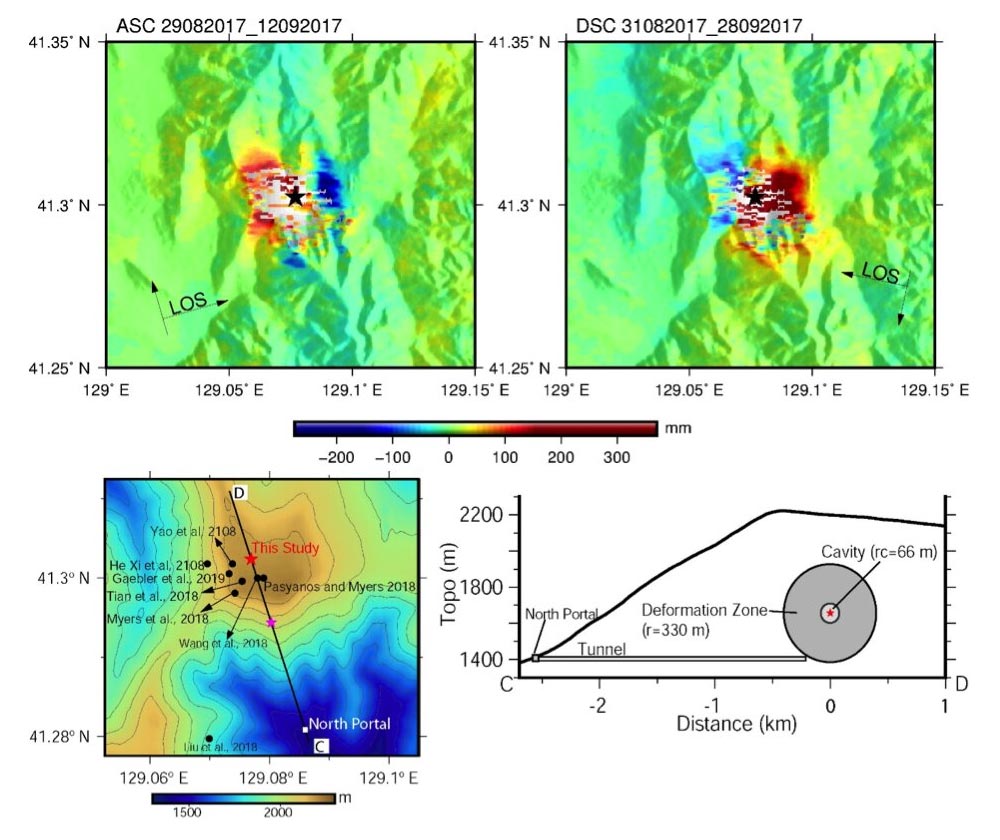
    InSAR Map of 2017 North Korean Nuclear Test Site
    (Top) InSAR data in ascending and descending orbits depicting surface deformation associated with the 2017 nuclear test. (Bottom) Comparison of the source location of the 2017 nuclear test estimated from this study (red star) with other estimations. Topography along profile CD showing the cavity, deformation zone and probable location of the tunnel. Note that the sizes of the cavity and deformation zones are exaggerated by 5 times for better visualization. Credit: K.M. Sreejith / Space Applications Center / Indian Space Research Organisation

    Dr. Sreejith and his team turned to space for a solution. Using data from the ALOS-2 satellite and a technique called Synthetic Aperture Radar Interferometry (InSAR), the scientists measured the changes on the surface above the test chamber resulting from the September 2017 explosion, sited at Mount Mantap in the northeast of North Korea. InSAR uses multiple radar images to create maps of deformation over time, and allows direct study of the sub-surface processes from space.

    The new data suggest that the explosion was powerful enough to shift the surface of the mountain above the detonation point by a few meters, and the flank of the peak moved by up to half a meter. Analyzing the InSAR readings in detail reveals that the explosion took place about 540 meters below the summit, about 2.5 kilometers north of the entrance of the tunnel used to access the test chamber.

    Based on the deformation of the ground, the ISRO team predicts that the explosion created a cavity with a radius of 66 meters (217 feet). It had a yield of between 245 and 271 kilotons, compared with the 15 kilotons of the ‘Little Boy’ bomb used in the attack on Hiroshima in 1945.

    Lead author of the study, Dr. Sreejith, commented, “Satellite-based radars are very powerful tools to gauge changes in earth’s surface, and allow us to estimate the location and yield of underground nuclear tests. In conventional seismology, by contrast, the estimations are indirect and depend on the availability of seismic monitoring stations.”

    The present study demonstrates the value of space-borne InSAR data for the measurement of the characteristics of underground nuclear tests, with greater precision than conventional seismic methods. At the moment though nuclear explosions are rarely monitored from space due to a lack of data. The team argues that currently operating satellites such as Sentinel-1 and ALOS-2 along with the NASA-ISRO Synthetic Aperture Radar (NISAR) mission, due to launch in 2022, could be used for this purpose.

    Reference: ” Constraints on the location, depth and yield of the 2017 September 3 North Korean nuclear test from InSAR measurements and modelling” by K M Sreejith, Ritesh Agrawal and A S Rajawat, 9 October 2019, Geophysical Journal International.
    DOI: 10.1093/gji/ggz451

    Never miss a breakthrough: Join the SciTechDaily newsletter.
    Follow us on Google and Google News.

    North Korea Nuclear Popular Royal Astronomical Society
    Share. Facebook Twitter Pinterest LinkedIn Email Reddit

    Related Articles

    “Nuclear Niño” – Nuclear War Could Trigger Big El Niño and Decrease Seafood

    MIT Devises New Effecient Way to Remove Contaminants From Nuclear Wastewater

    Little Ice Age Sparked by Volcanoes, Sustained by Sea-Ice Feedback

    ‘Blue Marble’ Image of the Earth Taken from NASA’s Suomi NPP Satellite

    Sandia Chemists Use MOFs to Remove Radioactive Gas from Nuclear Fuel

    Criegee Biradicals May Cool Planet and Offset Global Warming

    Greenland Loses 100 Billion Tons of Ice

    Nuclear Plant Helps Save Endangered Florida Crocodiles

    Amazing Time-Lapse Video of Earth from the International Space Station

    Leave A Reply Cancel Reply

    • Facebook
    • Twitter
    • Pinterest
    • YouTube

    Don't Miss a Discovery

    Subscribe for the Latest in Science & Tech!

    Trending News

    Scientists Discover How Coffee Impacts Memory, Mood, and Gut Health

    Why Did the Neanderthals Disappear? Scientists Reveal Humans Had a Hidden Advantage

    Physicists Propose Strange Experiment Where Time Goes Quantum

    Magnesium Magic: New Drug Melts Fat Even on a High-Fat, High-Sugar Diet

    Weight-Loss Drugs Like Ozempic May Come With an Unexpected Cost

    Mezcal “Worm” in a Bottle Mystery: DNA Testing Reveals a Surprise

    New Research Reveals That Your Morning Coffee Activates an Ancient Longevity Switch

    This Is What Makes You Irresistible to Mosquitoes

    Follow SciTechDaily
    • Facebook
    • Twitter
    • YouTube
    • Pinterest
    • Newsletter
    • RSS
    SciTech News
    • Biology News
    • Chemistry News
    • Earth News
    • Health News
    • Physics News
    • Science News
    • Space News
    • Technology News
    Recent Posts
    • This Popular Supplement May Boost Your Brain, Not Just Your Muscles
    • What Happened in Childhood Could Be Causing Your Gut Issues Today
    • Scientists Say This Simple Supplement May Actually Reverse Heart Disease
    • Scientists Just Captured Killer T Cells in Action Inside Tumors
    • Alaska’s Sky Explodes With Swirling Clouds and a Hidden Polar Storm
    Copyright © 1998 - 2026 SciTechDaily. All Rights Reserved.
    • Science News
    • About
    • Contact
    • Editorial Board
    • Privacy Policy
    • Terms of Use

    Type above and press Enter to search. Press Esc to cancel.