
Close Menu
    Facebook X (Twitter) Instagram
    SciTechDaily
    • Biology
    • Chemistry
    • Earth
    • Health
    • Physics
    • Science
    • Space
    • Technology
    Facebook X (Twitter) Pinterest YouTube RSS
    SciTechDaily
    Home»Science»Oceanographers Discover Compound That Shows Potency Against Anthrax
    Science

    Oceanographers Discover Compound That Shows Potency Against Anthrax

    By Scripps Institution of OceanographJuly 18, 2013No Comments3 Mins Read
    Facebook Twitter Pinterest Telegram LinkedIn WhatsApp Email Reddit
    Share
    Facebook Twitter LinkedIn Pinterest Telegram Email Reddit
    Chemical Compound Discovered at Sea Shows Potency Against Anthrax
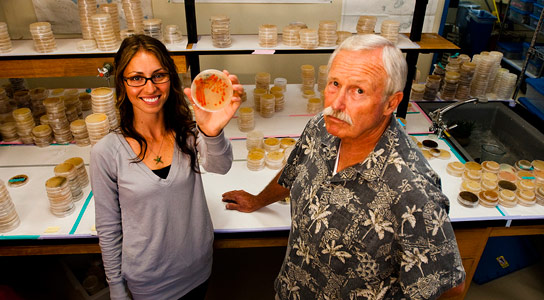
    Anthracimycin paper coauthors Lauren Paul and William Fenical. Credit: Scripps Institution of Oceanograph

    Oceanographers from Scripps UC San Diego have discovered a microorganism that produces a chemical compound that may offer new treatments for anthrax and other ailments such as methicillin-resistant Staphylococcus aureus (MRSA).

    A team led by William Fenical at Scripps Institution of Oceanography at UC San Diego has discovered a new chemical compound from an ocean microbe in a preliminary research finding that could one day set the stage for new treatments for anthrax and other ailments such as methicillin-resistant Staphylococcus aureus (MRSA).

    As reported in the international edition of the German journal Angewandte Chemie, Scripps researcher Chris Kauffman in Fenical’s group first collected the microorganism that produces the compound in 2012 from sediments close to shore off Santa Barbara, California. Fenical’s team in the Scripps Center for Marine Biotechnology and Biomedicine, working in conjunction with San Diego-based Trius Therapeutics, used an analytical technique known as spectroscopy to decipher the unusual structure of a molecule from a microscopic species known as Streptomyces. Initial testing of the compound, which they named anthracimycin, revealed its potency as a killer of anthrax, the infectious disease often feared as a biological weapon, as well as MRSA.


    Prof. William Fenical at Scripps Institution of Oceanography at UC San Diego discusses a new chemical compound which could set the stage for new treatments for anthrax and other ailments such as methicillin-resistant Staphylococcus aureus (MRSA).

    “The real importance of this work is the fact that anthracimycin has a new and unique chemical structure,” said Fenical, who added that the finding is a basic research discovery, which could lead to testing and development, and eventually a drug. “The discovery of truly new antibiotic compounds is quite rare. This discovery adds to many previous discoveries that show that marine bacteria are genetically and chemically unique.”

    The discovery provides the latest evidence that the oceans, and many of its unexplored regions, represent a vast resource for new materials that could one day treat a variety of diseases and illnesses. Fenical, a distinguished professor of oceanography and pharmaceutical science, helped found the field of marine biomedicine as a researcher at Scripps. He is a pioneer in discovering and identifying these novel compounds. His research has helped bring attention to the need for continued exploration of the ocean for science and society.

    In addition to Fenical and Kauffman, coauthors of the paper include Kyoung Jang, Sang-Jip Nam, Deanna Beatty, and Lauren Paul of Scripps and Jeff Locke of Trius Therapeutics.

    The National Institutes of Health and the Transformational Medical Technologies program of the Department of Defense Chemical and Biological Defense Program through the Defense Threat Reduction Agency supported the research.

    Reference: “Anthracimycin, a Potent Anthrax Antibiotic from a Marine-Derived Actinomycete” by Kyoung Hwa Jang, Sang-Jip Nam, Jeffrey B. Locke, Christopher A. Kauffman, Deanna S. Beatty, Lauren A. Paul and William Fenical, 17 June 2013, Angewandte Chemie International Edition.
    DOI: 10.1002/anie.201302749


    Never miss a breakthrough: Join the SciTechDaily newsletter.
    Follow us on Google and Google News.

    Biomedicine Biotechnology Medical Oceanography Pharmacology Scripps Institution of Oceanography UCSD
    Share. Facebook Twitter Pinterest LinkedIn Email Reddit

    Related Articles

    Surprise Discovery Could Rewrite the Global Carbon Cycle

    Jupiter’s Colossal Cyclones Driven by Earth-Like Atmospheric Processes

    Ocean Physics Explain Incredible Cyclones on Jupiter

    New “Bioloop” Science Behind Biodegradable Algae-Based Flip-Flops

    Bionic 3D-Printed Corals Could Optimize Bioenergy and Help Coral Reefs

    Scientists Use Spider Silk for New Biodegradable Bone-Fixing Composite

    New Hydrogel Adhesive Seals Moving Tissues Even in the Presence of Blood

    Maggots May Clean Wounds Faster Than Surgery

    Shock the Brain for Faster Learning

    Leave A Reply Cancel Reply

    • Facebook
    • Twitter
    • Pinterest
    • YouTube

    Don't Miss a Discovery

    Subscribe for the Latest in Science & Tech!

    Trending News

    Artificial Sweeteners May Harm Future Generations, Study Suggests

    Splashdown! NASA Artemis II Returns From Record-Breaking Moon Mission

    What If Consciousness Exists Beyond Your Brain

    Scientists Finally Crack the 100-Million-Year Evolutionary Mystery of Squid and Cuttlefish

    Beyond “Safe Levels”: Study Challenges What We Know About Pesticides and Cancer

    Researchers Have Found a Dietary Compound That Increases Longevity

    Scientists Baffled by Bizarre “Living Fossil” From 275 Million Years Ago

    Your IQ at 23 Could Predict Your Wealth at 27, Study Finds

    Follow SciTechDaily
    • Facebook
    • Twitter
    • YouTube
    • Pinterest
    • Newsletter
    • RSS
    SciTech News
    • Biology News
    • Chemistry News
    • Earth News
    • Health News
    • Physics News
    • Science News
    • Space News
    • Technology News
    Recent Posts
    • What if Dark Matter Has Two Forms? Bold New Hypothesis Could Explain a Cosmic Mystery
    • Researchers Expose Hidden Chemistry of “Ore-Forming” Elements in Biology
    • Geologists Reveal the Americas Collided Earlier Than We Thought
    • 20x Difference: Study Reveals True Source of Airborne Microplastics
    • Scientists Uncover Hidden Force Powering Yellowstone’s Supervolcano
    Copyright © 1998 - 2026 SciTechDaily. All Rights Reserved.
    • Science News
    • About
    • Contact
    • Editorial Board
    • Privacy Policy
    • Terms of Use

    Type above and press Enter to search. Press Esc to cancel.