
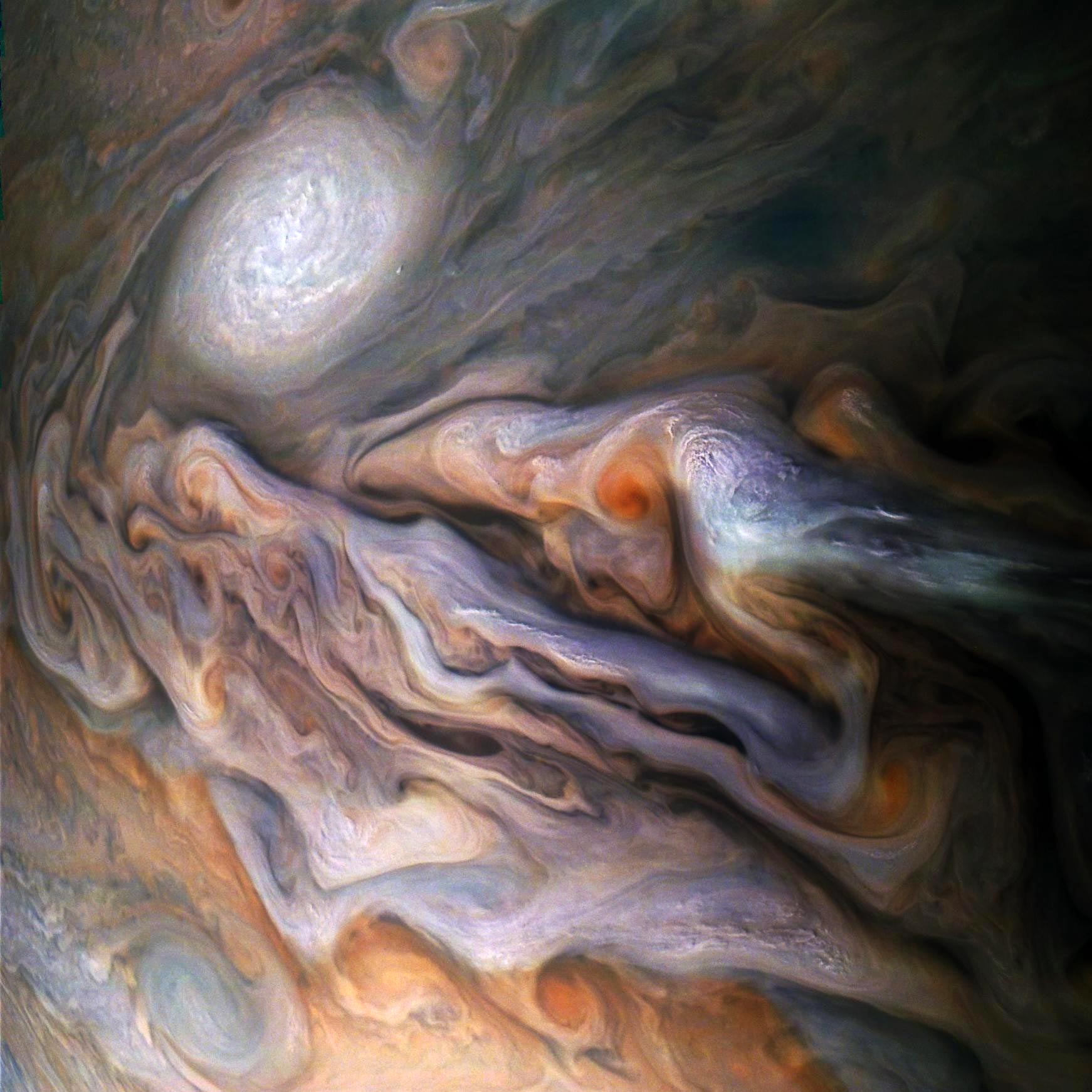
Images from NASA satellite of polar cyclones on Jupiter allow scientists to study the forces that drive them.
Hurtling around Jupiter and its 79 moons is the Juno spacecraft, a NASA-funded satellite that sends images from the largest planet in our solar system back to researchers on Earth. These photographs have given oceanographers the raw materials for a new study published today (January 10, 2022) in Nature Physics that describes the rich turbulence at Jupiter’s poles and the physical forces that drive the large cyclones.
Lead author Lia Siegelman, a physical oceanographer and postdoctoral scholar at Scripps Institution of Oceanography at the University of California San Diego, decided to pursue the research after noticing that the cyclones at Jupiter’s pole seem to share similarities with ocean vortices she studied during her time as a PhD student. Using an array of these images and principles used in geophysical fluid dynamics, Siegelman and colleagues provided evidence for a longtime hypothesis that moist convection — when hotter, less dense air rises — drives these cyclones.
“When I saw the richness of the turbulence around the Jovian cyclones with all the filaments and smaller eddies, it reminded me of the turbulence you see in the ocean around eddies,” said Siegelman. “These are especially evident on high-resolution satellite images of plankton blooms for example.”
How Moist Convection Fuels Jupiter’s Storms
Siegelman says that understanding Jupiter’s energy system, a scale much larger than Earth’s one, could also help us understand the physical mechanisms at play on our own planet by highlighting some energy routes that could also exist on Earth.
“To be able to study a planet that is so far away and find physics that apply there is fascinating,” she said. “It begs the question, do these processes also hold true for our own blue dot?”
Juno is the first spacecraft to capture images of Jupiter’s poles; previous satellites orbited the equatorial region of the planet, providing views of the planet’s famed Red Spot. Juno is equipped with two camera systems, one for visible light images and another that captures heat signatures using the Jovian Infrared Auroral Mapper (JIRAM), an instrument on the Juno spacecraft supported by the Italian Space Agency.
Siegelman and colleagues analyzed an array of infrared images capturing Jupiter’s north polar region, and in particular the polar vortex cluster. From the images, the researchers could calculate wind speed and direction by tracking the movement of the clouds between images. Next, the team interpreted infrared images in terms of cloud thickness. Hot regions correspond to thin clouds, where it is possible to see deeper into Jupiter’s atmosphere. Cold regions represent thick cloud cover, blanketing Jupiter’s atmosphere.
Jupiter’s Massive Storms: Sustained by Rising Heat
These findings gave the researchers clues on the energy of the system. Since Jovian clouds are formed when hotter, less dense air rises, the researchers found that the rapidly rising air within clouds acts as an energy source that feeds larger scales up to the large circumpolar and polar cyclones.
Juno first arrived at the Jovian system in 2016, providing scientists with the first look at these large polar cyclones, which have a radius of about 1,000 kilometers or 620 miles. There are eight of these cyclones occurring at Jupiter’s north pole, and five at its south pole. These storms have been present since that first view five years ago. Researchers are unsure how they originated or for how long they have been circulating, but they now know that moist convection is what sustains them. Researchers first hypothesized this energy transfer after observing lightning in storms on Jupiter.
Juno will continue orbiting Jupiter until 2025, providing researchers and the public alike with novel images of the planet and its extensive lunar system.
Reference: “Moist convection drives an upscale energy transfer at Jovian high latitudes” by Lia Siegelman, Patrice Klein, Andrew P. Ingersoll, Shawn P. Ewald, William R. Young, Annalisa Bracco, Alessandro Mura, Alberto Adriani, Davide Grassi, Christina Plainaki and Giuseppe Sindoni, 10 January 2022, Nature Physics.
DOI: 10.1038/s41567-021-01458-y
Seigelman is funded through the Scripps Institution of Oceanography Postdoctoral Program, working in the lab of physical oceanographer William Young, whose work is supported by the National Science Foundation.
Never miss a breakthrough: Join the SciTechDaily newsletter.
Follow us on Google and Google News.
2 Comments
I’ve been working for this company online for 2 years now and i never been happier…
Visit following page for more information…
I’ve been working for this company online for 2 years now and i never been happier…
Visit following page for more information…_____ gg.gg/wwrnu