

Berkeley Lab Optical Innovation Could Calm the Jitters of High-Power Lasers
The Berkeley Lab Laser Accelerator (BELLA) Center at the Department of Energy’s Lawrence Berkeley National Laboratory (Berkeley Lab) has developed and tested an innovative optical system to precisely measure and control the position and pointing angle of high-power laser beams with unprecedented accuracy – without interrupting or disturbing the beams. The new system will help users throughout the sciences get the most out of high-power lasers.
The experimental validation effort was led by doctoral candidate Fumika Isono of Berkeley Lab and UC Berkeley. Her findings are described in a paper published recently by the Cambridge University Press journal, High Power Laser Science and Engineering.
“This is a tremendous advancement in measurement and control that will benefit high-power laser facilities worldwide,” said Cameron Geddes, Director of Berkeley Lab’s Accelerator Technology and Applied Physics (ATAP) Division, of which the BELLA Center is a part.
Measurement Without Disturbance
People think of a laser as being so precise that it passes into the language as metaphor, but users with demanding applications know that laser beams move around at a tiny scale in response to the vibrations and variability of even the most controlled lab environment.
“Missing the target by as little as a few microns can make the difference between amazing science and an unwanted addition to background noise,” said Isono.
Pointing angle offsets of less than a thousandth of a degree can result in unwanted complexities as well. That’s where diagnostic sensors and feedback systems come into play.
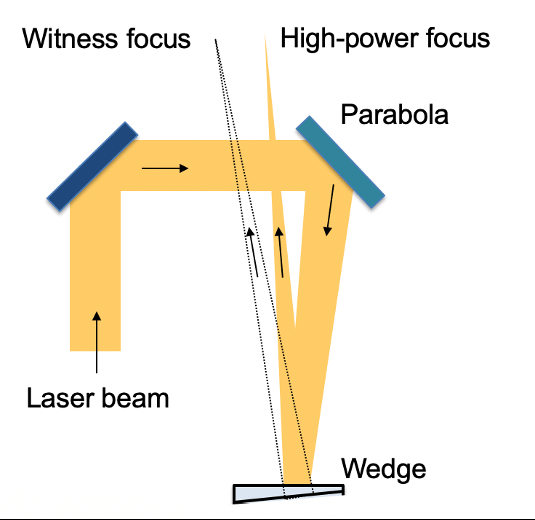
Measuring these parameters both accurately and without intercepting the beam is the trick. Traditional methods either greatly sap the power of the beam by intercepting its pulses (which at any rate is difficult for intense, high-powered beams) or suffer inaccuracies because they are not measuring the beam exactly as delivered. The BELLA Center’s innovative approach involves splitting off and monitoring a low-powered exact copy of the main beam, reflected from the rear surface of a specially designed final optic in the beam line.
The heart of this new approach is a laser architecture with three key attributes. First, it simultaneously provides five high-power pulses and a thousand low-power pulses per second, all following the same path. Second, the beamline design is optimized to keep the high-power and low-power pulses matched in size and divergence. Finally, it replaces one of the reflective beam line mirrors with an innovative wedge-shaped reflector that has specialty coatings on both the front and the rear surfaces.
Almost all of the main beam is reflected off the front surface of the optic without otherwise being noticeably affected. A tiny bit of the beam, representing perhaps 1% of the input power, propagates through the front surface and is reflected off the rear surface. This “witness beam” goes through any subsequent optics almost in parallel to the main beam, with just enough diversion for easy placement of measurement instruments. The end result is a witness beam with pointing angle and transverse position highly correlated to those of the main beam.
The result, said Isono, is “a measurement that won’t interfere with the main laser beam, yet very accurately tells us about it.”
Benefits for the BELLA Center and Beyond
A near-future goal is using this diagnostic as part of a feedback system for active stabilization of the laser’s transverse position and pointing angle. Preliminary studies with the 100-terawatt laser at BELLA Center have been promising. The manuscript lays out the prospect of removing the jitters on the high-power 5 Hz laser by actively stabilizing the low-power 1 kHz laser pulse train. Laser beam vibration and motion was observed to occur on a scale of a few tens of hertz, which is well within the range of a practical feedback system. A fivefold improvement in position and angle of high-power laser pulse delivery is expected.
The development of laser-plasma particle accelerators (LPAs), which is the primary mission of the BELLA Center, exemplifies the potential benefit of this innovation. LPAs produce ultrahigh electric fields that accelerate charged particles very rapidly, thereby offering the promise of a next generation of more compact, more affordable accelerators for a wide variety of applications. Since LPAs perform their acceleration within a thin hollow tube, or “capillary,” they would benefit greatly from improved control of the drive laser beam position and pointing angle.
One immediate application at the BELLA Center is the use of a laser-driven plasma accelerator (LPA) to provide electron beams for a free-electron laser (FEL) – a device that produces bright photon pulses at a far higher energy and shorter wavelength than visible light.
“The undulator, the magnetic array at the heart of the FEL, has very strict requirements on electron beam acceptance, which directly relates to the LPA drive laser pointing angle and transverse fluctuations,” said Isono.
The proposed kBELLA, a next-generation laser system that will combine high power with a kilohertz repetition rate, will be another likely application.
Interest from laser labs worldwide is anticipated. “This work is not limited to laser-plasma acceleration,” said BELLA Center Director Eric Esarey. “It addresses a specific need throughout the high-power laser community, namely, proving a correlated low-power copy of the high-power pulse without significant interference. Anywhere a high-power laser beam needs to be delivered with some precision to any application, this diagnostic is going to make a big difference. Think of laser-particle collision experiments, or laser interactions with micron-precision targets such as capillaries or droplets.”
Reference: “High-power non-perturbative laser delivery diagnostics at the final focus of 100-TW-class laser pulses” by Fumika Isono, Jeroen van Tilborg, Samuel K. Barber, Joseph Natal, Curtis Berger, Hai-En Tsai, Tobias Ostermayr, Anthony Gonsalves, Cameron Geddes and Eric Esarey, 26 May 2021, High Power Laser Science and Engineering.
DOI: 10.1017/hpl.2021.12
The work was supported by the DOE Office of Science, Office of Basic Energy Sciences, through an Early Career Research Program grant to Jeroen van Tilborg, in addition to the Office of High Energy Physics and the Gordon and Betty Moore Foundation.
Never miss a breakthrough: Join the SciTechDaily newsletter.
Follow us on Google and Google News.