
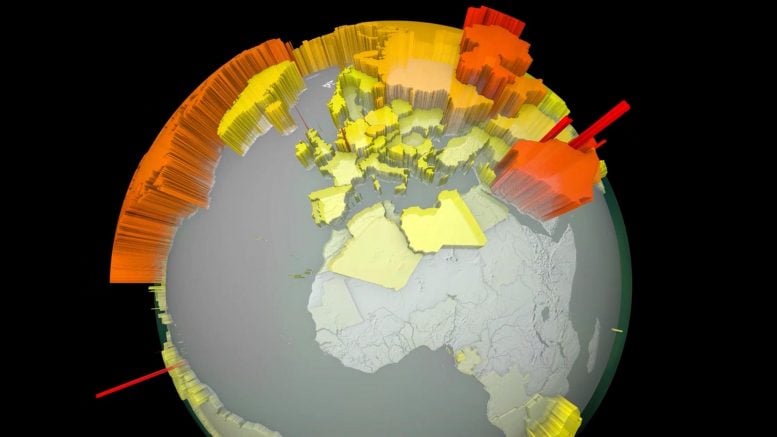
ESA is blending ground reports and satellite data to better track emissions and carbon sinks.
The Paris Agreement adopted a target for global warming not to exceed 1.5°C (2.7°F). This sets a limit on the additional carbon we can add to the atmosphere – the carbon budget. Only around 17% of the carbon budget is now left. That is about 10 years at current emission rates.
Each country reports its annual greenhouse gas emissions to the United Nations. Scientists then set these emissions against estimates of the carbon absorbed by Earth’s natural carbon sinks. This is known as the bottom-up approach to calculating the carbon budget.
Another way to track carbon sources and sinks is to measure the amounts of greenhouse gases in the atmosphere from space – the top-down approach. As well as tracking atmospheric carbon, ESA’s Climate Change Initiative is using satellite observations to track other carbon stocks on land and sea.
How we use the land accounts for about a quarter of our greenhouse gas emissions. Forests are the largest store of carbon on the land. Fire acts as a conduit for carbon to pass from the land to the atmosphere. And phytoplankton in the ocean are an important carbon sink.
ESA’s Regional Carbon Cycle Analysis and Processes project is using this information to reconcile the differences between the bottom-up and top-down approaches. Observations are combined with atmospheric and biophysical computer models to deduce carbon fluxes at the surface. This will improve the precision of each greenhouse gas budget and help separate natural fluxes from agricultural and fossil fuel emissions. This work will help us gauge whether we can stay within the 1.5°C carbon budget, or if more warming is in store.
Never miss a breakthrough: Join the SciTechDaily newsletter.
Follow us on Google and Google News.
7 Comments
Blow that crap out your ass. NO CARBON TAX! Get it, you effing shills.
Hm. Whys the largest emitter, China, show as relatively low on the global map?
it’s per capita, that’s why.
Just a little note about rainforests, too much propaganda over the years…
I will point no matter the gibberish talk on emissions it’s still important to preserve this ecosystems.
“Currently, the world is emitting around 40 billion tons of CO2 into the atmosphere every year. The Amazon absorbs 2 billion tons of CO2 per year (or 5% of annual emissions), making it a vital part of preventing climate change.”
https://apnews.com/article/latin-america-ap-top-news-brazil-international-news-climate-change-384fdb5ee7654667b53ddb49efce8023
“Most predictions of the Amazon rainforest’s ability to resist climate change are based on models that have outdated assumptions; one of those is that a sufficient supply of nutrients such as phosphorus exist in soils to enable trees to take in additional CO2 as global emissions increase,” said Berkeley Lab research scientist and study co-author Jennifer Holm. “But in reality the ecosystem is millions of years old, highly weathered, and therefore depleted of phosphorus in many parts of the Amazon.
https://newscenter.lbl.gov/2019/08/20/amazon-rainforest-absorbing-less-carbon-than-expected/
“The Amazon rainforest is now emitting more carbon dioxide than it is able to absorb, scientists have confirmed for the first time.
The emissions amount to a billion tonnes of carbon dioxide a year, according to a study. The giant forest had previously been a carbon sink, absorbing the emissions driving the climate crisis, but is now causing its acceleration, researchers said.”
https://www.theguardian.com/environment/2021/jul/14/amazon-rainforest-now-emitting-more-co2-than-it-absorbs
https://e360.yale.edu/features/scientists-probe-the-surprising-role-of-trees-in-methane-emissions
“Recent research is showing that trees, especially in tropical wetlands, are a major source of the second most important greenhouse gas in the atmosphere, methane. The knowledge that certain woodlands are high methane emitters should help guide reforestation projects in many parts of the world.”
Simple arithmetic shows that the assertion that the remaining 17% of the carbon budget will be used up in 10 years “at current emission rates” means that current emission rates are about 12% of the average emission rates for the 6 years 2015-2021. Can this be true??
If 6 years of emissions (2015-2021) use up 83% of the carbon budget, then (unless the emission rate is reduced) we will use up 100% of the carbon budget in 7.23 years; thus we have 1.23 years left, not 10 years.
Now you can play fast, free games here. 1v1 lol . Immerse yourself in a world full of splendor.