
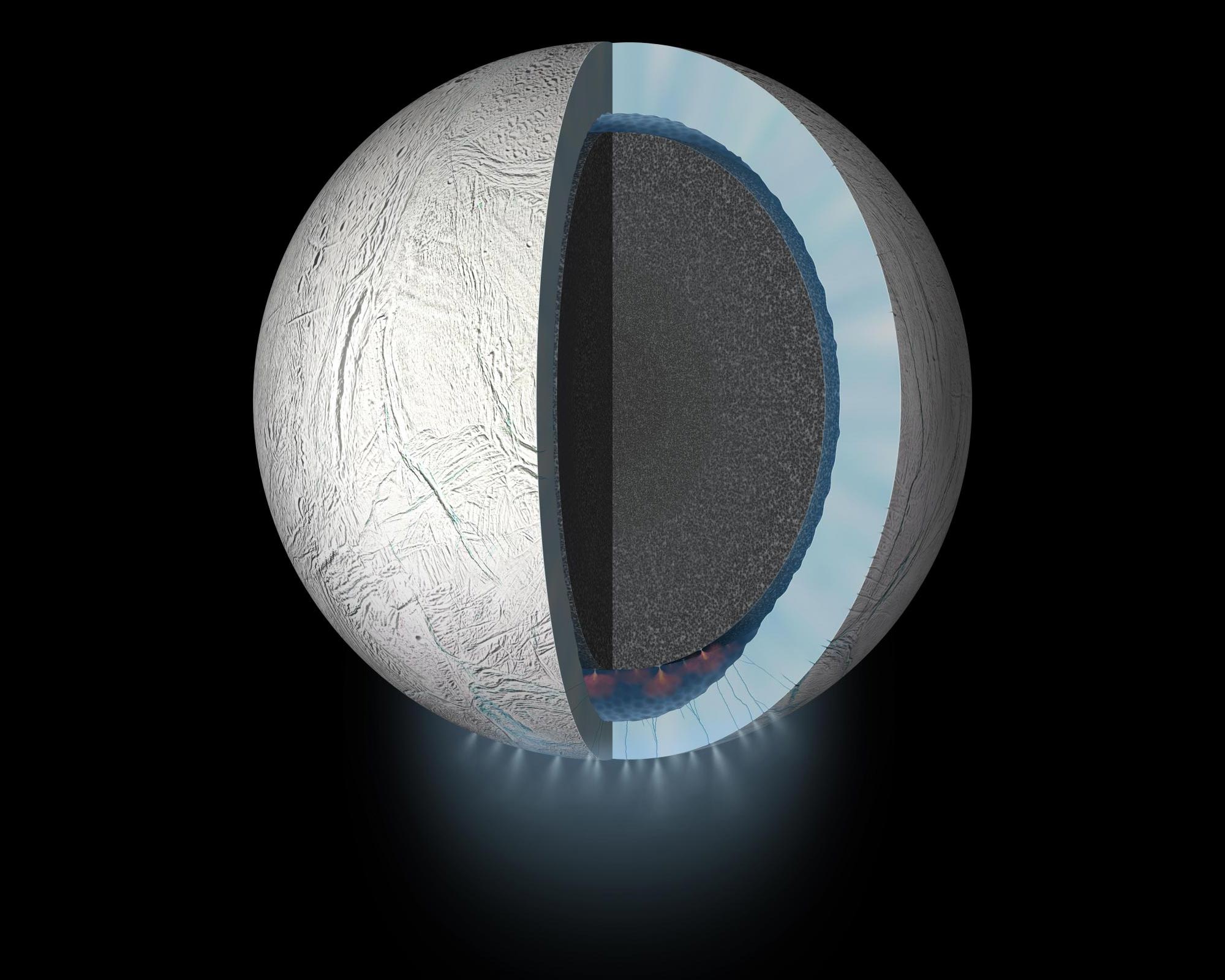
Enceladus’s hidden ocean may have Earth-like currents driven by salinity differences.
Buried beneath 20 kilometers (12 miles) of ice, the subsurface ocean of Enceladus—one of Saturn’s moons—appears to be churning with currents akin to those on Earth.
The theory, derived from the shape of Enceladus’s ice shell, challenges the current thinking that the moon’s global ocean is homogenous, apart from some vertical mixing driven by the warmth of the moon’s core.
Enceladus, a tiny frozen ball about 500 kilometers (310 miles) in diameter (about 1/7th the diameter of Earth’s moon), is the sixth largest moon of Saturn. Despite its small size, Enceladus attracted the attention of scientists in 2014 when a flyby of the Cassini spacecraft discovered evidence of its large subsurface ocean and sampled water from geyser-like eruptions that occur through fissures in the ice at the south pole. It is one of the few locations in the solar system with liquid water (another is Jupiter’s moon Europa), making it a target of interest for astrobiologists searching for signs of life.
Enceladus’s Ocean Compares to Earth’s
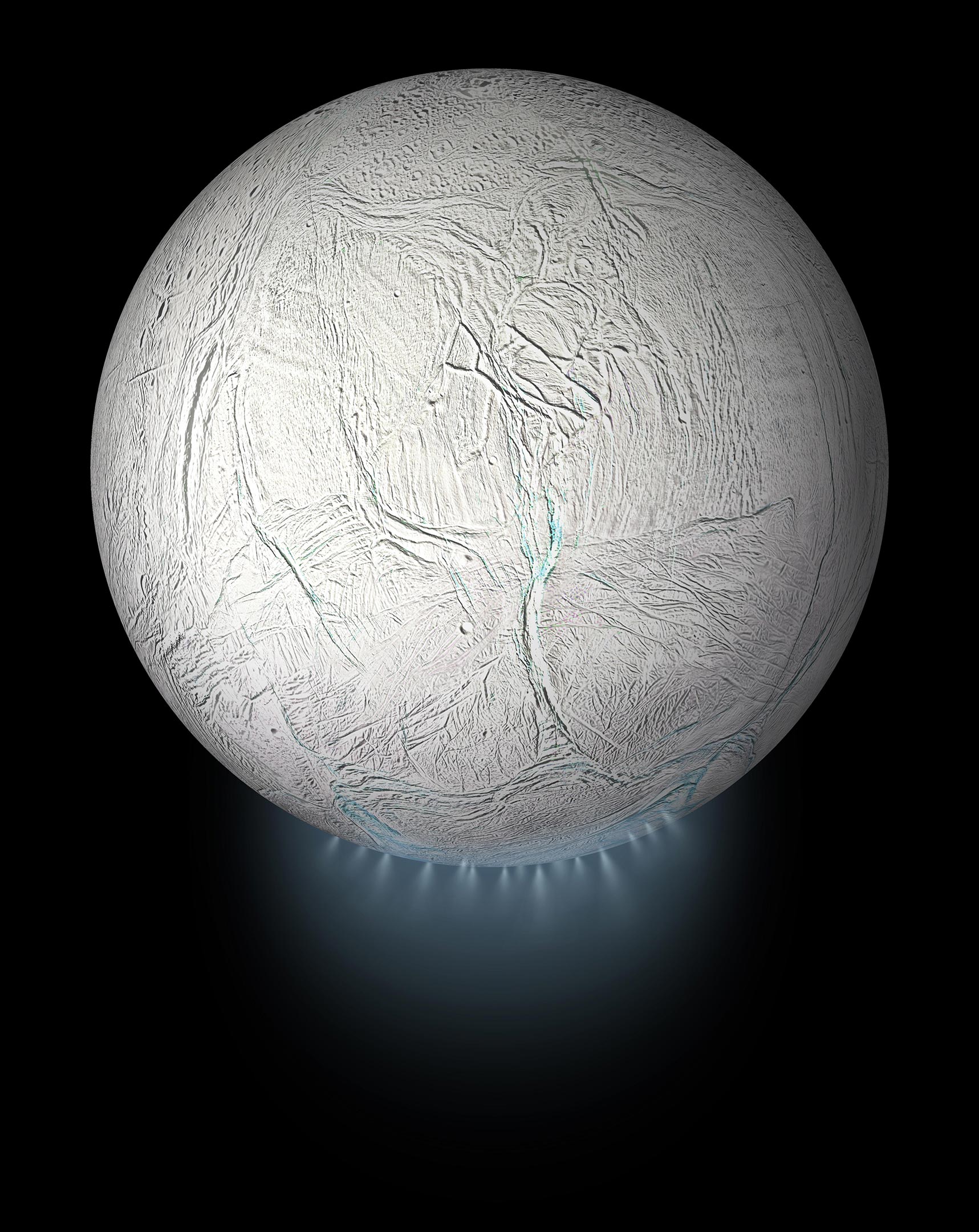
The ocean on Enceladus is almost entirely unlike Earth’s. Earth’s ocean is relatively shallow (an average of 3.6 km or 2.2 mi deep), covers three-quarters of the planet’s surface, is warmer at the top from the sun’s rays and colder in the depths near the seafloor, and has currents that are affected by wind; Enceladus, meanwhile, appears to have a globe-spanning and completely subsurface ocean that is at least 30 km (19 mi) deep and is cooled at the top near the ice shell and warmed at the bottom by heat from the moon’s core.
Despite their differences, Caltech graduate student Ana Lobo (MS ’17) suggests that oceans on Enceladus have currents akin to those on Earth. The work builds on measurements by Cassini as well as the research of Andrew Thompson, professor of environmental science and engineering, who has been studying the way that ice and water interact to drive ocean mixing around Antarctica.
Salinity and Circulation
The oceans of Enceladus and Earth share one important characteristic: they are salty. And as shown by findings published in Nature Geoscience on March 25, variations in salinity could serve as drivers of the ocean circulation on Enceladus, much as they do in Earth’s Southern Ocean, which surrounds Antarctica.
Lobo and Thompson collaborated on the work with Steven Vance and Saikiran Tharimena of JPL, which Caltech manages for NASA.
Gravitational measurements and heat calculations from Cassini had already revealed that the ice shell is thinner at the poles than at the equator. Regions of thin ice at the poles are likely associated with melting and regions of thick ice at the equator with freezing, Thompson says. This affects the ocean currents because when salty water freezes, it releases the salts and makes the surrounding water heavier, causing it to sink. The opposite happens in regions of melt.
Implications for Life and Future Exploration
“Knowing the distribution of ice allows us to place constraints on circulation patterns,” Lobo explains. An idealized computer model, based on Thompson’s studies of Antarctica, suggests that the regions of freezing and melting, identified by the ice structure, would be connected by the ocean currents. This would create a pole-to-equator circulation that influences the distribution of heat and nutrients.
“Understanding which regions of the subsurface ocean might be the most hospitable to life as we know it could one day inform efforts to search for signs of life,” Thompson says.
Reference: “A pole-to-equator ocean overturning circulation on Enceladus” by Ana H. Lobo, Andrew F. Thompson, Steven D. Vance and Saikiran Tharimena, 25 March 2021, Nature Geoscience.
DOI: 10.1038/s41561-021-00706-3
The paper is titled “A pole-to-equator ocean overturning circulation on Enceladus.” This work was supported by JPL’s Strategic Research and Technology Development program; the Icy Worlds node of NASA’s Astrobiology Institute; and the David and Lucile Packard Foundation.
Never miss a breakthrough: Join the SciTechDaily newsletter.
Follow us on Google and Google News.
1 Comment
500 kilometers is not equal to 1/7th the diameter of the earth.