
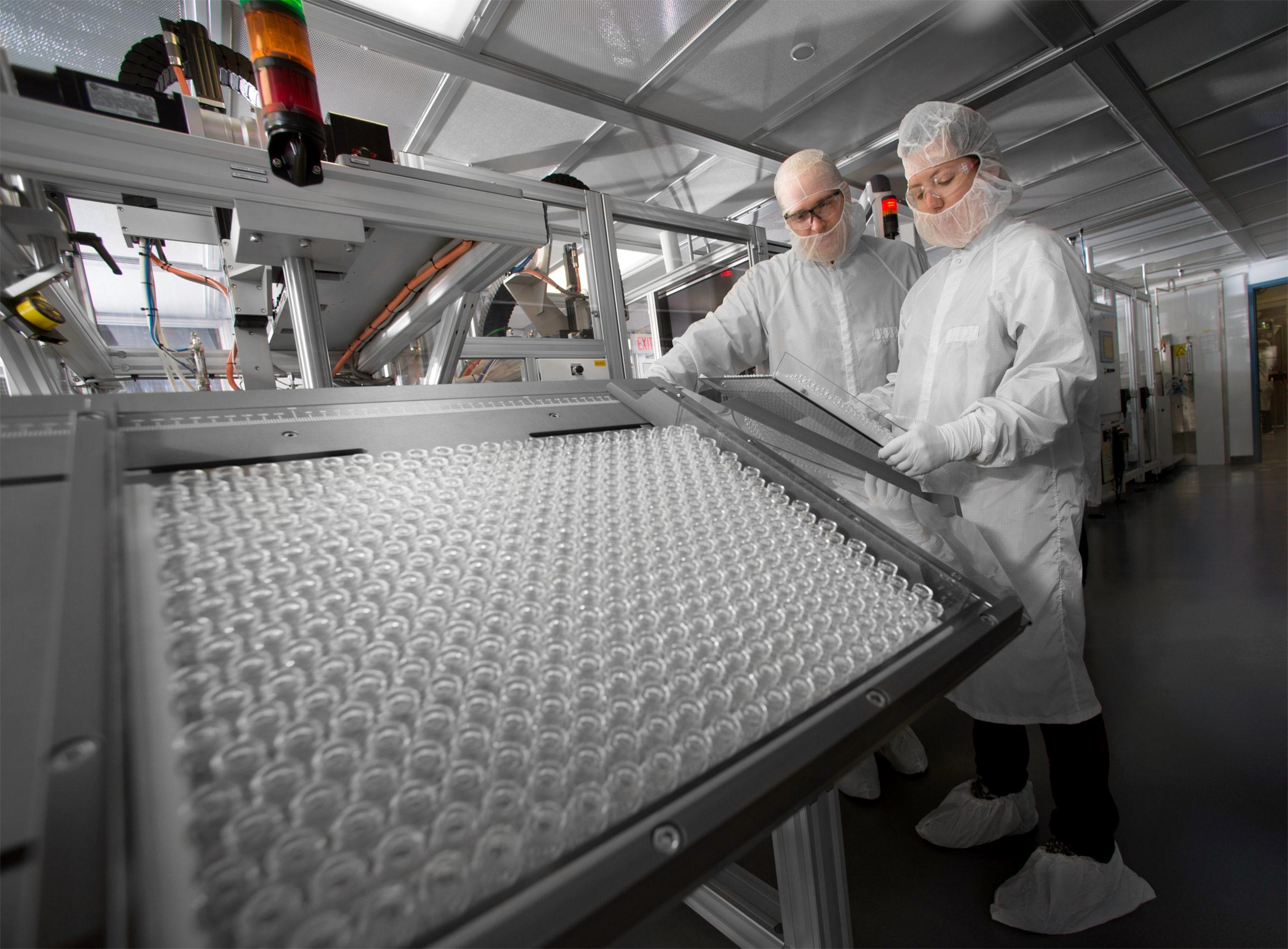
Corning executive Mark Kurz SM ’95 leads a team producing vials for vaccine distribution.
Some people are actually able to bottle their success, and Mark Kurz SM ’95 is one of the lucky few. Kurz is at the forefront of the fight against COVID-19 as a manufacturing supply chain leader at Corning, the New York-based pioneer in glass science and manufacturing technology.
Corning produces Valor Glass vials, a primary mode of delivery for vaccines as part of the U.S. government’s Operation Warp Speed. In his role as director of Corning’s Pharmaceutical Technologies manufacturing and operations, Kurz oversaw a four-fold acceleration of production capacity for vials. Production is slated to increase 10-fold by the end of this year.
Kurz never expected to be at the forefront of a pandemic — who does? — but his participation in the MIT Leaders for Global Operations (LGO) program positioned him well. He joined LGO (known at the time as Leaders for Manufacturing) as an operations professional at Kodak in 1993, receiving his SM from the Department of Mechanical Engineering as well as an SM from the MIT Sloan School of Management.

“I was really drawn to the MIT LGO program because it covered three main areas: engineering and technology — there’s no better school in the world for that — but also business management and leadership. Understanding people and how you lead them is so important, and that really drew me to this MIT program. It’s been the cornerstone of my career,” Kurz says.
Today, MIT LGO students earn an MBA from the MIT Sloan School of Management and a master’s degree from one of eight participating departments in the School of Engineering while participating in an immersive, six-month research fellowship at partner organizations, ranging from Amazon to Corning.

Kurz says that Corning was the perfect place to bring his operations skills, with its 170-year history in glass production. (In the early days, it helped to develop encasements for Edison’s light bulb.) Kurz became part of a team exploring ways to make stronger pharmaceutical glass packaging, a process that hadn’t changed in a century — making glass that was more efficient to fill, crack-resistant, and more durable for vials.
Reinventing Pharmaceutical Packaging
Valor Glass offers multiple improvements over conventional borosilicate vials by chemically strengthening the glass with molten salt. Not only does Valor Glass provide safety benefits with reduced surface delamination and fewer particles, but it is also more efficient for pharmaceutical filling operations by enabling higher production speeds. Corning also found that it was less prone to breaking during standard lyophilization, a freeze-drying process used with some pharmaceutical products. Cold temperature performance is a critical attribute for some vaccines. Valor Glass addresses expensive pain points for partners like Pfizer and Merck.
“When the Covid demand materialized, we had already laid the groundwork. It’s this lasting investment [with our partners] that positioned us to be able to go fast. We’d been positioning ourselves for expansion,” Kurz says. “We had some capacity that was ready to come up if we had the demand. We knew what needed to be done. It turned from planning to execution.”
Corning joined Operation Warp Speed to supply the vials, shifting to 24/7 production, delivering in weeks instead of months, streamlining the product line to a standard-sized vial, and focusing on quality and volume. In June 2020, Corning received $204 million in funding from the U.S. government to ramp up manufacturing capacity.
“It came back to the fundamentals I learned in the MIT LGO program — really challenging technical problems, understanding the business environment you’re operating in, and leading people. I’ve used my MIT background in every job I’ve ever been in. And this challenge required all three,” he says.
Machine Vision for High-Stakes Quality Control
One particularly important task? Rapidly spotting defects with a relatively new product. Kurz implemented a machine-vision system to examine every vial for flaws. The stakes were high.
“In early manufacturing, there are bugs. We didn’t want to throw out good vials. We also didn’t want to pass bad products along. So we put a lot of effort into that and actually were able to improve our output by more than 10 percent. If you look at it as doses of the vaccine getting to people, it’s inspiring,” he says.
Kurz has subsequently shifted roles to focus on global health services, implementing protective measures in Corning factories worldwide. Meanwhile, he’s confident that Valor glass will have pharmaceutical uses long after the pandemic fades, such as for cancer treatments. On that note, he’s eager to tell the MIT community what a valuable partner Corning is and what a forward-thinking company it continues to be.
“It’s easy to think, ‘Well, it’s just glass, right?’ Yet we keep innovating, 170 years after the company was formed. We keep investing nearly a billion dollars a year in R&D and finding new ways to take glass into places that it’s never been before,” he says, from Edison’s original light bulbs to ultra-durable, anti-microbial Gorilla Glass for wearable devices.
For Kurz, his pride in glass manufacturing is clear.
“People want a noble cause to work for. From a leadership standpoint, there can’t be a more noble goal than to try to help people overcome Covid,” he says.
Never miss a breakthrough: Join the SciTechDaily newsletter.
Follow us on Google and Google News.