

Study from Bielefeld finds major departure from the standard model.
How fast and in what direction is our solar system moving through space? This question, though simple in appearance, plays a central role in testing modern cosmological theories.
A team led by astrophysicist Lukas Böhme at Bielefeld University has now uncovered results that call the standard cosmological model into question. Their findings were recently published in Physical Review Letters.
“Our analysis shows that the solar system is moving more than three times faster than current models predict,” says lead author Lukas Böhme. “This result clearly contradicts expectations based on standard cosmology and forces us to reconsider our previous assumptions.”
A New Look at the Radio Galaxies of the Sky
To measure the solar system’s motion, the team examined the distribution of radio galaxies—distant galaxies that emit strong radio waves, a form of electromagnetic radiation with long wavelengths similar to those used in radio communication. Because radio waves can pass through dust and gas that obscure visible light, radio telescopes can detect galaxies that optical instruments cannot.
As the solar system travels through the universe, its motion produces a faint “headwind,” causing slightly more radio galaxies to appear in the direction of motion. This difference is extremely small and can only be identified through highly precise observations.
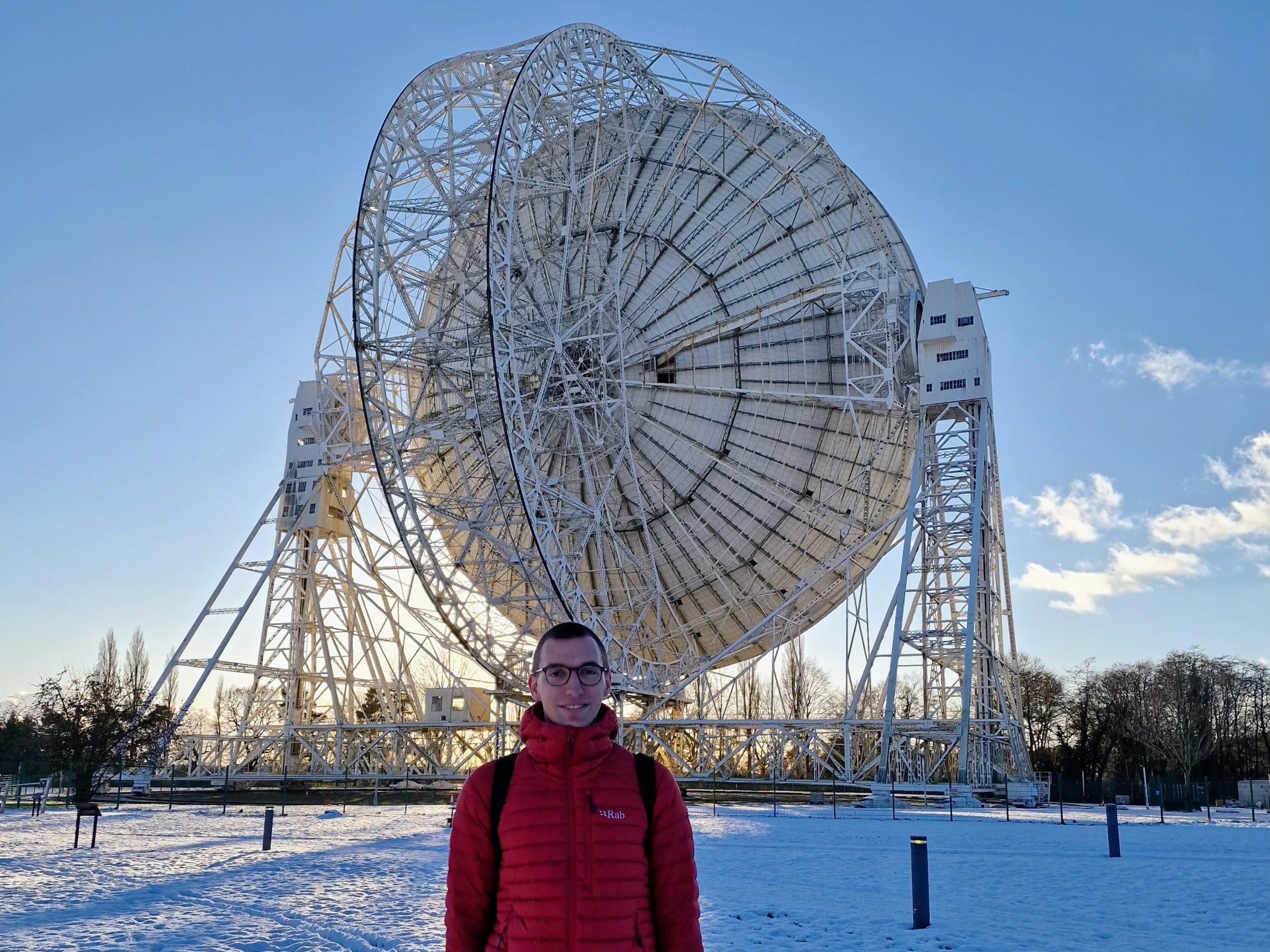
Using data from the LOFAR (Low Frequency Array) telescope, a large European radio observatory network, along with two additional radio telescope datasets, the researchers achieved the most detailed count of radio galaxies to date. They also introduced a new statistical approach that considers how many radio galaxies are made up of multiple components. This refined analysis produced larger but more accurate uncertainty estimates, providing a clearer picture of the solar system’s motion relative to the universe.
Despite this, the combination of data from all three radio telescopes revealed a deviation exceeding five sigma, a statistically very strong signal considered in science as evidence for a significant result.
Cosmological Consequences
The measurement shows an anisotropy (“dipole”) in the distribution of radio galaxies that is 3.7 times stronger than what the standard model of the universe predicts. This model describes the origin and evolution of the cosmos since the Big Bang and assumes a largely uniform distribution of matter.
“If our solar system is indeed moving this fast, we need to question fundamental assumptions about the large-scale structure of the universe,” explains Professor Dominik J. Schwarz, cosmologist at Bielefeld University and co-author of the study. “Alternatively, the distribution of radio galaxies itself may be less uniform than we have believed. In either case, our current models are being put to the test.”
The new results confirm earlier observations in which researchers studied quasars, the extremely bright centers of distant galaxies where supermassive black holes consume matter and emit enormous amounts of energy. The same unusual effect appeared in these infrared data, suggesting that it is not a measurement error but a genuine feature of the universe.
The study highlights how new observational methods can fundamentally reshape our understanding of the cosmos and how much there still remains to discover in the universe.
Reference: “Overdispersed Radio Source Counts and Excess Radio Dipole Detection” by Lukas Böhme, Dominik J. Schwarz, Prabhakar Tiwari, Morteza Pashapour-Ahmadabadi, Benedict Bahr-Kalus, Maciej Bilicki, Catherine L. Hale, Caroline S. Heneka and Thilo M. Siewert, 10 November 2025, Physical Review Letters.
DOI: 10.1103/6z32-3zf4
Never miss a breakthrough: Join the SciTechDaily newsletter.
Follow us on Google and Google News.
2 Comments
Correct, our methods of measurement may be flawed. The questions to ask are: what exactly are the devices and substrates used in detectors? In accelerators, they have 1″ and 2″ squares of silicon supplying signal. This is about like sticking a wire into the earth to detect a bouncing basketball in Alaska – when you’re in Cern.
Dude, how do you know this? Why do u know this?