
Close Menu
    Facebook X (Twitter) Instagram
    SciTechDaily
    • Biology
    • Chemistry
    • Earth
    • Health
    • Physics
    • Science
    • Space
    • Technology
    Facebook X (Twitter) Pinterest YouTube RSS
    SciTechDaily
    Home»Physics»Physicists Stunned by Nature in the Wrong Direction: Magnetic Spins That “Freeze” When Heated
    Physics

    Physicists Stunned by Nature in the Wrong Direction: Magnetic Spins That “Freeze” When Heated

    By Radboud University NijmegenJuly 4, 2022No Comments3 Mins Read
    Facebook Twitter Pinterest Telegram LinkedIn WhatsApp Email Reddit
    Share
    Facebook Twitter LinkedIn Pinterest Telegram Email Reddit
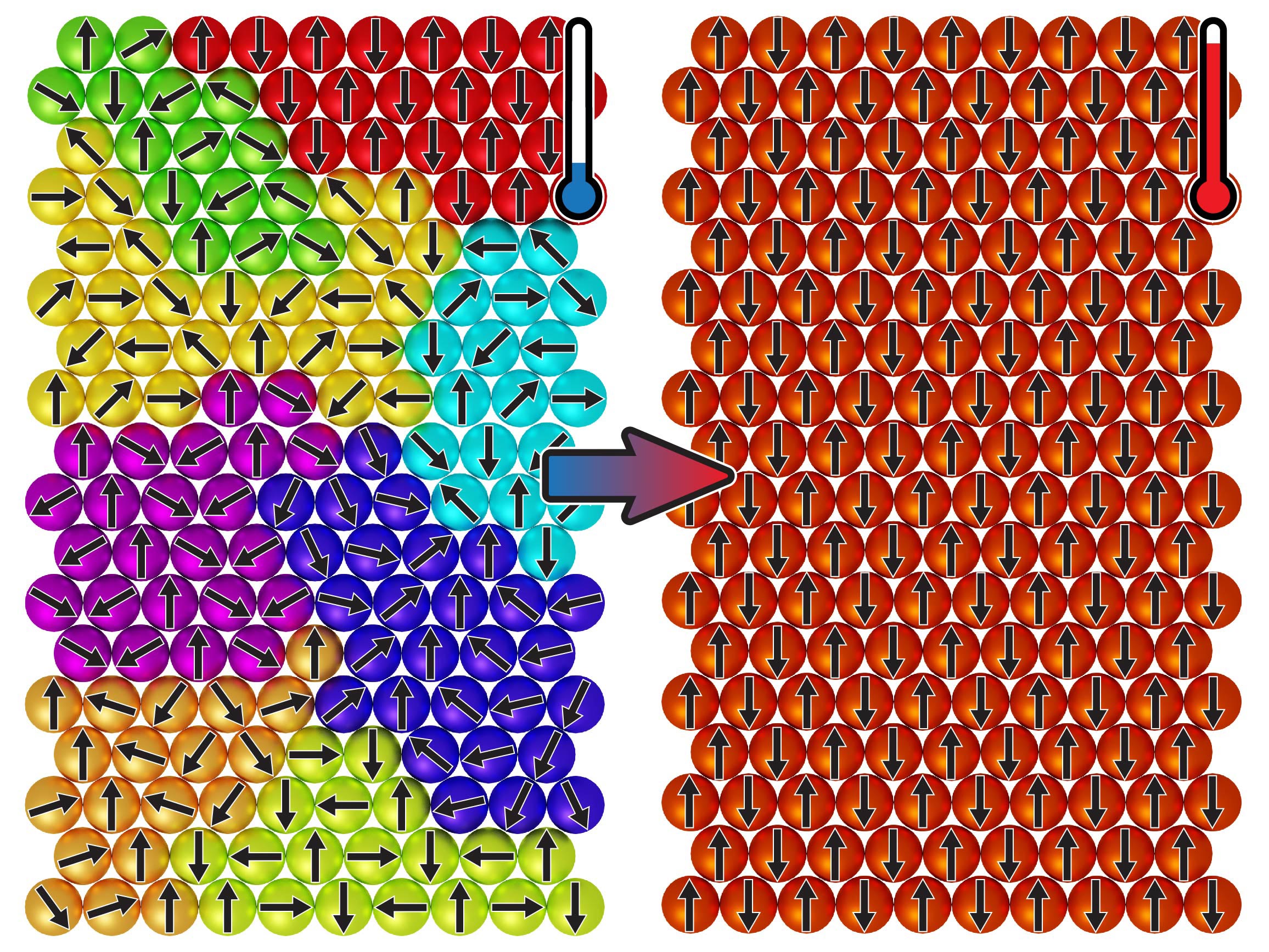
    Magnetic Spins That Freeze When Heated
    At cooler temperatures, the spins in the material form random patterns, where each pattern whirls like a helix with a particular twist. When heating up the material, the spins choose one of the particular helix patterns, a phenomenon that normally occurs when the temperature decreases in magnetic materials. Credit: Radboud University

    Physicists observed a very strange new type of behavior in a magnetic material when it’s heated up. When the temperature rises, the magnetic spins ‘freeze’ into a static pattern, a phenomenon that normally occurs when the temperature decreases. Their findings were published in Nature Physics today, July 4th.

    The scientists discovered the phenomenon in the material neodymium, an element that they described as a “self-induced spin glass” several years ago. Spin glasses are typically alloys where iron atoms for example are randomly dispersed into a grid of copper atoms. Each iron atom behaves like a small magnet, or a spin. These randomly placed spins point in all different directions.

    “It’s quite counterintuitive, like water that becomes an ice cube when it’s heated up.” Alexander Khajetoorians

    Neodymium is not like conventional spin glasses, where there is random mixing of magnetic materials. It is an element and without significant amounts of any other material, shows glassy behavior in its crystalline form. The spins form patterns that whirl like a helix, and this whirling is random and constantly changes.

    Solid Pattern When Heated

    In this new study, the physicists discovered that when they heated neodymium up from -268 °C to -265 °C (-450 °F to -445 °F), the spins ‘freeze’ into a solid pattern forming a type of magnet, at the higher temperature. When cooling down the material, the random whirling helix patterns came back. “This ‘freezing’ of the pattern does not normally occur in magnetic material,” says Alexander Khajetoorians, professor of scanning probe microscopy at Radboud University.

    Temperature increases the energy in a solid, liquid, or gas. The same holds true for a magnet: with more temperature, spins start to shake. “The magnetic behavior in neodymium that we observed is actually the opposite of what “normally” happens. It’s quite counterintuitive, like water that becomes an ice cube when it’s heated up,” says Khajetoorians.

    These kinds of phenomena are not found often in nature. There are very few materials known that behave in the wrong way. Another well-known example is the Rochelle salt, where charges build up and form an ordered pattern at a higher temperature, where at a lower temperature they are randomly distributed.

    How It Works

    The complex theoretical description of spin glasses was the subject of the Nobel Prize in Physics awarded to Parisi in 2021. Figuring out how these spin glasses work also has importance for other scientific fields. If we ultimately can model how these materials behave, this could also be extrapolated to the behavior of a wide range of other materials.

    The underlying odd behavior was linked to the concept of degeneracy: where many different states have the same energy, and the system becomes frustrated. The effect of temperature is to break this predicament: certain states survive, allowing the system to clearly settle into one pattern. We may also be able to harness this behavior toward new types of information storage or computational concepts, like brain-like computing.

    Reference: “Thermally induced magnetic order from glassiness in elemental neodymium” by Benjamin Verlhac, Lorena Niggli, Anders Bergman, Umut Kamber, Andrey Bagrov, Diana Iusan, Lars Nordström, Mikhail I. Katsnelson, Daniel Wegner, Olle Eriksson and Alexander A. Khajetoorians, 4 July 2022, Nature Physics.
    DOI: 10.1038/s41567-022-01633-9

    Never miss a breakthrough: Join the SciTechDaily newsletter.
    Follow us on Google and Google News.

    Magnets Popular Radboud University
    Share. Facebook Twitter Pinterest LinkedIn Email Reddit

    Related Articles

    A Third Type of Magnet? Researchers Confirm Exotic Altermagnetism

    Scientists Develop New Alloy That Breaks the Rules of Thermal Expansion

    Challenging Conventional Understanding – Scientists Discover Groundbreaking Connection Between Light and Magnetism

    Defying Gravity: Scientists Solve Mystery of Magnetic Hovering Beyond Classical Physics

    DNA Origami Nanoturbine: Pioneering the Nanomotor Revolution

    Scientists “See” Spinning Quasiparticles in a 2D Magnet

    The First Steps Toward a Quantum Brain: An Intelligent Material That Learns by Physically Changing Itself

    Higgs Boson Signals Gain Strength at Large Hadron Collider

    Scientists Use Ultra-Short Pulses of Terahertz Laser Light to Manipulate Magnetism

    Leave A Reply Cancel Reply

    • Facebook
    • Twitter
    • Pinterest
    • YouTube

    Don't Miss a Discovery

    Subscribe for the Latest in Science & Tech!

    Trending News

    Popular Sugar-Free Sweetener Linked to Liver Disease, Study Warns

    What Is Hantavirus? The Deadly Disease Raising Alarm Worldwide

    Scientists Just Discovered How the Universe Builds Monster Black Holes

    Scientists Unveil New Treatment Strategy That Could Outsmart Cancer

    A Simple Vitamin May Hold the Key to Treating Rare Genetic Diseases

    Scientists Think the Real Fountain of Youth May Be Hiding in Your Gut

    Ravens Don’t Follow Wolves, They Predict Them

    This Common Knee Surgery May Be Doing More Harm Than Good

    Follow SciTechDaily
    • Facebook
    • Twitter
    • YouTube
    • Pinterest
    • Newsletter
    • RSS
    SciTech News
    • Biology News
    • Chemistry News
    • Earth News
    • Health News
    • Physics News
    • Science News
    • Space News
    • Technology News
    Recent Posts
    • Scientists May Have Found a Way To Repair Nerve Damage in Multiple Sclerosis
    • GLP-1 Weight Loss Linked To Dramatically Lower Risk of Sleep Apnea, Kidney Disease and More
    • Scientists Uncover the Surprising Source of Strange Clouds Near the Milky Way’s Supermassive Black Hole
    • This Dazzling Green Snake Was Hiding in Plain Sight for Decades
    • Scientists Discover That a Single Dose of Psilocybin Changes the Human Brain
    Copyright © 1998 - 2026 SciTechDaily. All Rights Reserved.
    • Science News
    • About
    • Contact
    • Editorial Board
    • Privacy Policy
    • Terms of Use

    Type above and press Enter to search. Press Esc to cancel.