
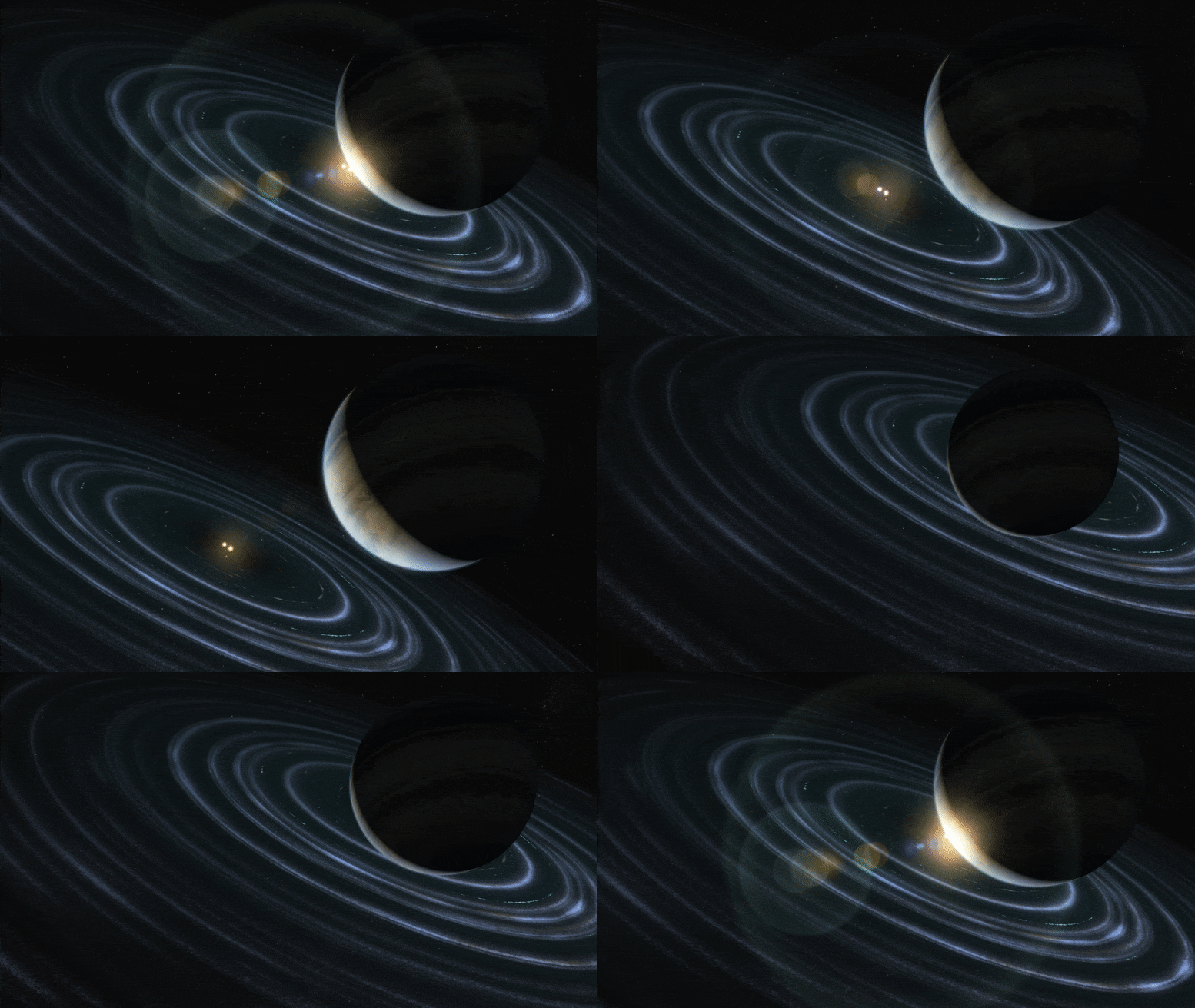
Refined predictions bring astronomers closer than ever to finally spotting—or dismissing—the elusive Planet 9.
There are eight known planets in the solar system (ever since Pluto was booted from the club), but for a while, there has been some evidence that there might be one more. A hypothetical Planet 9 lurking on the outer edge of our solar system. So far this world has eluded discovery, but a new study has pinned down where it should be.
The evidence for Planet 9 comes from its gravitational pull on other bodies. If the planet exists, its gravity will affect the orbits of other planets. So if something seems to be tugging on a planet, just do a bit of math to find the source. This is how Neptune was discovered, when John Couch Adams and Urbain Le Verrier noticed independently that Uranus seemed to be tugged by an unseen planet.
In the case of Planet 9, we don’t have any gravitational effect on a planet. What we do see is an odd clustering of small icy bodies in the outer solar system known as Kuiper belt objects (KBOs). If there were no planet beyond the Kuiper belt, you would expect the orbits of KBOs to be randomly oriented within the orbital plane of the solar system. But instead, we see lots of KBO orbits are clustered in the same orientation. It’s possible that this is just due to random chance, but that isn’t likely.
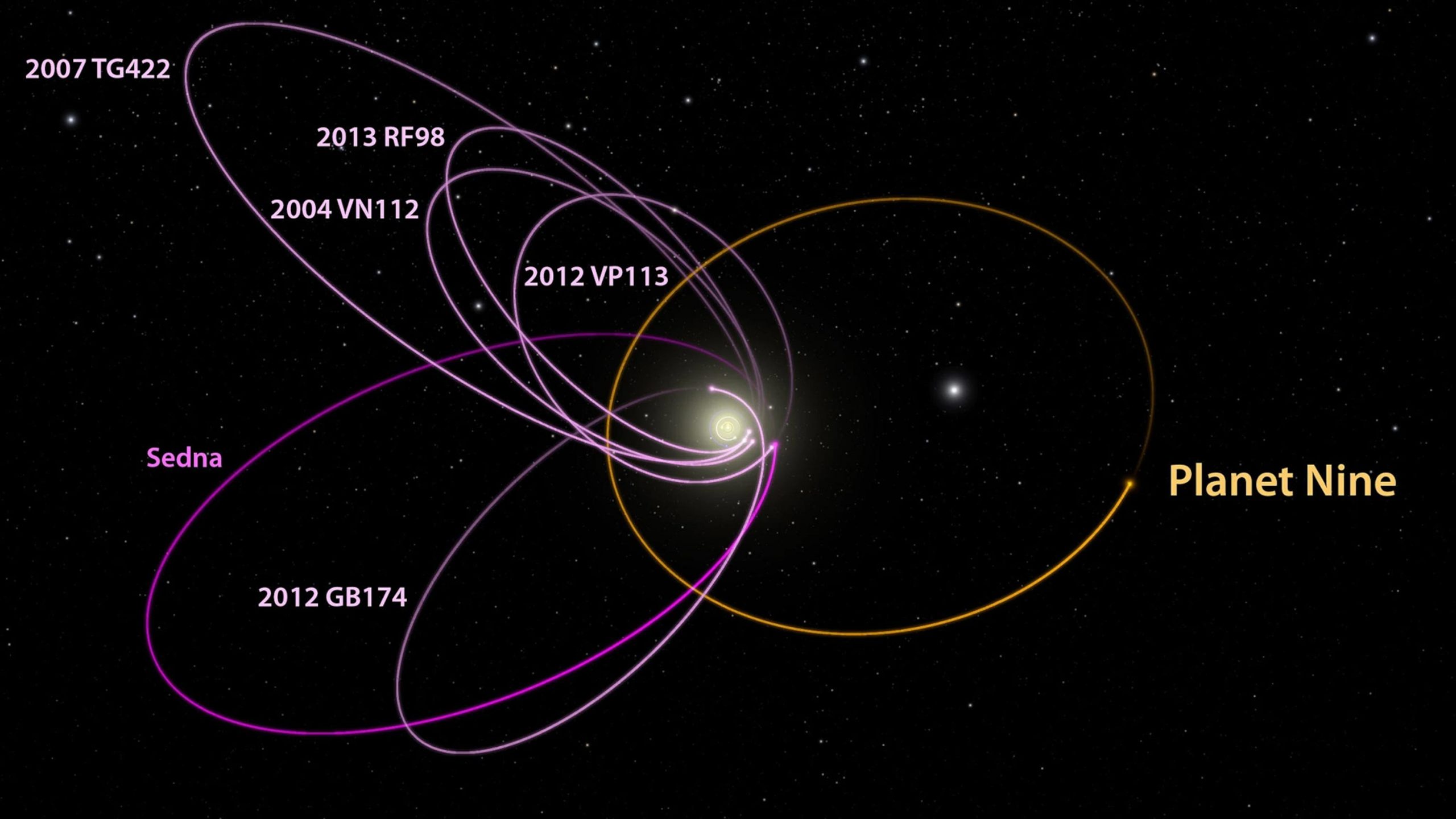
Back in 2016, the authors looked at the statistical distribution of KBOs and concluded the clustering was caused by an undetected outer planet. Based on their calculations, this world has a mass of 5 Earths and is about 10 times more distant from the Sun than Neptune. The paper even calculated a broad region of the sky where the planet might be. But searches turned up nothing. This led some to conclude the planet doesn’t exist. Orbital oddness doesn’t prove a planet exists. Just ask Planet Vulcan. Others went so far as to argue Planet 9 does exist, but we can’t see it because it’s a primordial black hole.
A Fresh Look at the Data
This new study reexamines the original work in light of some of the criticism it received. One big criticism is that outer solar system bodies are difficult to find, so we look for them where it’s convenient. The clustering effect we see could just be due to biased data. Taking observational bias into effect, the authors find the clustering is still statistically unusual. There’s only a 0.4% chance of it being a fluke. When they recalculated the likely orbit of Planet 9, they were able to better localize where to look.
One interesting aspect of the study is that the newly calculated orbit puts Planet 9 closer to the Sun than originally thought. This is odd, because if it is closer then we should have already found it. The authors argue that observations thus far have ruled out the closest options for Planet 9, which helps narrow down its possible location even further. If the planet exists, it should be detectable by the Vera Rubin Observatory in the near future.
This study isn’t conclusive, and many astronomers still argue that Planet 9 doesn’t exist. But this study makes it clear that we won’t have to argue about it for much longer. Either it will be discovered soon, or observations will rule it out as an explanation for the KBO clustering effect.
Reference: “The orbit of Planet Nine” by Michael E. Brown and Konstantin Batygin, 28 October 2021, The Astronomical Journal.
DOI: 10.3847/1538-3881/ac2056
arXiv: 2108.09868
Adapted from an article originally published on Universe Today.
Never miss a breakthrough: Join the SciTechDaily newsletter.
Follow us on Google and Google News.
4 Comments
We know planet 9 Nibiru is out there, Sitchin already explained everything we need from the archived cuneiform tablets.
Your very first sentence is incorrect. There are not “eight known planets in the solar system.” There are a minimum of 13 and counting. Your statement, along with the subsequent, “ever since Pluto was booted from the club” amounts to presenting one side in an ongoing debate without even acknowledging that there is a debate! The IAU planet definition, adopted by 4% of its members, most of whom were not planetary scientists but other types of astronomers, represents just one view in this debate, not gospel truth.” That definition was opposed by an equal number of professional planetary scientists who signed a formal petition rejecting the definition. They view dwarf planets as a subclass of planets, as intended by the scientist who first coined the term “dwarf planet,” New Horizons principal investigator Alan Stern. And they support an alternative planet definition, the geophysical one, which does not require a celestial object to clear or dominate its orbit to be a planet.
The appropriate term for the hypothetical object discussed in this paper is “Planet X,” with “X” representing the unknown rather than the number 10. In August 2018, scientists at the Planetary Science Institute, in their “Planetary Exploration Newsletter” objected to the biased term “Planet Nine” and requested it be replaced with “Planet X” to acknowledge the ongoing debate over planet definition.
Hi,..There are some reasons, why planet 9 wasnt find yet, though we know probably quite precisely its position,.. Main reason is, that there are probably 2 quite heavy planets, Planet 9 and Planet 10. Planet 9 should have orbit like many other planetoids behind Pluto with aphelia cca 300AU, with quite prolongated orbit. Planet 10 should be on less prolongated orbit, with aphelia cca till 1000AU,..like other group of planetoids,.. Position of P10 is cca where Aldebaran is,..based on my computations cca 13 years ago,..Results of Milagro cosmic rays pool survay show it too,..computations, simul. of Brown, Batygin too. P9 should be somewhere in const. Libra,…like comp. of R. Finch, Mattia Galiazzo show, my. Milagro,…too. Why we dont see P9,P10? They are too far, too small ,too dark,..Vanished old civil. but used active cosmic rays-proton hughe telescopes. Such complex with generators in form of pyramids, with huge Techen towers for static. electr. production, wind towers and system of big antenas for accumul. sun beams,..,..with water solv. with various,….was used probably in Gisa Plateau,…for tracking of P9,10,…
Hi,
“Look in the direction of the Pleiades!”
Perhaps this may help your cause … spotting ‘Planet Nine’. …
http://iopot.blogspot.com/2016/04/we-may-find-planet-nine-or-some-other.html?m=0