
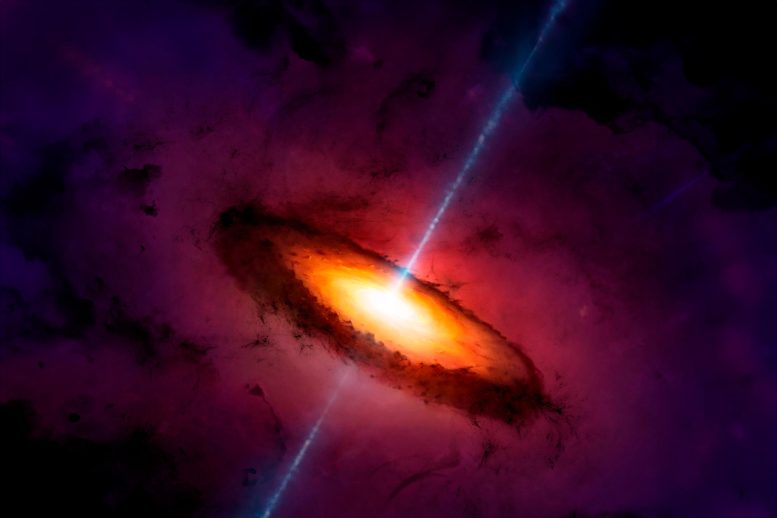
Astronomers found a peculiar alignment of novae explosions with a massive jet in the M87 galaxy. Despite various theories, the exact reason for this alignment remains a mystery.
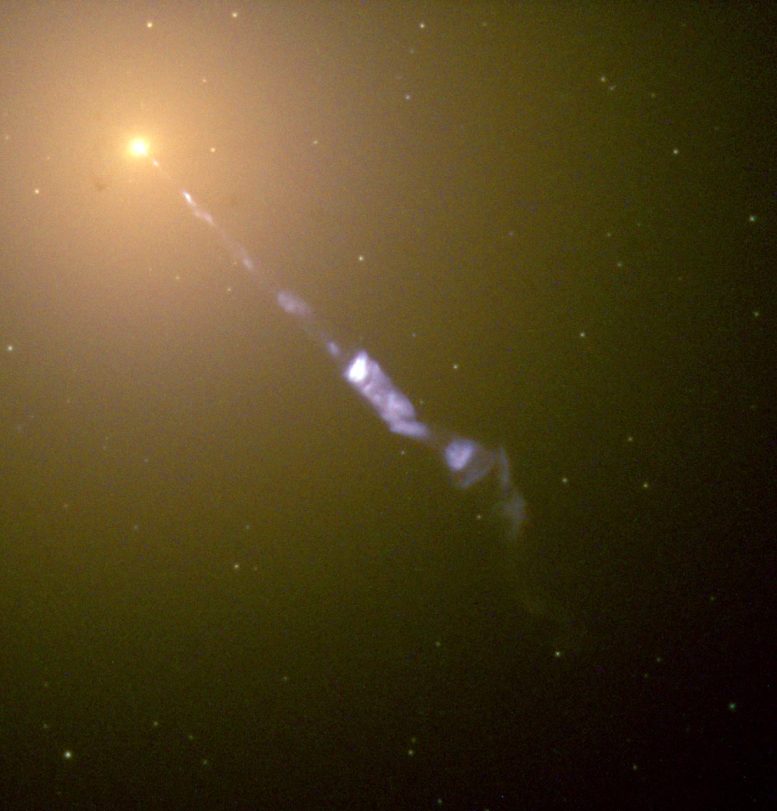
Everyone loves a good mystery, and astronomers have just uncovered a new one in a nearby supermassive galaxy called M87. Like most galaxies, M87 regularly plays host to a smattering of stellar explosions called novae, each the result of a star stealing material from a neighbor. M87 also features a massive jet of plasma blasting out into deep space from the galactic core.
These phenomena: the jet and the novae, are unrelated astronomical occurrences, or so scientists believed. But astronomers recently discovered that the novae in M87 seem to be uncharacteristically aligned along the jet, instead of scattered randomly throughout the galaxy. Is the jet somehow triggering nova explosions?
It might be, but the mystery is: how?
Recent Findings and Theories
Using data from two separate surveys by the Hubble Space Telescope, a team of astronomers confirmed the presence of 135 novae within M87, and they appear to occur with unexpected frequency in the path of the jet. “The likelihood that this distribution occurred by chance is of order 0.3%,” the team wrote in a preprint release of their paper.
For the moment, it is unclear if this situation is unique to M87, or if this is a common effect of galactic jets.
“No other galaxy with jets has been observed with sufficient sensitivity or frequency to yield samples of novae large enough to check if M87’s putative nova-jet connection is ubiquitous, rare, or spurious,” the scientists said.
Understanding Novae and Galactic Jets
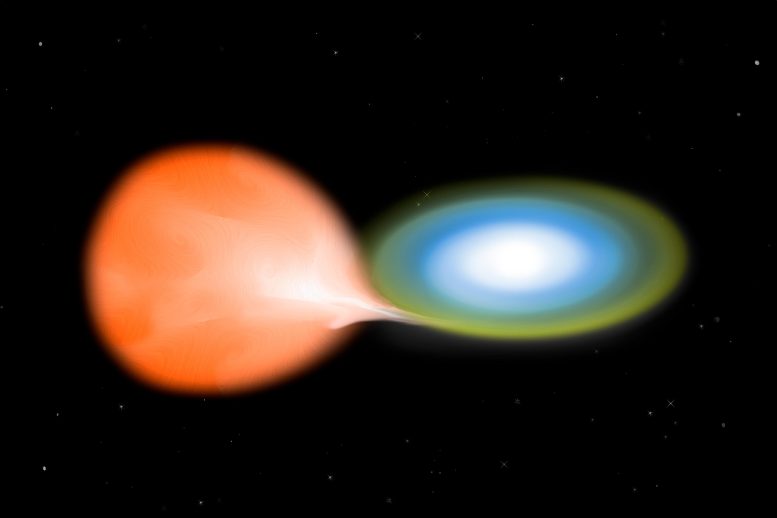
Here’s what we know so far. Novae are caused by explosions from the surface of white-dwarf stars. For a nova to occur, the white dwarf must be in a binary pair, and be close enough to its partner star to accrete material from it. Unlike a supernova, a nova doesn’t completely destroy the white dwarf, and the same star can have multiple novae occur over time as more and more material is stolen from its partner.
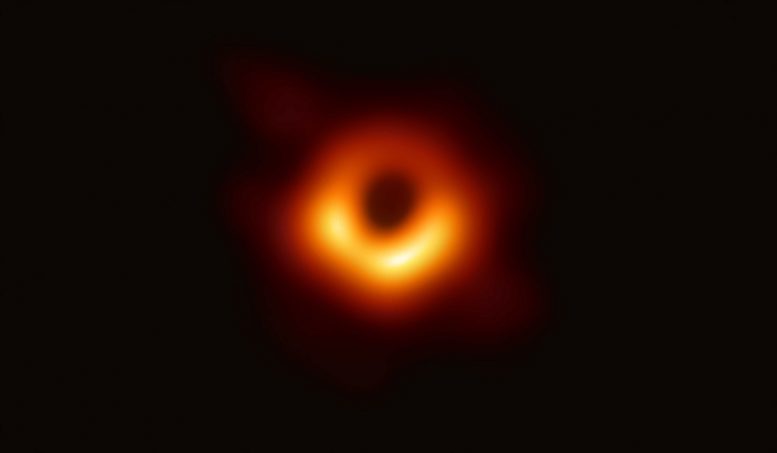
Meanwhile, M87’s galactic jet is driven by the black hole at the center of the galaxy – which, incidentally, was the first black hole ever imaged by astronomers in 2019. As material spirals in towards the back hole, an accretion disk forms around it, and powerful magnetic fields funnel intense radiation outward, causing it to be expelled at relativistic speeds, traveling almost 5000 lightyears out into deep space.
Challenging Theories
There are a couple of theories as to how the jet might set off novae.
One simple explanation is that radiation from the jet is heating donor stars in its path, increasing mass transfer to their white dwarf partners and triggering a thermonuclear runaway. Such heating would make novae more frequent.
Unfortunately, the math on this theory doesn’t check out. As powerful as the radiation from the jet is, the stars are too small and the distances too great for it to have much influence. We can probably rule this answer out: the effect is “orders of magnitude” too weak.
Another suggestion is that the jet is triggering star formation: more stars means more binaries, which means more novae. But there’s a problem with this explanation too. In this scenario, you would also expect to see a similar increase in star formation along the galaxy’s ‘counterjet’, and that isn’t borne out by the evidence.
So astronomers are going back to the drawing board.
Emerging Hypotheses
There are a couple of other ideas they are considering but have not yet properly tested. Perhaps, for example, the jet’s shock waves are shepherding gas and dust together as it moves through the galaxy, forming clouds of interstellar medium. As one of these clouds arrives at a binary star system, it would increase the rate of material accretion, setting off a nova. Similarly, a shock wave might also heat a star up (more effectively than radiation could on its own), increasing the mass transfer rate.
These last two possibilities are as-of-yet just guesses: they haven’t yet been fully explored.
So for now, it remains a mystery.
In the words of the authors, “the enhanced rate of novae along M87’s jet is now firmly established, and unexplained.”
Adapted from an article originally published on Universe Today.
Reference: “A 9-Month Hubble Space Telescope Near-UV Survey of M87. II. A Strongly Enhanced Nova Rate near the Jet of M87” by Alec M. Lessing, Michael M. Shara, Rebekah Hounsell, Shifra Mandel, Nava Feder and William Sparks, 28 September 2023, Astrophysics > High Energy Astrophysical Phenomena.
arXiv:2309.16856
Never miss a breakthrough: Join the SciTechDaily newsletter.
Follow us on Google and Google News.
1 Comment
What is different about the “counterjet” that it doesn’t produce novae? It’s an elliptical galaxy, so it shouldn’t have empty spaces like a spiral galaxy. Sorry I asked, already.