
Close Menu
    Facebook X (Twitter) Instagram
    SciTechDaily
    • Biology
    • Chemistry
    • Earth
    • Health
    • Physics
    • Science
    • Space
    • Technology
    Facebook X (Twitter) Pinterest YouTube RSS
    SciTechDaily
    Home»Science»Planetary ‘Runaway Greenhouse’ Climates More Easily Triggered than Previously Thought
    Science

    Planetary ‘Runaway Greenhouse’ Climates More Easily Triggered than Previously Thought

    By Peter Kelley, University of WashingtonJuly 30, 20132 Comments3 Mins Read
    Facebook Twitter Pinterest Telegram LinkedIn WhatsApp Email Reddit
    Share
    Facebook Twitter LinkedIn Pinterest Telegram Email Reddit
    Runaway Greenhouse Climates More Easily Triggered than Previously Thought
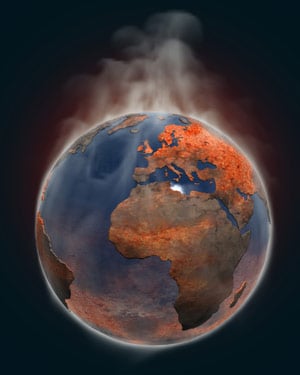
    In the runaway greenhouse stage, a planet absorbs excessive solar energy, leading to overheating, boiling oceans, and a steam-filled atmosphere, rendering it forever uninhabitable like Venus.

    A newly published study suggests that planetary “runaway greenhouse” climates are more easily triggered than previously thought.

    It might be easier than previously thought for a planet to overheat into the scorchingly uninhabitable “runaway greenhouse” stage, according to new research by astronomers at the University of Washington and the University of Victoria published July 28 in the journal Nature Geoscience.

    In the runaway greenhouse stage, a planet absorbs more solar energy than it can give off to retain equilibrium. As a result, the world overheats, boiling its oceans and filling its atmosphere with steam, which leaves the planet glowing-hot and forever uninhabitable, as Venus is now.

    One estimate of the inner edge of a star’s “habitable zone” is where the runaway greenhouse process begins. The habitable zone is that ring of space around a star that’s just right for water to remain in liquid form on an orbiting rocky planet’s surface, thus giving life a chance.

    Revisiting this classic planetary science scenario with new computer modeling, the astronomers found a lower thermal radiation threshold for the runaway greenhouse process, meaning that stage may be easier to initiate than had been previously thought.

    “The habitable zone becomes much narrower, in the sense that you can no longer get as close to the star as we thought before going into a runaway greenhouse,” said Tyler Robinson, a UW astronomy postdoctoral researcher and second author on the paper. The lead author is Colin Goldblatt of the University of Victoria.

    Though further research is called for, the findings could lead to a recalibration of where the habitable zone begins and ends, with some planets having their candidacy as possible habitable worlds revoked.

    “These worlds on the very edge got ‘pushed in,’ from our perspective — they are now beyond the runaway greenhouse threshold,” Robinson said.

    Subsequent research, the astronomers say, is needed in part because their computer modeling was done in a “single-column, clear-sky model,” or a one-dimensional measure averaged around a planetary sphere that does not account for the atmospheric effect of clouds.

    The findings apply to planet Earth as well. As the sun increases in brightness over time, Earth, too, will move into the runaway greenhouse stage — but not for a billion and a half years or so. Still, it inspired the astronomers to write, “As the solar constant increases with time, Earth’s future is analogous to Venus’s past.”

    Other co-authors are Kevin J. Zahnle of the NASA Ames Research Center in Moffett Field, California; and David Crisp of the Jet Propulsion Laboratory in Pasadena, California.

    Reference: “Low simulated radiation limit for runaway greenhouse climates” by Colin Goldblatt, Tyler D. Robinson, Kevin J. Zahnle and David Crisp, 28 July 2013, Nature Geoscience.
    DOI: 10.1038/ngeo1892

    Never miss a breakthrough: Join the SciTechDaily newsletter.
    Follow us on Google and Google News.

    Astronomy Climate Change Geoscience Greenhouse Gas Planetary Science University of Washington
    Share. Facebook Twitter Pinterest LinkedIn Email Reddit

    Related Articles

    Scientists Propose Possible Mechanism for Saturn’s Polar Cyclones

    Presence of Water in the Primary Crust Indicates That the Early Moon Was Wet

    An Updated Model for Identifying Habitable Zones Around Stars

    Methane Gas Leaks Undermine Shift to Natural Gas

    Xenon Gas Has Almost Vanished From the Atmosphere

    Diogenites Provide Clues of the Earliest Days of Our Solar System

    Many Mammals in Western Hemisphere are Unlikely to Outrun Climate Change

    Researchers Clarify Recycling Mechanism for Hydroxyl Radicals

    Natural Gas Mining Could Leak Enough Methane, No Longer Considered as Clean

    2 Comments

    1. Brandon343 on July 30, 2013 2:37 pm

      If the sun is increasing in temperature, could there have been a time when it was cold enough for Venus to be in the habitual zone?

      Reply
    2. Charles sifers on July 30, 2013 3:23 pm

      Hard to believe that these guys actually call themselves scientists.

      Reply
    Leave A Reply Cancel Reply

    • Facebook
    • Twitter
    • Pinterest
    • YouTube

    Don't Miss a Discovery

    Subscribe for the Latest in Science & Tech!

    Trending News

    Scientists Recreate a Nuclear Fireball and Uncover Fallout’s Hidden Chemistry

    These Tiny Gut Particles Could Be Accelerating Aging Throughout the Body

    Doctors Changed One Thing and Weight Gain Stopped

    Magnetic Fields May Solve a Longstanding Binary Star Mystery

    The Probiotic Breakthrough for Natural Anxiety Relief and Better Mental Health

    Animal vs. Plant Protein: Scientists Found a Surprising Nutritional Difference

    According to Scientists, This Simple Dietary Change Is Linked to Lower Depression Scores

    Researchers Discover a Hidden Vitamin D Problem That Persists Year-Round

    Follow SciTechDaily
    • Facebook
    • Twitter
    • YouTube
    • Pinterest
    • Newsletter
    • RSS
    SciTech News
    • Biology News
    • Chemistry News
    • Earth News
    • Health News
    • Physics News
    • Science News
    • Space News
    • Technology News
    Recent Posts
    • Scientists Tracked 4,500 Animals During COVID – What They Discovered Was Surprising
    • Hidden Phase of Matter Finally Captured After Decades of Predictions
    • The Strange “Spacetime Crystal” That Can Suddenly Turn Into a Black Hole
    • A Hidden Gut Signal May Be Driving Sleep Apnea’s Deadly Heart Risks
    • This AI-Designed “Universal Vaccine” Could Stop Future Pandemics Before They Start
    Copyright © 1998 - 2026 SciTechDaily. All Rights Reserved.
    • Science News
    • About
    • Contact
    • Editorial Board
    • Privacy Policy
    • Terms of Use

    Type above and press Enter to search. Press Esc to cancel.