
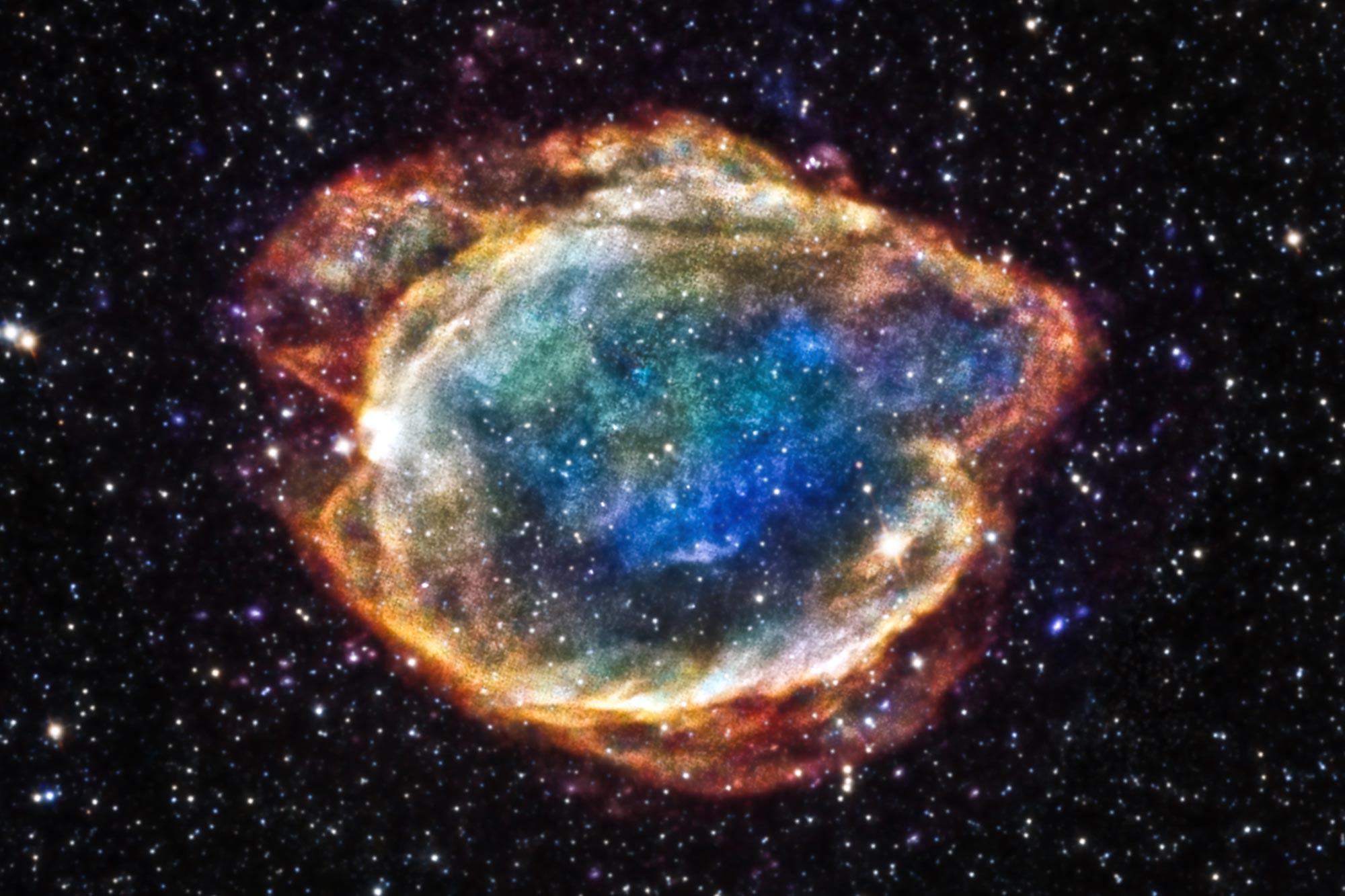
A recent study on ‘pre-supernova’ neutrinos—tiny cosmic particles that are extremely hard to detect—has brought scientists one step closer to understanding what happens to stars before they explode and die. The study, co-authored by postdoctoral researcher Ryosuke Hirai, from the ARC Centre of Excellence for Gravitational Wave Discovery (OzGrav) at Monash University, investigated stellar evolution models to test uncertain predictions.
When a star dies, a huge number of neutrinos are emitted which are thought to drive the resulting supernova explosion. The neutrinos flow freely through and out of the star before the explosion reaches the surface of the star. Scientists can then detect neutrinos before the supernova occurs, in fact, a few dozen neutrinos were detected from a supernova that exploded in 1987, several hours before the explosion was seen in light.
The next generation of neutrino detectors are expected to detect about 50,000 neutrinos from a similar kind of supernova. The technology has become so powerful that scientists predict they will detect the weak neutrino signals that come out days before the explosion; just like a supernova forecast, it will give astronomers a heads up to catch the first light of a supernova. It’s also one of the only ways to directly extract information from a star’s core—similar to an X-ray image of your body, except it’s for stars. But an X-ray image is meaningless unless you know what you’re looking at.
Although there is a general understanding of how a massive star evolves and explodes, scientists are still uncertain about the lead up to the supernova explosion. Many physicists have attempted to model these final phases, but the outcomes appear random; there is no way to confirm if they’re correct. Since pre-supernova neutrino detections allow scientists to better assess these models. a team of OzGrav scientists investigated the late stages of stellar evolution models and how that might affect pre-supernova neutrino estimates.
OzGrav researcher and co-author Ryosuke Hirai says: ‘This will help us make the most of the information from future pre-supernova neutrino detections’. In this first study, we explored the uncertainty on a single star that is 15 times the mass of the Sun. The neutrino emission calculated from these stellar models differed greatly in the neutrino luminosity. This means that pre-supernova neutrino estimates are very sensitive to these small details of the stellar model.’
The study revealed the significant uncertainty of pre-supernova neutrino predictions, as well as the relationship between the neutrino features and the star’s properties.
‘The next supernova in our galaxy can happen any day, and scientists are looking forward to detecting pre-supernova neutrinos, but we still don’t know what we can learn from it. This study lays out the first steps of how to interpret the data. Eventually, we’ll be able to use pre-supernova neutrinos to understand crucial parts of massive star evolution and the supernova explosion mechanism.’
Never miss a breakthrough: Join the SciTechDaily newsletter.
Follow us on Google and Google News.
1 Comment
“Scientists can then detect neutrinos before the supernova occurs, in fact, a few dozen neutrinos were detected from a supernova that exploded in 1987, several hours before the explosion was seen in light.”
What a crap, I’ve whitnesed today, this evening, 1 hour before, the star vanished before my eyes. Did u recorded that star?
Did u detect any neutrinos before that explosion?