
Close Menu
    Facebook X (Twitter) Instagram
    SciTechDaily
    • Biology
    • Chemistry
    • Earth
    • Health
    • Physics
    • Science
    • Space
    • Technology
    Facebook X (Twitter) Pinterest YouTube RSS
    SciTechDaily
    Home»Space»Proving the Existence of the Quark-Gluon Plasma With Gravitational Waves
    Space

    Proving the Existence of the Quark-Gluon Plasma With Gravitational Waves

    By Goethe University FrankfurtApril 30, 20201 Comment3 Mins Read
    Facebook Twitter Pinterest Telegram LinkedIn WhatsApp Email Reddit
    Share
    Facebook Twitter LinkedIn Pinterest Telegram Email Reddit
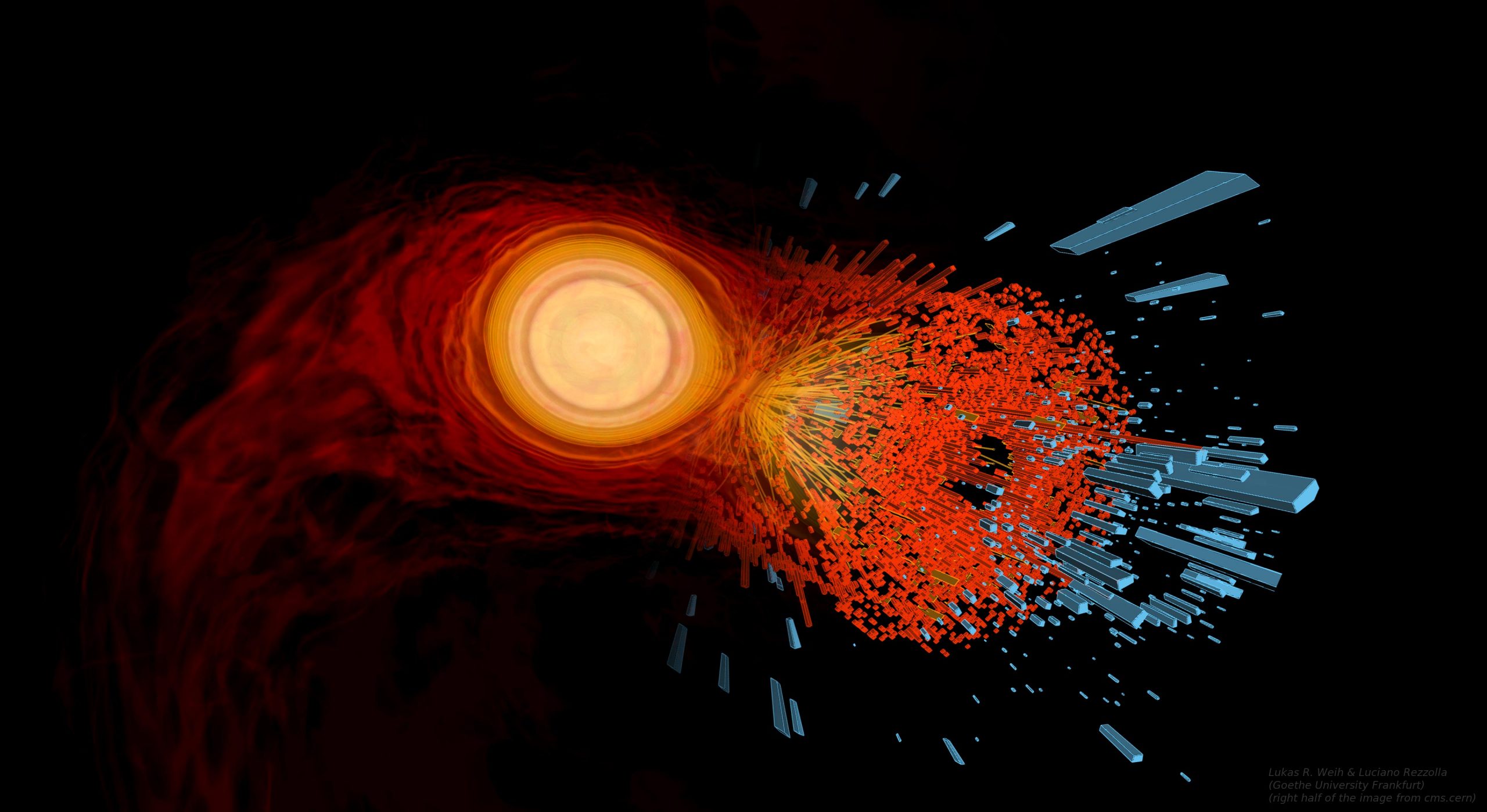
    Two Merging Neuron Stars
    Montage of the computer simulation of two merging neutron stars that blends over with an image from heavy-ion collisions to highlight the connection of astrophysics with nuclear physics. Credit: Lukas R. Weih & Luciano Rezzolla (Goethe University Frankfurt) (right half of the image from cms.cern)

    Computer models of merging neutron stars predicts new signature in the gravitational waves to tell when this happens.

    Neutron stars are among the densest objects in the universe. If our Sun, with its radius of 700,000 kilometers (435,000 miles) were a neutron star, its mass would be condensed into an almost perfect sphere with a radius of around 12 kilometers. When two neutron stars collide and merge into a hyper-massive neutron star, the matter in the core of the new object becomes incredibly hot and dense. According to physical calculations, these conditions could result in hadrons such as neutrons and protons, which are the particles normally found in our daily experience, dissolving into their components of quarks and gluons and thus producing a quark-gluon plasma.


    This simulation shows the density of the ordinary matter (mostly neutrons) in red-yellow. Shortly after the two stars merge the extremely dense center turns green, depicting the formation of the quark-gluon plasma.

    In 2017 it was discovered for the first time that merging neutron stars send out a gravitational wave signal that can be detected on Earth. The signal not only provides information on the nature of gravity, but also on the behavior of matter under extreme conditions. When these gravitational waves were first discovered in 2017, however, they were not recorded beyond the merging point.
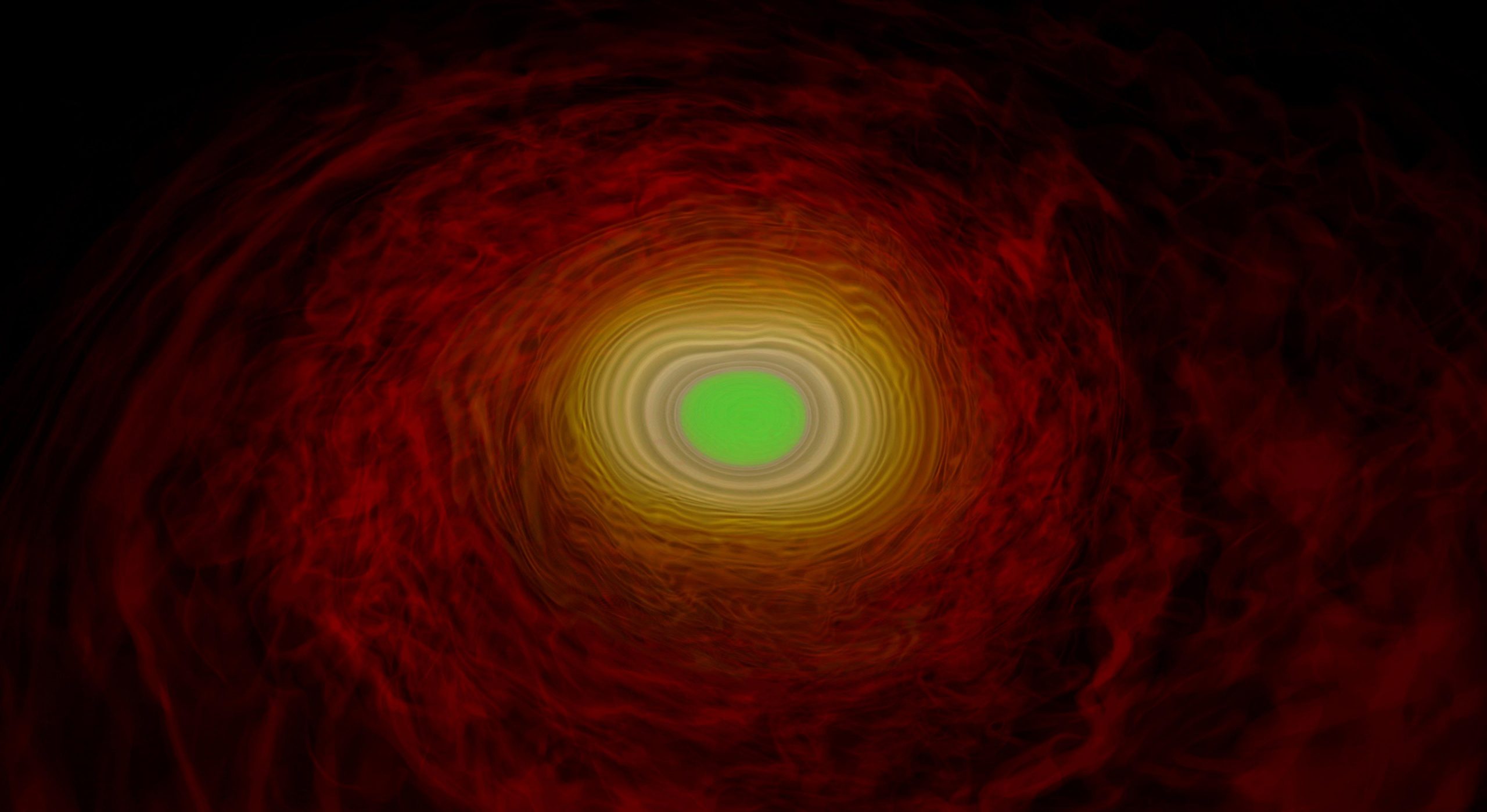
    Quark Gluon Plasma Forms
    Shortly after two neutron stars merge a quark gluon plasma forms in the center of the new object. Red yellow: ordinary matter, mostly neutrons. Credit: Lukas R. Weih & Luciano Rezzolla (Goethe University Frankfurt)

    This is where the work of the Frankfurt physicists begins. They simulated merging neutron stars and the product of the merger to explore the conditions under which a transition from hadrons to a quark-gluon plasma would take place and how this would affect the corresponding gravitational wave. The result: in a specific, late phase of the life of the merged object a phase transition to the quark-gluon plasma took place and left a clear and characteristic signature on the gravitational-wave signal.

    Professor Luciano Rezzolla from Goethe University is convinced: “Compared to previous simulations, we have discovered a new signature in the gravitational waves that is significantly clearer to detect. If this signature occurs in the gravitational waves that we will receive from future neutron-star mergers, we would have clear evidence for the creation of quark-gluon plasma in the present universe.”

    Reference: “Postmerger Gravitational-Wave Signatures of Phase Transitions in Binary Mergers” by Lukas R. Weih, Matthias Hanauske and Luciano Rezzolla, 30 April 2020, Physical Review Letters.
    DOI: 10.1103/PhysRevLett.124.171103

    Never miss a breakthrough: Join the SciTechDaily newsletter.
    Follow us on Google and Google News.

    Astronomy Astrophysics Goethe University Frankfurt Gravitational Waves Particle Physics Popular
    Share. Facebook Twitter Pinterest LinkedIn Email Reddit

    Related Articles

    New Study Suggests Gravitational Waves May Have Created Dark Matter

    Gravitational Waves Expose Hidden Dark Matter Around Black Holes

    In a First for Humanity, Scientists May Have Finally Seen Dark Matter

    Black Hole Shadows Could Reveal the Limits of Einstein’s Theory of Relativity

    Scientists Just Solved a Black Hole Mystery 100 Years in the Making

    Einstein Was Right Again: Ripples in Space-Time Confirm Century-Old Theory

    LIGO Detects Black Hole Smashup So Extreme It’s Bending Einstein’s Rules

    Cosmic Heavyweights Collide – LIGO Detects Largest, Fastest-Spinning Black Holes Yet

    Dark Matter May Be Annihilating Itself at the Heart of the Milky Way

    1 Comment

    1. Frosted Flake on May 4, 2020 1:44 am

      I love it when scientists make predictions.

      Reply
    Leave A Reply Cancel Reply

    • Facebook
    • Twitter
    • Pinterest
    • YouTube

    Don't Miss a Discovery

    Subscribe for the Latest in Science & Tech!

    Trending News

    New “Nanozyme Hypothesis” Could Rewrite the Story of Life’s Origins

    Anatomy Isn’t Finished: The Human Body Still Holds Secrets

    “Pretty Close to Home”: The Hidden Earthquake Threat Beneath Seattle

    The Surprising Reason You Might Want To Sleep Without a Pillow

    Scientists Say This Natural Hormone Reverses Obesity by Targeting the Brain

    35-Million-Year-Old Mystery: Strange Arachnid Discovered Preserved in Amber

    Is AI Really Just a Tool? It Could Be Altering How You See Reality

    JWST Reveals a “Forbidden” Planet With a Baffling Composition

    Follow SciTechDaily
    • Facebook
    • Twitter
    • YouTube
    • Pinterest
    • Newsletter
    • RSS
    SciTech News
    • Biology News
    • Chemistry News
    • Earth News
    • Health News
    • Physics News
    • Science News
    • Space News
    • Technology News
    Recent Posts
    • The Ocean Current Stronger Than All Rivers Changed Earth Forever
    • NASA Artemis II Splashdown and Astronaut Recovery Operation [Image Gallery]
    • Splashdown! NASA Artemis II Returns From Record-Breaking Moon Mission
    • Scientists Freeze a Spinning Nanoparticle to Its Quantum Limit
    • A 100x Faster Breakthrough Could Fix Quantum Computers’ Biggest Problem
    Copyright © 1998 - 2026 SciTechDaily. All Rights Reserved.
    • Science News
    • About
    • Contact
    • Editorial Board
    • Privacy Policy
    • Terms of Use

    Type above and press Enter to search. Press Esc to cancel.