
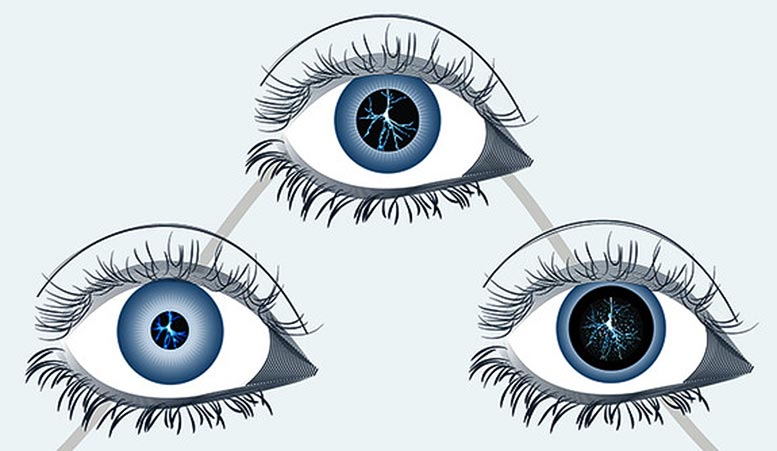
Researchers from the Yale School of Medicine reveal how changes in the activity of individual neurons during performance of a task correspond exactly to the diameter of the pupil, showing signatures of high arousal for a wide diameter and low arousal for a small diameter.
If you want to know who is ready to perform at the highest level, look them in the eyes — or more specifically, look at the diameter of their pupils, Yale School of Medicine researchers report.
They found that a state of moderate arousal — as opposed to a lethargic or a hyperactive state — leads to optimum performance in sound recognition tests of mice. A moderate dilation of the pupil matches perfectly this optimum arousal state, a finding that confirms an observation first made by Yale psycho-biologist Robert Yerkes in 1908.
In the July 1 issue of the journal Neuron, the Yale team showed how changes in the activity of individual neurons during performance of a task correspond exactly to the diameter of the pupil — showing signatures of high arousal for a wide diameter and low arousal for a small diameter.
“During low arousal, the brain is in a rhythmic state, similar to what it does during sleep, and does not generate a vigorous response to sounds,” said Matthew J. McGinley, lead author of the paper and postdoctoral researcher in neurobiology. “Conversely, when you are hyper-aroused, perhaps after having too many cups of coffee, the brain is spontaneously reactive even in the absence of sensory stimulation. Both of these states make it difficult to accurately respond to sensory stimuli.”
The sweet spot, McGinley said, is during moderate arousal, when pupil diameter is mid-range and neurons are relatively quiescent and poised to react to stimuli.
In sports, this state is called being in “the zone” — neither too keyed up or too tired to perform well. Pupil size could become an easy marker to assess readiness to perform a host of tasks, say the researchers. In theory, for instance, the ability of fighter pilots to be at their best could be detected simply by measuring pupil size in real time, said senior author David McCormick, the Dorys McConnell Duberg Professor of Neurobiology and professor of psychology, and vice director of the Yale Kavli Institute for Neuroscience.
“You could assess whether the pilot was currently too stressed out or too relaxed and use pupil size as feedback,” McCormick added.
While the linkage between pupil diameter and arousal has been known for more than a century, the new study shows how pupil size corresponds exactly to what is happening in the brain of mice during performance of a task.
“Changes in the brain are ongoing all the time, and sometimes it is filled with spontaneous noise — which explains why I miss slides during scientific presentations,” McCormick said.
These constant fluctuations explain why neural responses aren’t always robust and accurate and why it is difficult to stay in “the zone,” he added.
“So much of life is about balance,” McCormick said. “And now we have a solid handle on the brain activity associated with that sweet spot.”
Reference: “Cortical Membrane Potential Signature of Optimal States for Sensory Signal Detection” by Matthew J. McGinley, Stephen V. David and David A. McCormick, 11 June 2015, Neuron.
DOI: 10.1016/j.neuron.2015.05.038
Never miss a breakthrough: Join the SciTechDaily newsletter.
Follow us on Google and Google News.