

Close Menu
    Facebook X (Twitter) Instagram
    SciTechDaily
    • Biology
    • Chemistry
    • Earth
    • Health
    • Physics
    • Science
    • Space
    • Technology
    Facebook X (Twitter) Pinterest YouTube RSS
    SciTechDaily
    Home»Physics»Quantum Batteries Edge Closer to Reality With New Breakthrough
    Physics

    Quantum Batteries Edge Closer to Reality With New Breakthrough

    By RMIT UniversityApril 8, 20262 Comments3 Mins Read
    Facebook Twitter Pinterest Telegram LinkedIn WhatsApp Email Reddit
    Share
    Facebook Twitter LinkedIn Pinterest Telegram Email Reddit
    Lithium Solid State Battery Illustration
    Scientists have demonstrated a proof-of-concept quantum battery that can charge, store, and release energy, marking a significant step toward making this long-theoretical technology a reality. Credit: Shutterstock

    A new quantum battery prototype demonstrates fast, scalable charging using quantum effects, bringing the technology closer to real-world energy applications.

    Scientists have developed a proof-of-concept quantum battery capable of charging, storing, and releasing energy, marking a major step toward a functional version of this technology.

    Unlike conventional batteries that depend on chemical reactions, quantum batteries rely on quantum superposition and interactions between light and electrons. This approach could enable much faster charging and greater energy storage capacity.

    Although fully operational quantum batteries are not yet available, progress like this could eventually reshape how energy is stored and used.
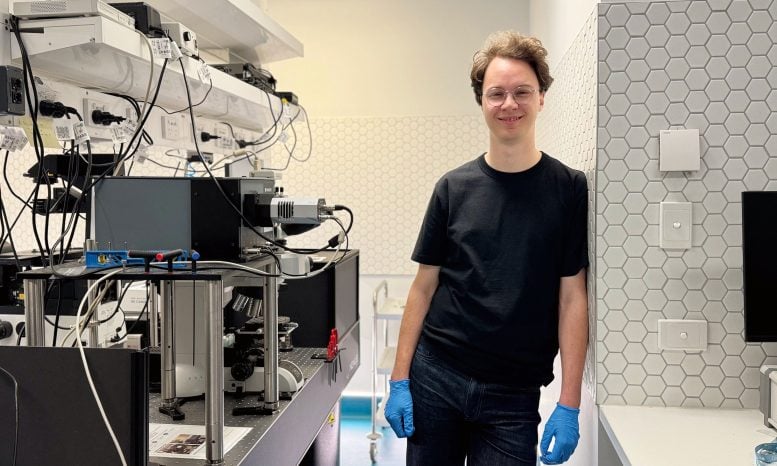
    Daniel Tibben
    Study co-author and RMIT PhD candidate Daniel Tibben. Credit: RMIT University

    Research Collaboration and Publication

    The study was led by CSIRO, Australia’s national science agency, in collaboration with RMIT University and the University of Melbourne. The findings were published in Light: Science & Applications.

    Study co-author and RMIT PhD candidate Daniel Tibben said the results reveal an unexpected benefit of quantum batteries.
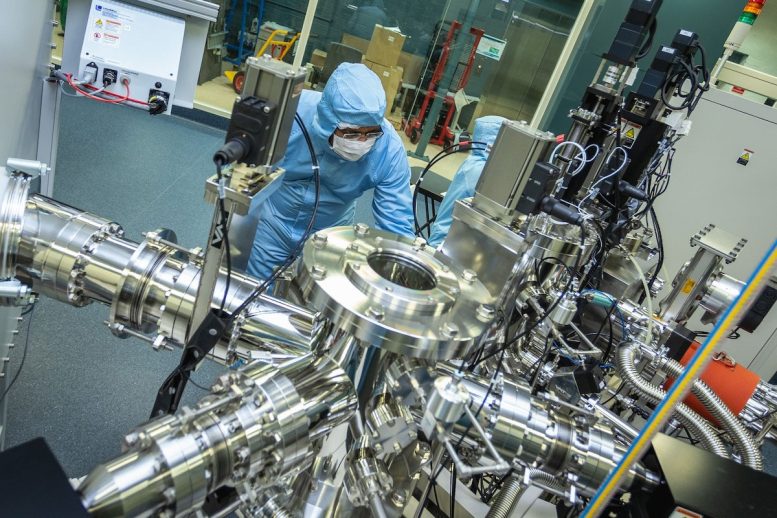
    CSIRO’s Clean Lab
    CSIRO’s clean lab for engineering prototype quantum batteries. Credit: CSIRO

    “Our study found quantum batteries charge faster as they get larger, which is not how today’s batteries work,” Tibben said.

    “It’s a sign that quantum batteries could one day outperform conventional energy-storage technologies.”

    Proof-of-Concept Device Milestone

    Co-author and RMIT Professor of Chemical Physics Daniel Gómez said the prototype represents the closest progress yet toward a working quantum battery.

    “We demonstrated a device that can be charged, store that energy, and then discharge it,” Gómez said.

    “This is an exciting development in a rapidly growing interdisciplinary field. Hopefully, quantum batteries will soon no longer be a theoretical idea but something than can be built in the lab.”

    How Quantum Batteries Work

    Quantum batteries operate using principles of quantum mechanics, such as superposition and entanglement, instead of the chemical processes used in standard batteries.

    The team’s prototype is a small, layered organic device that can be wirelessly charged with a laser.
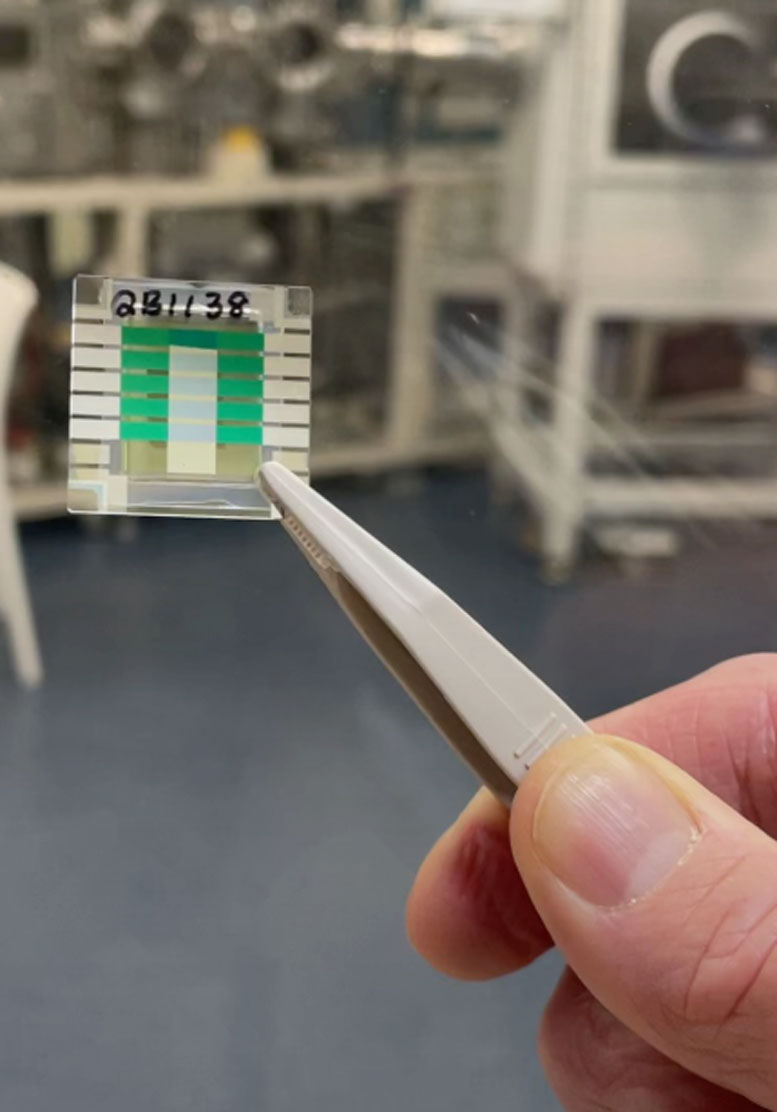
    Quantum Battery
    The world’s first fully functioning proof-of-concept quantum battery was engineered by CSIRO and collaborators at the University of Melbourne and RMIT. Credit: CSIRO

    Study lead author and CSIRO Science Leader Dr. James Quach said the work highlights the potential of quantum-based energy systems.

    Future Potential and Challenges

    “Our proof-of-concept device showcases rapid, scalable charging and energy storage at room temperature, laying the groundwork for next-gen energy solutions,” he said.

    “While there’s still much work to be done in quantum battery research, we’ve made an important move towards realizing the possibilities. My ultimate ambition is a future where we can charge electric cars much faster than fuel petrol cars or charge devices over long distances wirelessly.”

    The researchers are now working to extend how long quantum batteries can hold energy, an important step toward making them commercially viable.

    Reference: “Superextensive electrical power from a quantum battery” by Kieran Hymas, Jack B. Muir, Daniel Tibben, Joel van Embden, Tadahiko Hirai, Christopher J. Dunn, Daniel E. Gómez, James A. Hutchison, Trevor A. Smith and James Q. Quach, 13 March 2026, Light: Science & Applications.
    DOI: 10.1038/s41377-026-02240-6

    Never miss a breakthrough: Join the SciTechDaily newsletter.
    Follow us on Google and Google News.

    Battery Technology Quantum Mechanics Quantum Physics RMIT University
    Share. Facebook Twitter Pinterest LinkedIn Email Reddit

    Related Articles

    Photons Traverse Optical Obstacles as Both a Wave and Particle Simultaneously

    The Experimental Design of a Space-Time Crystal

    Interpretation of Heisenberg’s Principle is Proven False

    New System Converts Laser Beam Into Controlled Stream of Single Photons

    Quantum Bits Store Data for Nearly Two Seconds Using Laboratory Grown Diamonds

    Experiment Shows That Light Defies the Principles of Classical Physics

    “Schrödinger’s Hat” Conceals Matter Waves Inside an Invisible Container

    Simulating Quantum Walks in Two Dimensions

    Evidence of Elusive Majorana Fermions Raises Possibilities for Quantum Computing

    2 Comments

    1. Marvin Rumery III on April 8, 2026 12:25 pm

      argon,, helium and sugar properties would oleviate any corrosion but you would need a base that’s affordable and could be pressuoized iof ever needing recharged. my first instinct was thinking diamond but if you utilized other semi pressious stones such as imibar properties broken down and replenished with hematite and coconut oil pressurized into a stone.. all you would need to do is pressurize the base of the battery with electricity and the battery would replenish itself

      Reply
    2. kamir bouchareb st on April 10, 2026 2:28 pm

      thanks

      Reply
    Leave A Reply Cancel Reply

    • Facebook
    • Twitter
    • Pinterest
    • YouTube

    Don't Miss a Discovery

    Subscribe for the Latest in Science & Tech!

    Trending News

    Artificial Sweeteners May Harm Future Generations, Study Suggests

    Splashdown! NASA Artemis II Returns From Record-Breaking Moon Mission

    What If Consciousness Exists Beyond Your Brain

    Scientists Finally Crack the 100-Million-Year Evolutionary Mystery of Squid and Cuttlefish

    Beyond “Safe Levels”: Study Challenges What We Know About Pesticides and Cancer

    Researchers Have Found a Dietary Compound That Increases Longevity

    Scientists Baffled by Bizarre “Living Fossil” From 275 Million Years Ago

    Your IQ at 23 Could Predict Your Wealth at 27, Study Finds

    Follow SciTechDaily
    • Facebook
    • Twitter
    • YouTube
    • Pinterest
    • Newsletter
    • RSS
    SciTech News
    • Biology News
    • Chemistry News
    • Earth News
    • Health News
    • Physics News
    • Science News
    • Space News
    • Technology News
    Recent Posts
    • What if Dark Matter Has Two Forms? Bold New Hypothesis Could Explain a Cosmic Mystery
    • Researchers Expose Hidden Chemistry of “Ore-Forming” Elements in Biology
    • Geologists Reveal the Americas Collided Earlier Than We Thought
    • 20x Difference: Study Reveals True Source of Airborne Microplastics
    • Scientists Uncover Hidden Force Powering Yellowstone’s Supervolcano
    Copyright © 1998 - 2026 SciTechDaily. All Rights Reserved.
    • Science News
    • About
    • Contact
    • Editorial Board
    • Privacy Policy
    • Terms of Use

    Type above and press Enter to search. Press Esc to cancel.