
New technologies could enhance methods for storing and transferring data.
Quantum computing leverages the principles of quantum mechanics to address complex challenges in various fields, including medicine and machine learning, that surpass the capabilities of traditional computers. Quantum simulators, composed of programmable interacting quantum units, allow scientists to emulate intricate physical world models. By adjusting these interactions and observing the behavior of the simulators, researchers can glean insights about these models and, indirectly, the real world.
In a paper published in Physical Review B, and selected by the journal as an editors’ suggestion, a UC Riverside-led research team has proposed a chain of quantum magnetic objects, called spin centers, that, in the presence of an external magnetic field, can quantum simulate a variety of magnetic phases of matter as well as the transitions between these phases.
“We are designing new devices that house the spin centers and can be used to simulate and learn about interesting physical phenomena that cannot be fully studied with classical computers,” said Shan-Wen Tsai, a professor of physics and astronomy, who led the research team. “Spin centers in solid-state materials are localized quantum objects with great untapped potential for the design of new quantum simulators.”
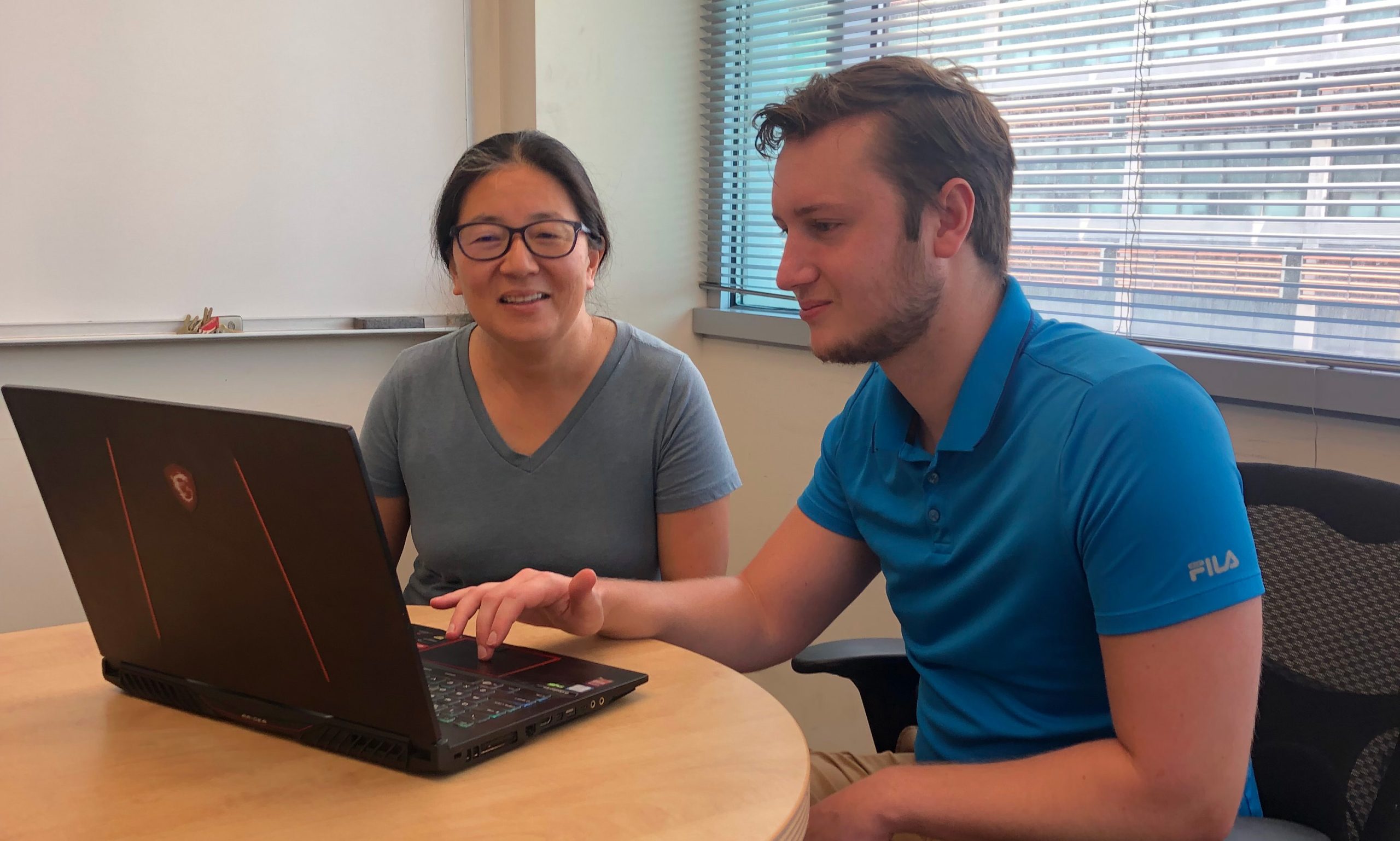
According to Troy Losey, Tsai’s graduate student and first author of the paper, advances with these devices could make it possible to study more efficient ways of storing and transferring information, while also developing methods needed to create room-temperature quantum computers.
“We have many ideas for how to make improvements to spin-center-based quantum simulators compared to this initial proposed device,” he said. “Employing these new ideas and considering more complex arrangements of spin centers could help create quantum simulators that are easy to build and operate, while still being able to simulate novel and meaningful physics.”
Below, Tsai and Losey answer a couple of questions about the research:
Q: What is a quantum simulator?
Tsai: It is a device that exploits the unusual behaviors of quantum mechanics to simulate interesting physics that is too difficult for a regular computer to calculate. Unlike quantum computers that operate with qubits and universal gate operations, quantum simulators are individually designed to simulate/solve specific problems. By trading off universal programmability of quantum computers in favor of exploiting the richness of different quantum interactions and geometrical arrangements, quantum simulators may be easier to implement and provide new applications for quantum devices, which is relevant because quantum computers aren’t yet universally useful.
A spin center is a roughly atom-sized quantum magnetic object that can be placed in a crystal. It can store quantum information, communicate with other spin centers, and be controlled with lasers.
Q: What are some applications of this work?
Losey: We can build the proposed quantum simulator to simulate exotic magnetic phases of matter and the phase transitions between them. These phase transitions are of great interest because at these transitions the behaviors of very different systems become identical, which implies that there are underlying physical phenomena connecting these different systems.
The techniques used to build this device can also be used for spin-center-based quantum computers, which are a leading candidate for the development of room-temperature quantum computers, whereas most quantum computers require extremely cold temperatures to function. Furthermore, our device assumes that the spin centers are placed in a straight line, but it is possible to place the spin centers in up to 3-dimensional arrangements. This could allow for the study of spin-based information devices that are more efficient than methods that are currently used by computers.
As quantum simulators are easier to build and operate than quantum computers, we can currently use quantum simulators to solve certain problems that regular computers don’t have the ability to address, while we wait for quantum computers to become more refined. However, this doesn’t mean that quantum simulators can be built without challenge, as we are just now getting close to being good enough at manipulating spin centers, growing pure crystals, and working at low temperatures to build the quantum simulator that we propose.
Reference: “Quantum simulation of the spin-12 XYZ model using solid-state spin centers” by Troy Losey, Denis R. Candido, Jin Zhang, Y. Meurice, Michael E. Flatté and S.-W. Tsai, 8 July 2024, Physical Review B.
DOI: 10.1103/PhysRevB.110.014413
Never miss a breakthrough: Join the SciTechDaily newsletter.
Follow us on Google and Google News.