
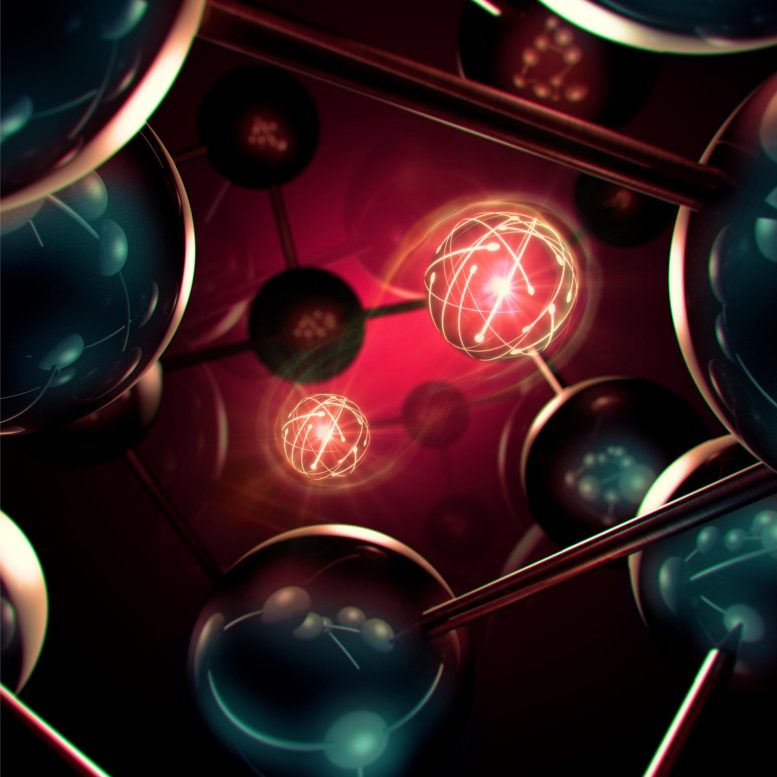
Computers, smartphones, GPS: quantum physics has enabled many technological advances. It is now opening up new fields of research in cryptography (the art of coding messages) with the aim of developing ultra-secure telecommunications networks. There is one obstacle, however: after a few hundred kilometers within an optical fiber, the photons that carry the qubits or ‘quantum bits’ (the information) disappear. They therefore need ‘repeaters’, a kind of ‘relay’, which are partly based on a quantum memory. By managing to store a qubit in a crystal (a “memory”) for 20 milliseconds, a team from the University of Geneva (UNIGE) has set a world record and taken a major step towards the development of long-distance quantum telecommunications networks. This research can be found in the journal npj Quantum Information.
Developed during the 20th century, quantum physics has enabled scientists to describe the behavior of atoms and particles as well as certain properties of electromagnetic radiation. By breaking with classical physics, these theories generated a real revolution and introduced notions without equivalent in the macroscopic world such as superposition, which describes the possibility for a particle to be in several places at once, or entanglement, which describes the ability of two particles to affect each other instantaneously even at a distance (‘spooky action at a distance’).
Quantum theories are now at the heart of much research in cryptography, a discipline that brings together techniques for encoding a message. Quantum theories make it possible to guarantee perfect authenticity and confidentiality for information (a qubit) when it is transmitted between two interlocutors by a particle of light (a photon) within an optical fiber. The phenomenon of superposition let the sender know immediately whether the photon conveying the message has been intercepted.
Memorizing the Signal
However, there is a major obstacle to the development of long-distance quantum telecommunication systems: beyond a few hundred kilometers, the photons are lost and the signal disappears. Since the signal cannot be copied or amplified — it would lose the quantum state that guarantees its confidentiality — the challenge is to find a way of repeating it without altering it by creating ‘repeaters’ based, in particular, on a quantum memory.
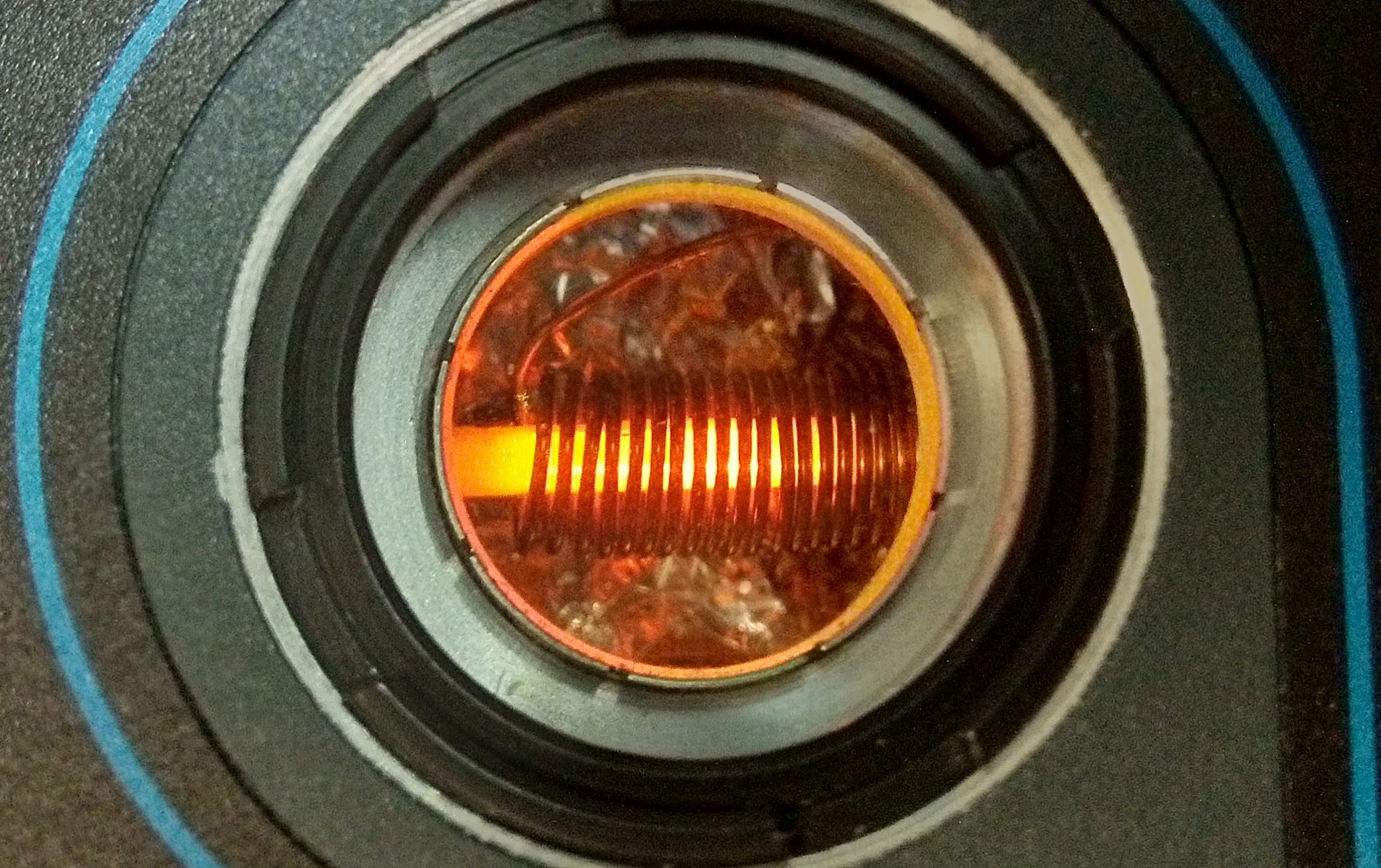
In 2015, the team led by Mikael Afzelius, a senior lecturer in the Department of Applied Physics at the Faculty of Science of the University of Geneva (UNIGE), succeeded in storing a qubit carried by a photon for 0.5 milliseconds in a crystal (a ‘memory’). This process allowed the photon to transfer its quantum state to the atoms of the crystal before disappearing. However, the phenomenon did not last long enough to allow the construction of a larger network of memories, a prerequisite for the development of long-distance quantum telecommunications.
Storage Record
Today, within the framework of the European Quantum Flagship program, Mikael Afzelius’ team has managed to increase this duration significantly by storing a qubit for 20 milliseconds. “This is a world record for a quantum memory based on a solid-state system, in this case a crystal. We have even managed to reach the 100 millisecond mark with a small loss of fidelity”, enthuses the researcher. As in their previous work, the UNIGE scientists used crystals doped with certain metals called ‘rare earths’ (europium in this case), capable of absorbing light and then re-emitting it. These crystals were kept at -273.15°C (absolute zero), because beyond 10°C (10°F) above this temperature, the thermal agitation of the crystal destroys the entanglement of the atoms.
“We applied a small magnetic field of one-thousandth of a Tesla to the crystal and used dynamic decoupling methods, which consist in sending intense radio frequencies to the crystal. The effect of these techniques is to decouple the rare-earth ions from perturbations of the environment and increase the storage performance we have known until now by almost a factor of 40,” explains Antonio Ortu, a post-doctoral fellow in the Department of Applied Physics at UNIGE. The results of this research constitute a major advance in the development of long-distance quantum telecommunications networks. They also bring the storage of a quantum state carried by a photon to a time scale that can be estimated by humans.
An Efficient System in Ten Years
However, there are still several challenges to be met. “The challenge now is to extend the storage time further. In theory, it would be enough to increase the duration of exposure of the crystal to radio frequencies, but for the time being, technical obstacles to their implementation over a longer period of time prevent us from going beyond 100 milliseconds. However, it is certain that these technical difficulties can be resolved,” says Mikael Afzelius.
The scientists will also have to find ways of designing memories capable of storing more than a single photon at a time, and thus of having ‘entangled’ photons which will guarantee confidentiality. “The aim is to develop a system that performs well on all these points and that can be marketed within ten years,” concludes the researcher.
Reference: “Storage of photonic time-bin qubits for up to 20 ms in a rare-earth doped crystal” by Antonio Ortu, Adrian Holzäpfel, Jean Etesse and Mikael Afzelius, 15 March 2022, npj Quantum Information.
DOI: 10.1038/s41534-022-00541-3
Never miss a breakthrough: Join the SciTechDaily newsletter.
Follow us on Google and Google News.
1 Comment
wow, you reached absolute zero? that’s a huge achievement, one would think there would be more headlines about this. Considering every other article says that it’s impossible to reach absolute zero.