

By using tailored pulses of light and powerful X-ray techniques, scientists have discovered how to create long-lived, light-induced quantum states in a copper oxide material—something previously thought to last only trillionths of a second.
This breakthrough allows electrons to tunnel and become trapped in a new configuration, revealing rare insights into electronic symmetry and opening possibilities for revolutionary technologies like optoelectronic devices and quantum data storage.
Unlocking Hidden Quantum Powers With Light
Some materials have remarkable quantum properties that could pave the way for next-generation technologies, from ultra-efficient electronics to powerful batteries. But there’s a catch: these special behaviors are usually hidden in the material’s natural state. To reveal them, scientists need a clever way to gently coax them out.
One powerful method involves hitting the material with extremely short pulses of light. These pulses can subtly shift how atoms and electrons interact at the microscopic level, allowing the material’s hidden quantum properties to briefly emerge. The problem? These light-induced states vanish almost instantly, often lasting just trillionths of a second. That makes them hard to study, let alone use in real-world devices.
In rare cases, these states last a bit longer, but scientists still don’t fully understand why, and there’s no clear rulebook for how to create them on demand.
Now, researchers from Harvard University, working with colleagues at the Paul Scherrer Institute (PSI) in Switzerland, have taken a major step forward. By carefully tuning the symmetry of electronic states in a copper oxide material, they managed to create a quantum state that sticks around for several nanoseconds—about a thousand times longer than usual. They achieved this using the powerful SwissFEL X-ray laser, which helped them trigger and observe this unusually long-lived behavior.
Cuprate Ladders: A Simplified Quantum Playground
The compound under study, Sr14Cu24O41 – a so-called cuprate ladder – is nearly one-dimensional. It is composed of two distinct structural units, the ladders and chains, representing the shape in which copper and oxygen atoms organise. This one-dimensional structure offers a simplified platform to understand complex physical phenomena that also show up in higher-dimensional systems.
“This material is like our fruit fly. It is the idealised platform that we can use to study general quantum phenomena,” comments experimental condensed matter physicist Matteo Mitrano from Harvard University, who led the study.
Electronic Tricks to Avoid Structural Change
One way to achieve a long-lived (‘metastable’) non-equilibrium state is to trap it in an energy well from which it does not have enough energy to escape. However, this technique risks inducing structural phase transitions that change the material’s molecular arrangement, and that is something Mitrano and his team wanted to avoid.
“We wanted to figure out whether there was another way to lock the material in a non-equilibrium state through purely electronic methods,” explains Mitrano. For that reason, an alternative approach was proposed.
Breaking Symmetry to Trap Charge
In this compound, the chain units hold a high density of electronic charge, while the ladders are relatively empty. At equilibrium, the symmetry of the electronic states prevents any movement of charges between the two units. A precisely engineered laser pulse breaks this symmetry, allowing charges to quantum tunnel from the chains to the ladders.
“It’s like switching on and off a valve,” explains Mitrano. Once the laser excitation is turned off, the tunnel connecting ladders and chains shuts down, cutting off the communication between these two units and trapping the system in a new long-lived state for some time that allows scientists to measure its properties.
Capturing Quantum Motion With SwissFEL
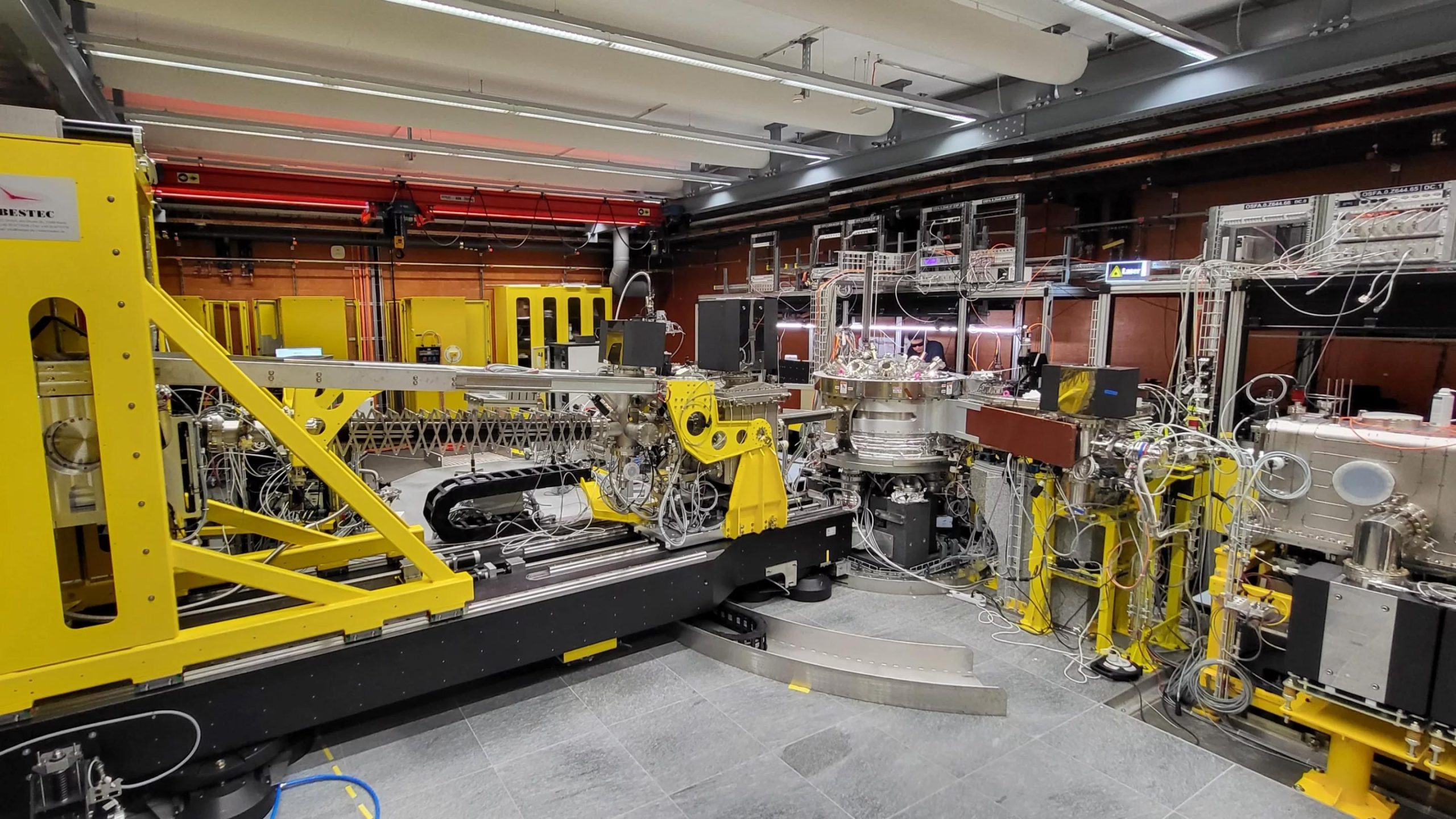
The ultra-bright femtosecond X-ray pulses generated at the SwissFEL enabled the ultrafast electronic processes governing the formation and subsequent stabilization of the metastable state to be captured in action. Using a technique known as time-resolved Resonant Inelastic X-ray scattering (tr-RIXS) at the SwissFEL Furka endstation, researchers can gain unique insight into magnetic, electric, and orbital excitations – and their evolution over time – revealing properties that often remain hidden to other probes.
“We can specifically target those atoms that determine the physical properties of the system,” comments Elia Razzoli, group leader of the Furka endstation and responsible for the experimental setup.
This capability was key to dissecting the light-induced electronic motion that gave rise to the metastable state. “With this technique, we could observe how the electrons moved at their intrinsic ultrafast timescale and hence reveal electronic metastability,” adds Hari Padma, postdoctoral scholar at Harvard and lead author of the paper.
Time-Resolved Probing of Metastable States
tr-RIXS gives unique insight into energy and momentum dynamics of excited materials, opening new scientific opportunities for users of SwissFEL in studying quantum materials; indeed, these results come from the first experiment conducted by a user group at the new Furka endstation. It was the interest in the development of tr-RIXS at Furka that motivated the Harvard team to collaborate with scientists at PSI. “It’s a rare opportunity to get time on a machine where you can do these sorts of experiments,” comments Mitrano.
Since this initial pilot experiment, the Furka endstation has undergone upgrades to improve the RIXS energy resolution, and it is ready to study new types of individual and collective excitations, such as lattice excitations. “This experiment was very important to showcase the kind of experiments that we can carry out. The endstation and its instrumentation are already much better now, and we will keep improving it,” concludes Razzoli.
Toward Quantum Devices and Data Storage
This work represents a major step forward in controlling quantum materials far from equilibrium, with broad implications for future technologies. By stabilising light-induced non-equilibrium states, the study opens new possibilities for designing materials with tunable functionalities. This could enable ultrafast optoelectronic devices, including transducers that convert electrical signals to light and vice versa, key components for quantum communication and photonic computing. It also offers a pathway toward non-volatile information storage, where data is encoded in quantum states created and controlled by light.
Reference: “Symmetry-protected electronic metastability in an optically driven cuprate ladder” by Hari Padma, Filippo Glerean, Sophia F. R. TenHuisen, Zecheng Shen, Haoxin Wang, Luogen Xu, Joshua D. Elliott, Christopher C. Homes, Elizabeth Skoropata, Hiroki Ueda, Biaolong Liu, Eugenio Paris, Arnau Romaguera, Byungjune Lee, Wei He, Yu Wang, Seng Huat Lee, Hyeongi Choi, Sang-Youn Park, Zhiqiang Mao, Matteo Calandra, Hoyoung Jang, Elia Razzoli, Mark P. M. Dean, Yao Wang and Matteo Mitrano, 3 June 2025, Nature Materials.
DOI: 10.1038/s41563-025-02254-2
Never miss a breakthrough: Join the SciTechDaily newsletter.
Follow us on Google and Google News.
1 Comment
This breakthrough allows electrons to tunnel and become trapped in a new configuration, by stabilising light-induced non-equilibrium states, the study opens new possibilities for designing materials with tunable functionalities.
good!
Deleting meaningful comments will make this comment section not worth reading again. Fighting against rampant pseudoscience requires more people to understand. If researchers are interested in this, please browse https://zhuanlan.zhihu.com/p/1918614826130838141 and https://zhuanlan.zhihu.com/p/1915292792520966679.
Within spacetime-matter interactions, absolute space furnishes a substrate, framework, and arena intrinsically characterized by the properties of an ideal fluid.