
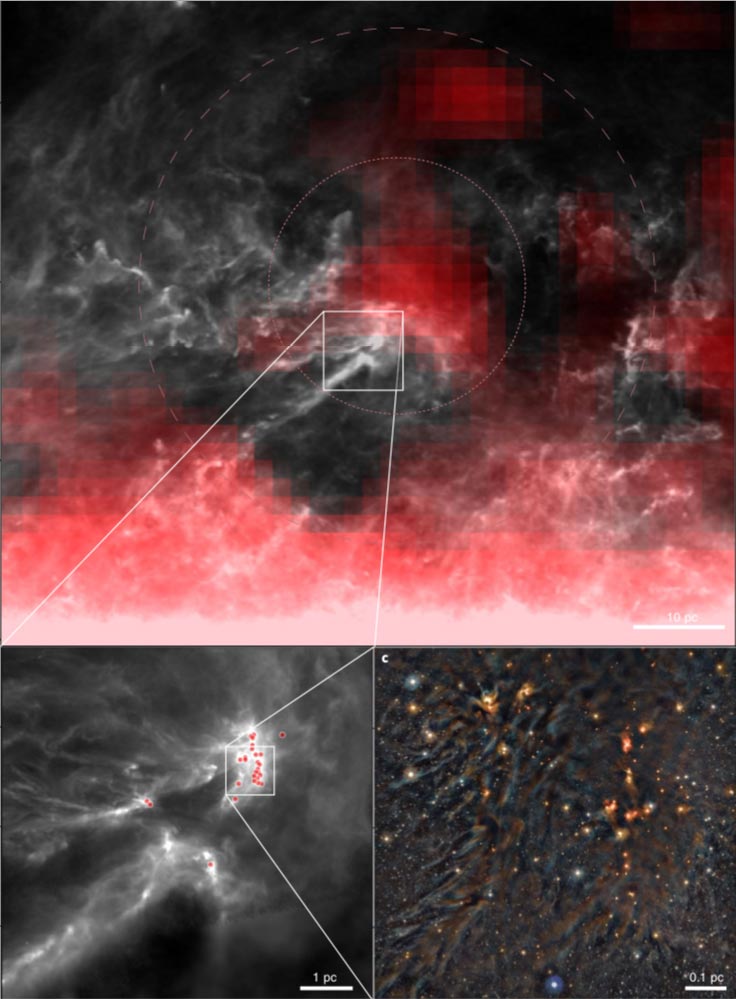
The Ophiuchus star-forming complex offers an analog for the formation of the solar system, including the sources of elements found in primitive meteorites.
A region of active star formation in the constellation Ophiuchus is giving astronomers new insights into the conditions in which our own solar system was born. In particular, a new study of the Ophiuchus star-forming complex shows how our solar system may have become enriched with short-lived radioactive elements.
Evidence of this enrichment process has been around since the 1970s, when scientists studying certain mineral inclusions in meteorites concluded that they were pristine remnants of the infant solar system and contained the decay products of short-lived radionuclides. These radioactive elements could have been blown onto the nascent solar system by a nearby exploding star (a supernova) or by the strong stellar winds from a type of massive star known as a Wolf-Rayet star.
The authors of the new study, published today (August 16, 2021) in Nature Astronomy, used multi-wavelength observations of the Ophiuchus star-forming region, including spectacular new infrared data, to reveal interactions between the clouds of star-forming gas and radionuclides produced in a nearby cluster of young stars. Their findings indicate that supernovas in the star cluster are the most likely source of short-lived radionuclides in the star-forming clouds.
“Our solar system was most likely formed in a giant molecular cloud together with a young stellar cluster, and one or more supernova events from some massive stars in this cluster contaminated the gas which turned into the sun and its planetary system,” said coauthor Douglas N. C. Lin, professor emeritus of astronomy and astrophysics at UC Santa Cruz. “Although this scenario has been suggested in the past, the strength of this paper is to use multi-wavelength observations and a sophisticated statistical analysis to deduce a quantitative measurement of the model’s likelihood.”
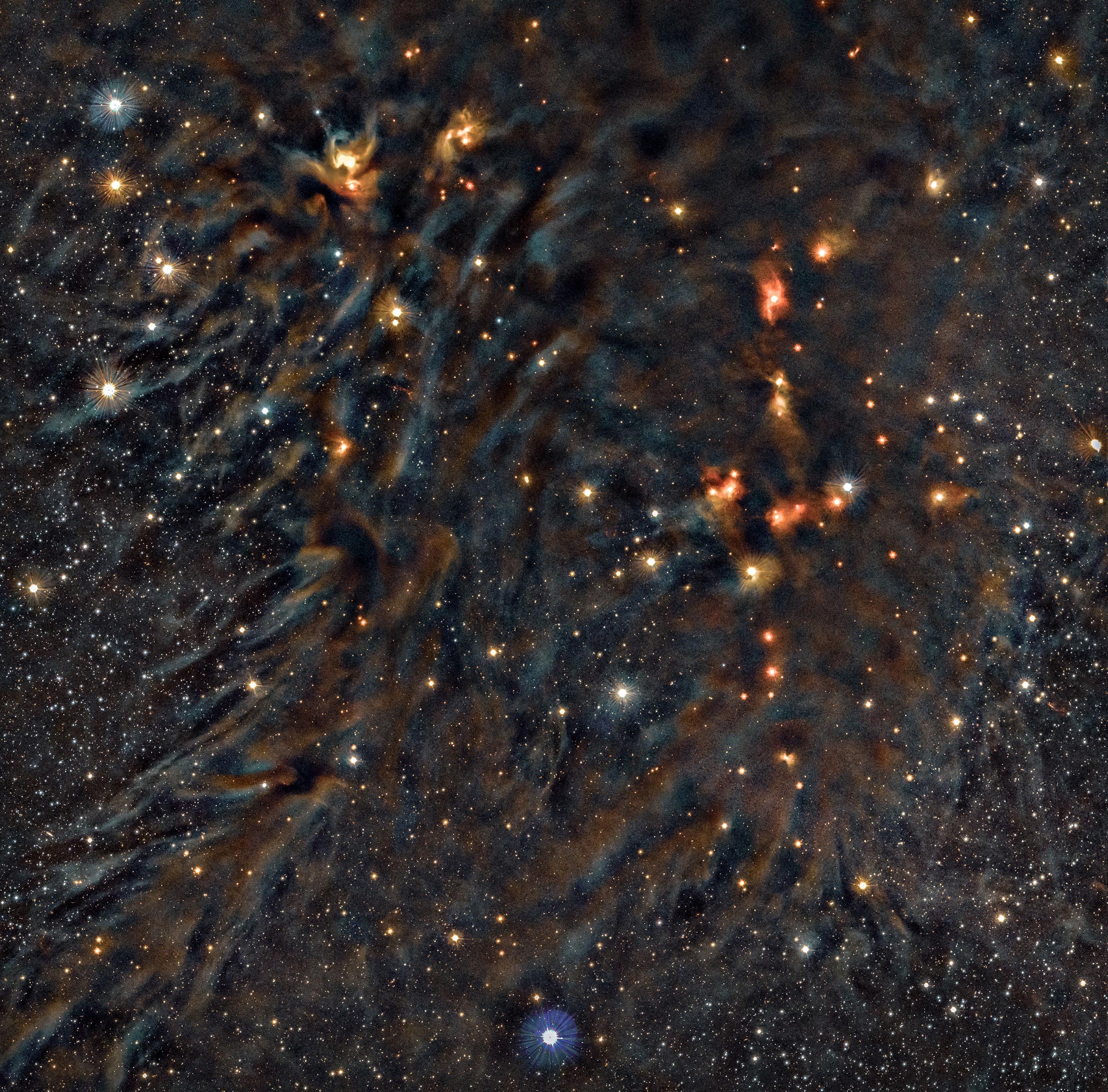
First author John Forbes at the Flatiron Institute’s Center for Computational Astrophysics said data from space-based gamma-ray telescopes enable the detection of gamma rays emitted by the short-lived radionuclide aluminum-26. “These are challenging observations. We can only convincingly detect it in two star-forming regions, and the best data are from the Ophiuchus complex,” he said.
Stellar Feedback in Planet Nurseries
The Ophiuchus cloud complex contains many dense protostellar cores in various stages of star formation and protoplanetary disk development, representing the earliest stages in the formation of a planetary system. By combining imaging data in wavelengths ranging from millimeters to gamma rays, the researchers were able to visualize a flow of aluminum-26 from the nearby star cluster toward the Ophiuchus star-forming region.
“The enrichment process we’re seeing in Ophiuchus is consistent with what happened during the formation of the solar system 5 billion years ago,” Forbes said. “Once we saw this nice example of how the process might happen, we set about trying to model the nearby star cluster that produced the radionuclides we see today in gamma rays.”
Forbes developed a model that accounts for every massive star that could have existed in this region, including its mass, age, and probability of exploding as a supernova, and incorporates the potential yields of aluminum-26 from stellar winds and supernovas. The model enabled him to determine the probabilities of different scenarios for the production of the aluminum-26 observed today.
“We now have enough information to say that there is a 59 percent chance it is due to supernovas and a 68 percent chance that it’s from multiple sources and not just one supernova,” Forbes said.
Cosmic Chemistry and Planetary Impacts
This type of statistical analysis assigns probabilities to scenarios that astronomers have been debating for the past 50 years, Lin noted. “This is the new direction for astronomy, to quantify the likelihood,” he said.
The new findings also show that the amount of short-lived radionuclides incorporated into newly forming star systems can vary widely. “Many new star systems will be born with aluminum-26 abundances in line with our solar system, but the variation is huge—several orders of magnitude,” Forbes said. “This matters for the early evolution of planetary systems, since aluminum-26 is the main early heating source. More aluminum-26 probably means drier planets.”
The infrared data, which enabled the team to peer through dusty clouds into the heart of the star-forming complex, was obtained by coauthor João Alves at the University of Vienna as part of the European Southern Observatory’s VISION survey of nearby stellar nurseries using the VISTA telescope in Chile.
“There is nothing special about Ophiuchus as a star formation region,” Alves said. “It is just a typical configuration of gas and young massive stars, so our results should be representative of the enrichment of short-lived radioactive elements in star and planet formation across the Milky Way.”
Reference: “A Solar System formation analogue in the Ophiuchus star-forming complex” 16 August 2021, Nature Astronomy.
DOI: 10.1038/s41550-021-01442-9
The team also used data from the European Space Agency’s (ESA) Herschel Space Observatory, the ESA’s Planck satellite, and NASA’s Compton Gamma Ray Observatory.
Never miss a breakthrough: Join the SciTechDaily newsletter.
Follow us on Google and Google News.
4 Comments
Forbes developed a model that accounts for every massive star that could have existed in this region, including its mass, age, and probability of exploding as a supernova, and incorporates the potential yields of aluminum-26 from stellar winds and supernovas.
its a pity he dont give us the amount
i count 21 stars lighting up the picture
the central sun system has a possible 36 supernovaes in its stellar nursey so are we lacking some forbes or do we have the right amount or do we have an excess amount can u advise
but at 330 light years spacings those stars would need a lot of velocity to dust speed them to a cloud to start to form a nascent central stellar sun star
Stars cannot be born of dust and gas, just as firewood cannot be born of burnt ashes. Stars are born from a quark nucleus in the centers of galaxies.
https://www.youtube.com/watch?v=tFUM3vAlaGc
Dust cloud formation is in the paper because that is how stars are observed to form.
The link is therefore pseudoscience.
If you read the paper ypu would see that the paper uses column densities of observations and only the model uses a certain number of stars to match those densities.
Supernovas can eject at 0.1 c or thereabouts which with a half life for Al26 of ~ 800 kyrs means the ejecta can travel 80 klyrs before the Al26 is half depleted. I.e. it can travel the 20 klyrs of the galactic disk, say.