
Herding could help curb Arctic greening and shrubification caused by climate change.
On the Yamal Peninsula in West Siberia, the nomadic Nenets people have a long tradition of herding reindeer on the Arctic tundra. In recent decades, however, the tundra has been changing, and so are the ways that reindeer interact with it.
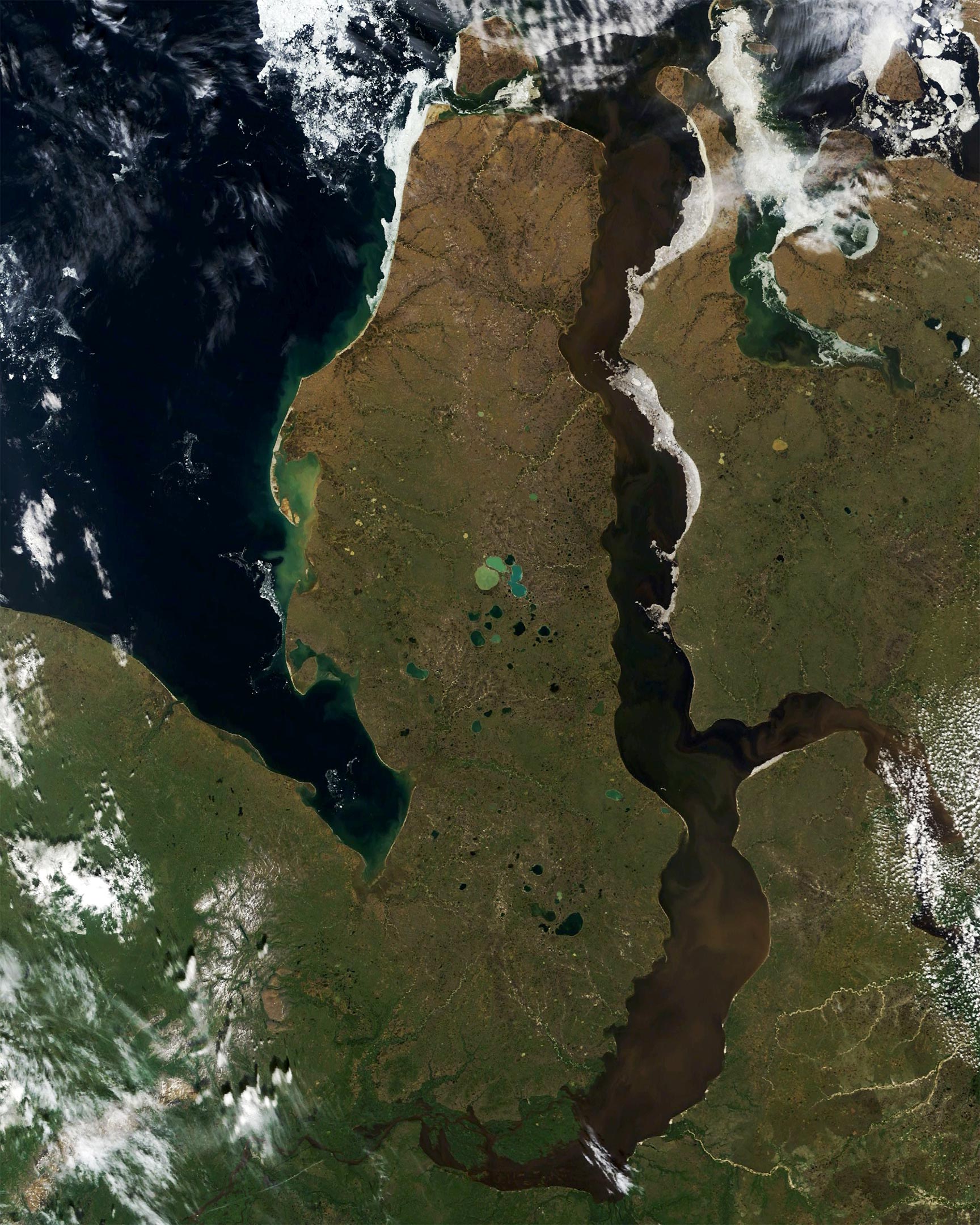
The Yamal Peninsula is shown above in a natural-color image acquired by the Moderate Resolution Imaging Spectroradiometer (MODIS) on NASA’s Terra satellite on July 8, 2021. At that time of year, Nenets herders likely were making their summer migration to the north.
In the Arctic, temperatures have been rising faster than anywhere else in the world. Climate change has been altering the plant communities in tundra and taiga (boreal) ecosystems. As growing seasons become longer and warmer, plant growth has increased—an effect called Arctic greening. Additionally, the tundra grasses and small plants that normally grow here are being replaced by taller, woodier shrubs and trees—a change called shrubification. These changes in vegetation affect the tundra ecosystem, including its carbon cycle, human and wildlife habitat, and susceptibility to wildfire.
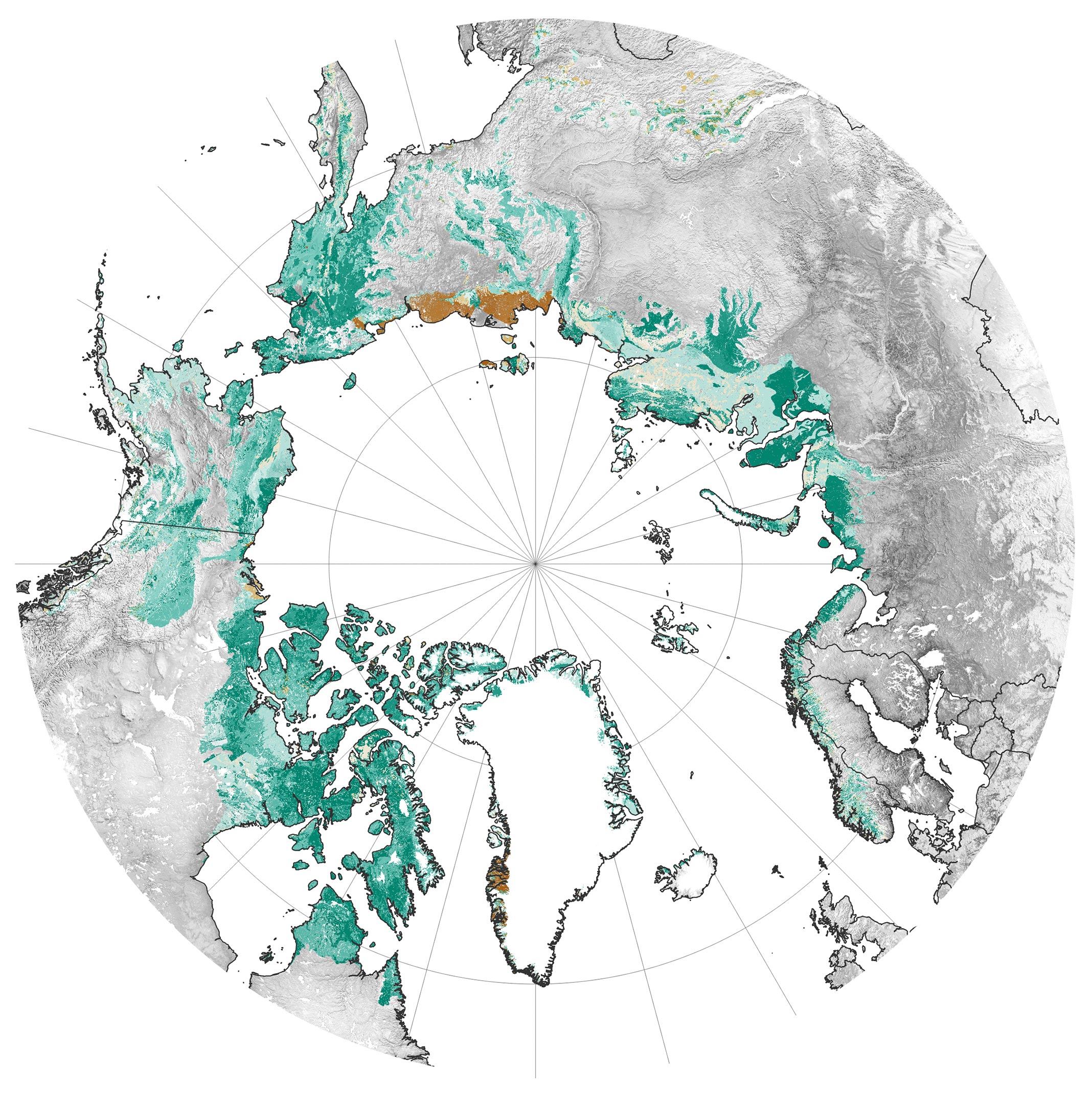
But the changes have not been uniform across the Arctic. For example, research supported by NASA’s Arctic-Boreal Vulnerability Experiment (ABoVE) found that instead of greening, some colder, drier areas have experienced browning. The map below is based on Landsat satellite observations between 2000 and 2016 that show about 22 percent of the Arctic became greener while 5 percent became browner.
Tracking Vegetation-Reindeer Interactions from Space
For decades, satellite instruments have monitored vegetation from space. Ground-based studies have shown how reindeer—the only large herbivore in many areas of the Arctic—can affect vegetation, including reducing greenness and lichen abundances, slowing the encroachment of shrubs, and increasing soil nitrogen. Now, satellites are being used to investigate the interactions between the vegetation and reindeer.
In a 2020 study, researchers used 30 years of Landsat imagery data to map changes in shrub cover across the Yamal Peninsula. They found it was stable between 1986 and 2016, despite the warming climate and a 75 percent increase in the reindeer population over that time.
“Our results thus point towards increases in large herbivore pressures having compensated for the warming of the Peninsula, halting the shrubification of the area,” the authors wrote in the Journal of Environmental Management. “This suggests that strategic semi-domesticated reindeer husbandry, which is a common practice across the Eurasian Arctic, could represent an efficient environmental management strategy for maintaining open tundra landscapes in the face of rapid climate change.”
However, another 2020 study of the Yamal reindeer found that this strategy may have its limits. Using Landsat imagery, along with ground surveys based on fecal pellets, scientists tried to quantify land-use by reindeer. They found that while foraging and trampling do hold back the growth of low-growing shrubs, they do not appear to prevent the further growth or expansion of taller, already established shrubs because these are areas where reindeer are unlikely to forage.
“Our results suggest that reindeer use of the landscape, and hence their effects on the landscape, correlates with the landscape structure,” the authors wrote in Environmental Research Letters, adding that further research will be needed to evaluate the role of “reindeer as ecosystem engineers capable of mediating the effects of climate change.”
NASA Earth Observatory images by Lauren Dauphin, using MODIS data from NASA EOSDIS LANCE and GIBS/Worldview and using data from Berner, Logan, et al. (2020).
Never miss a breakthrough: Join the SciTechDaily newsletter.
Follow us on Google and Google News.