
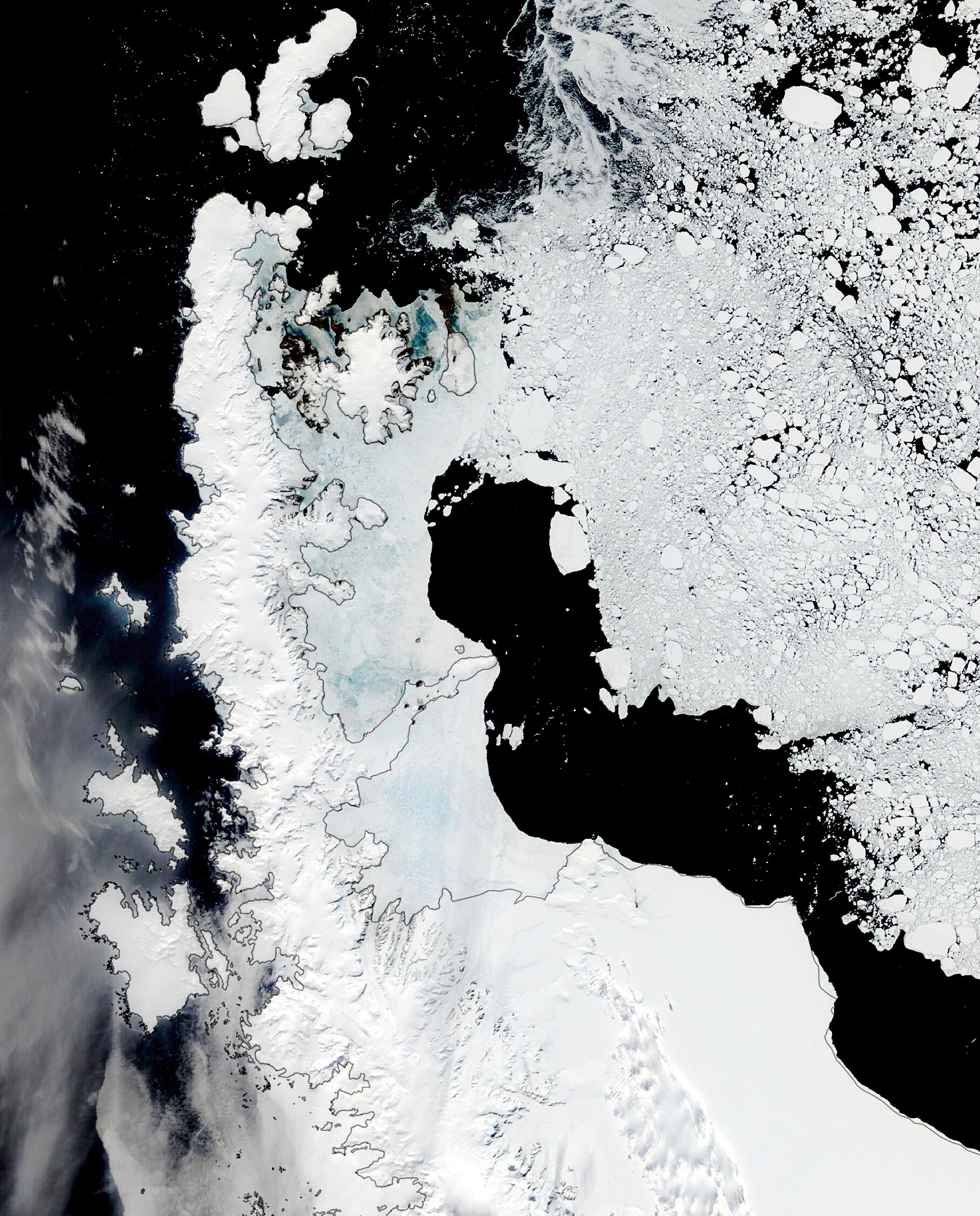
In mid-November, about a month before the start of summer in the southern hemisphere, the Antarctic melting season is usually just starting. By that time this year, vast areas along the Antarctic Peninsula were already painted blue with meltwater.
This natural-color image was acquired on November 21, 2020, by the Moderate Resolution Imaging Spectroradiometer (MODIS) on NASA’s Terra satellite. The sea ice anchored to the peninsula’s coast appears light blue where the surface ice has melted. The white ice farther off the coast is a mixture of broken sea ice and small icebergs. Dark areas indicate open water.
By the end of November 2020, much of the meltwater on the ice had refrozen. But scientists want to know if this event was similar to a strong early season melt that launched the 2019-2020 melt season. Last year, unusually warm air and water led to record-breaking melting across the Larsen C Ice Shelf. It is the largest remaining ice shelf along the Antarctic Peninsula, even though it lost a Delaware-sized iceberg in 2017.
Widespread melting on Larsen C, located just south of this image, was not apparent in natural-color satellite images. But scientists are watching how this season progresses. The ice shelf surface on the Larsen A was full of ponded meltwater just before its complete collapse in 1995; the same thing occurred before the near-complete collapse of Larsen B in 2002.
Only a small remnant of the Larsen B Ice Shelf remains today, stabilized by fast ice in front of the shelf. Loss of the fast ice can destabilize the floating shelf ice, which in turn would allow glacial ice on land to flow unimpeded into the ocean. The effect has already been observed in the Larsen A and upper Larsen B embayments.
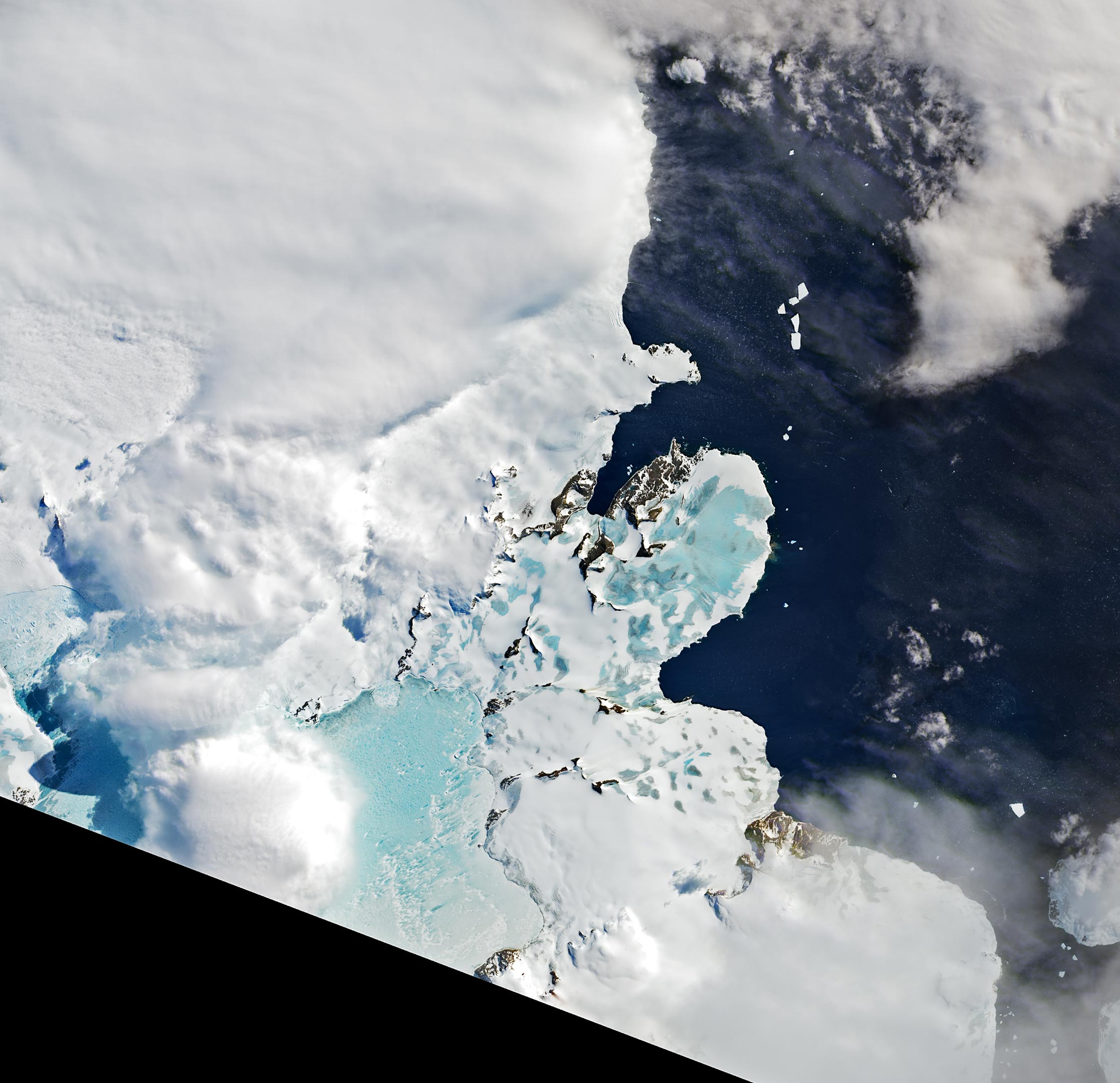
The second image, acquired on November 11, 2020, by the Operational Land Imager (OLI) on the Landsat 8 satellite, offers a detailed view of melting near the northernmost end of the Peninsula. The high temperature recorded that day at Esperanza Base measured 8°C (47°F). That was warmer than average for November, but not nearly as hot as the record-breaking 18.3°C (64.9°F) reached on February 6, 2020. Time will tell if temperatures this melt season will continue to climb and how the ice will respond.
NASA Earth Observatory images by Lauren Dauphin, using Landsat data from the U.S. Geological Survey and MODIS data from NASA EOSDIS/LANCE and GIBS/Worldview. Story by Kathryn Hansen, with image interpretation from Christopher Shuman (NASA/UMBC).
Never miss a breakthrough: Join the SciTechDaily newsletter.
Follow us on Google and Google News.
1 Comment
Interesting.
Figure out what the earths atmosphere was like from its birth much more accurately i.e.from inception. The Time frames and evidence give a great deal of information , which we need to look at much mre closely.
Data Never Lies , but biased data —without timeframes and actual conditions in both the short term and long-term —- can can certainly mislead and lead to conclusions which mayand be erroneous and leead to incorrect conclusions.s.
The rality is Ice is melting. Globally and probably at a faster rate than in the past when looked at in the shortter, times we have been monitoring. There may be mutiple causes for the same. Getting into determining the root cause on a Global Scale may be quite difficult and building models for taking all these factors and determining the root cause is a difficult job. Theory and actual evidencce needs to be examined with the sme level of rigour as in less coomplex scientific problems. This needs to be better uderstood, Doesnt mean we should take no action to address the risks and consequences of the same.
A fallacy I have observed in Science and Scientific Reasearch is that Research which Confirmed by many is necessarily 100% correct. This Certainty may be misplaced. Many Scientific Discovery’s from the past and mecanism to explain the same from the past may need to be constantly re-examined in light of new knowledge , and new tools and technologies avalable to us a species. Democracy and the belief in the wisdom of the many over the maverick my be misplced. All major breakthroughs in Human Progress happen as a result of such maverick thinking. In Risk msnsgement we call this Weak Signals and we need to watch it carefully and understand the implications of Outliers.