
Close Menu
    Facebook X (Twitter) Instagram
    SciTechDaily
    • Biology
    • Chemistry
    • Earth
    • Health
    • Physics
    • Science
    • Space
    • Technology
    Facebook X (Twitter) Pinterest YouTube RSS
    SciTechDaily
    Home»Technology»Magnetism Does the Twist: Skyrmions 10,000 Times Thinner Than a Human Hair Could Advance High-Density Data Storage
    Technology

    Magnetism Does the Twist: Skyrmions 10,000 Times Thinner Than a Human Hair Could Advance High-Density Data Storage

    By Oak Ridge National LaboratoryDecember 3, 2020No Comments2 Mins Read
    Facebook Twitter Pinterest Telegram LinkedIn WhatsApp Email Reddit
    Share
    Facebook Twitter LinkedIn Pinterest Telegram Email Reddit
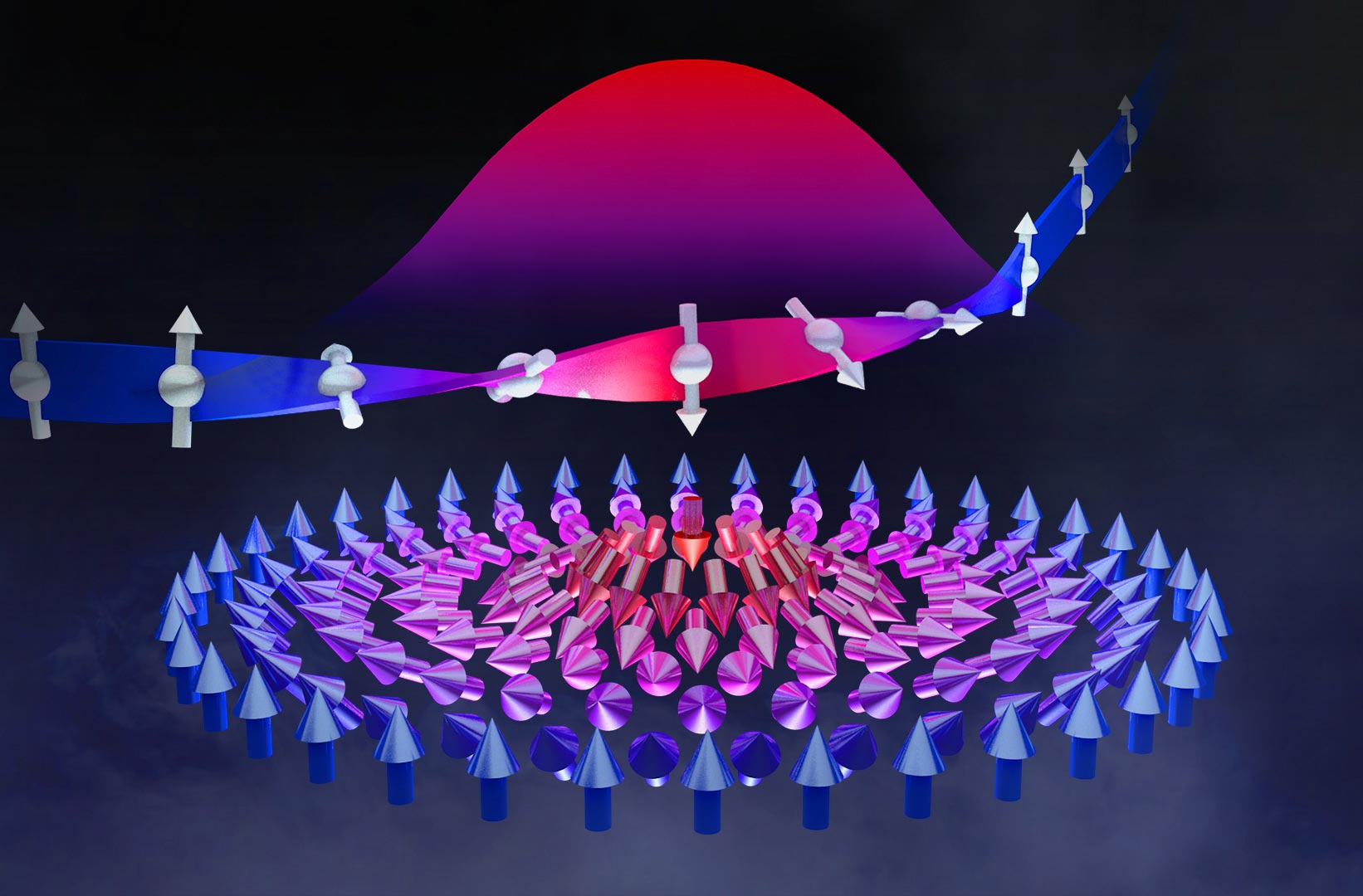
    Nanoscale Magnetic Structure of Twisting, Swirling Spin Orientations
    The layering of crystals into a superlattice yields a nanoscale magnetic structure of twisting, swirling spin orientations, shown from red to blue, that deflect electrons, shown as white dots. Credit: Adam Malin/ORNL, U.S. Dept. of Energy

    Scientists discovered a strategy for layering dissimilar crystals with atomic precision to control the size of resulting magnetic quasi-particles called skyrmions. This approach could advance high-density data storage and quantum magnets for quantum information science.

    In typical ferromagnets, magnetic spins align up or down. Yet in skyrmions, they twist and swirl, forming unique shapes like petite porcupines or tiny tornadoes.

    The tiny intertwined magnetic structures could innovate high-density data storage, for which size does matter and must be small. The Oak Ridge National Laboratory-led project produced skyrmions as small as 10 nanometers – 10,000 times thinner than a human hair.

    “The way we design and synthesize the superlattice creates the atomic-scale magnetic interactions responsible for twisting the spins,” said physicist Elizabeth Skoropata, who co-led the study with John Nichols, both formerly of ORNL.

    ORNL’s Ho Nyung Lee added, “Our finding demonstrates how to precisely engineer interfaces in oxide quantum heterostructures to create nanometer-sized skyrmions.”

    Reference: “Interfacial tuning of chiral magnetic interactions for large topological Hall effects in LaMnO3/SrIrO3 heterostructures” by Elizabeth Skoropata, John Nichols, Jong Mok Ok, Rajesh V. Chopdekar, Eun Sang Choi, Ankur Rastogi, Changhee Sohn, Xiang Gao, Sangmoon Yoon, Thomas Farmer, Ryan D. Desautels, Yongseong Choi, Daniel Haskel, John W. Freeland, Satoshi Okamoto, Matthew Brahlek and Ho Nyung Lee, 3 July 2020, Science Advances.
    DOI: 10.1126/sciadv.aaz3902

    Never miss a breakthrough: Join the SciTechDaily newsletter.
    Follow us on Google and Google News.

    Nanotechnology Oak Ridge National Laboratory Quantum Information Science Skyrmions
    Share. Facebook Twitter Pinterest LinkedIn Email Reddit

    Related Articles

    Boosting Efficiency of Next-Gen Solar Cells by Blocking Vibrations That Remove Heat

    Scientists Create Quietest Semiconductor Quantum Bits Ever – 10 Times Lower Noise Than Previous Record

    Innovative New Device Lights Up the Way for Quantum Technologies

    Skyrmions: Nanoscale Magnetic ‘Whirls’ for Low-Energy Computer Circuits

    Tapping Graphene’s Hidden Potential for the Advancement of Quantum Information Science

    Insect-Inspired Motion Sensing – Researchers Create Miniaturized Mechanical Gyroscope

    Bio-Circuitry Mimics Synapses and Neurons – Accelerates Routes to Brain-Like Computing

    Researchers Develop Transistors without Semiconductors

    Physicists Work on Nano Loudspeakers to Make Better MRIs, Quantum Computers

    Leave A Reply Cancel Reply

    • Facebook
    • Twitter
    • Pinterest
    • YouTube

    Don't Miss a Discovery

    Subscribe for the Latest in Science & Tech!

    Trending News

    Scientists Discover Cheap, Natural Remedy for High Blood Pressure

    Earth’s Upper Atmosphere Is Cooling Fast and Scientists Finally Know Why

    32,000 Olympic Pools of Magma Nearly Erupted Beneath Atlantic Island

    Exercise Changes the Heart in a Way Researchers Never Expected

    Too Much Sleep May Age Your Body Faster, New Study Warns

    Scientists Uncover Promising New Strategy To Stop Parkinson’s in Its Tracks

    Experts Reveal the Surprising Cancer Link Behind a Common Vitamin

    This Strange “Golden Orb” Found 2 Miles Deep Stumped Scientists for Years

    Follow SciTechDaily
    • Facebook
    • Twitter
    • YouTube
    • Pinterest
    • Newsletter
    • RSS
    SciTech News
    • Biology News
    • Chemistry News
    • Earth News
    • Health News
    • Physics News
    • Science News
    • Space News
    • Technology News
    Recent Posts
    • Breakthrough Parkinson’s Drug Targets Disease at Its Genetic Roots
    • 10-Cent Pill Could Transform Heart Failure Treatment Worldwide
    • Just 4 Weeks of Simple Diet Changes Reversed Signs of Aging in Older Adults
    • Scientists May Have Finally Solved Why Humans Are Right-Handed
    • Physicists Found String Theory Without Even Looking for It
    Copyright © 1998 - 2026 SciTechDaily. All Rights Reserved.
    • Science News
    • About
    • Contact
    • Editorial Board
    • Privacy Policy
    • Terms of Use

    Type above and press Enter to search. Press Esc to cancel.