
Small Magnetic Whirlpools Could Revolutionize High-Performance Computer Memory Storage
Magnets create invisible fields that attract certain materials. A familiar example is refrigerator magnets. However, they also play a vital role in storing data in computers. By exploiting the direction of the magnetic field (for example, up or down), microscopic bar magnets can each store one bit of memory as a zero or one, which is the basis of computer language.
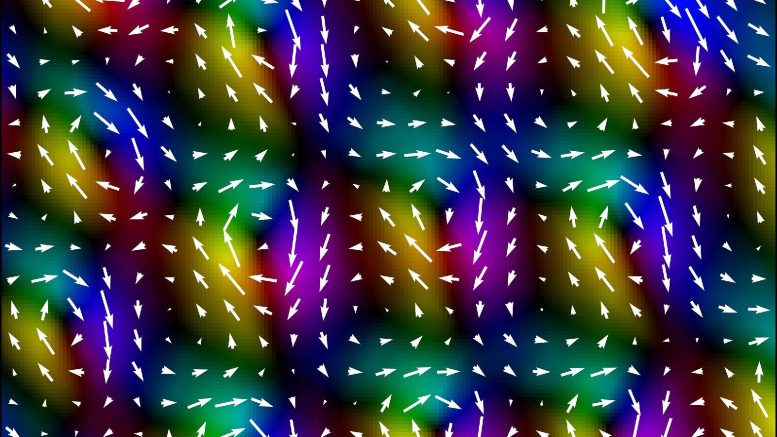
Scientists at the U.S. Department of Energy’s Argonne National Laboratory are working on replacing these bar magnets with tiny magnetic vortices, known as skyrmions. These vortices, which are as small as billionths of a meter, form in certain magnetic materials and have the potential to bring about a new generation of microelectronics for memory storage in high-performance computers.
Advantages of Skyrmions Over Traditional Bar Magnets
“The bar magnets in computer memory are like shoelaces tied with a single knot; it takes almost no energy to undo them,” said Arthur McCray, a Northwestern University graduate student working in Argonne’s Materials Science Division (MSD). And any bar magnets malfunctioning due to some disruption will affect the others.
“By contrast, skyrmions are like shoelaces tied with a double knot. No matter how hard you pull on a strand, the shoelaces remain tied.” The skyrmions are thus extremely stable to any disruption. Another important feature is that scientists can control their behavior by changing the temperature or applying an electric current.
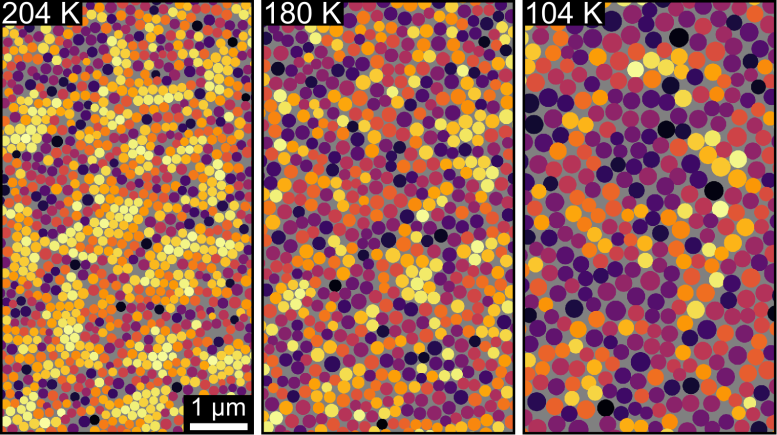
Scientists have much to learn about skyrmion behavior under different conditions. To study them, the Argonne-led team developed an artificial intelligence (AI) program that works with a high-power electron microscope at the Center for Nanoscale Materials (CNM), a DOE Office of Science user facility at Argonne. The microscope can visualize skyrmions in samples at very low temperatures.
The team’s magnetic material is a mixture of iron, germanium, and tellurium. In structure, this material is like a stack of paper with many sheets. A stack of such sheets contains many skyrmions, and a single sheet can be peeled from the top and analyzed at facilities like CNM.
“The CNM electron microscope coupled with a form of AI called machine learning enabled us to visualize skyrmion sheets and their behavior at different temperatures,” said Yue Li, a postdoctoral appointee in MSD.
Temperature-Dependent Behavior of Skyrmions
“Our most intriguing finding was that the skyrmions are arranged in a highly ordered pattern at minus 60 degrees Fahrenheit (minus 51 degrees Celsius) and above,” said Charudatta Phatak, a materials scientist and group leader in MSD. “But as we cool the sample the skyrmion arrangement changes.” Like bubbles in beer foam, some skyrmions became larger, some smaller, some merge, and some vanish.
At minus 270 (minus 168 Celsius), the layer reached a state of nearly complete disorder, but the order came back when the temperature returned to minus 60. This order-disorder transition with temperature change could be exploited in future microelectronics for memory storage.
Energy-Efficient Memory Storage
“We estimate the skyrmion energy efficiency could be 100 to 1000 times better than current memory in the high-performance computers used in research,” McCray said.
Energy efficiency is essential to the next generation of microelectronics. Today’s microelectronics already account for a notable fraction of the world’s energy use and could consume nearly 25% within the decade. More energy-efficient electronics must be found.
“We have a way to go before skyrmions find their way into any future computer memory with low power,” Phatak said. “Nonetheless, this kind of radical new way of thinking about microelectronics is key to next-generation devices.”
Reference: “Thermal Hysteresis and Ordering Behavior of Magnetic Skyrmion Lattices” by Arthur R. C. McCray, Yue Li, Rabindra Basnet, Krishna Pandey, Jin Hu, Daniel P. Phelan, Xuedan Ma, Amanda K. Petford-Long and Charudatta Phatak, 21 September 2022, Nano Letters.
DOI: 10.1021/acs.nanolett.2c02275
The study was funded by the DOE Office of Basic Energy Sciences. The team’s machine learning program was run on supercomputing resources at the Argonne Leadership Computing Facility, a DOE Office of Science user facility.
Never miss a breakthrough: Join the SciTechDaily newsletter.
Follow us on Google and Google News.
1 Comment
[[[ ROTTING CORPSE IS HERE ]]]
Yeah, they are going to crack your passwords and break into your accounts with this quantum magnet.
[[[ ROTTING CORPSE IS HERE ]]]