
Close Menu
    Facebook X (Twitter) Instagram
    SciTechDaily
    • Biology
    • Chemistry
    • Earth
    • Health
    • Physics
    • Science
    • Space
    • Technology
    Facebook X (Twitter) Pinterest YouTube RSS
    SciTechDaily
    Home»Biology»Remarkable Fossil of Extinct Giant Penguin Species Discovered in New Zealand
    Biology

    Remarkable Fossil of Extinct Giant Penguin Species Discovered in New Zealand

    By Federation of American Societies for Experimental BiologyNovember 10, 2019No Comments3 Mins Read
    Facebook Twitter Pinterest Telegram LinkedIn WhatsApp Email Reddit
    Share
    Facebook Twitter LinkedIn Pinterest Telegram Email Reddit
    Kawhia Penguin
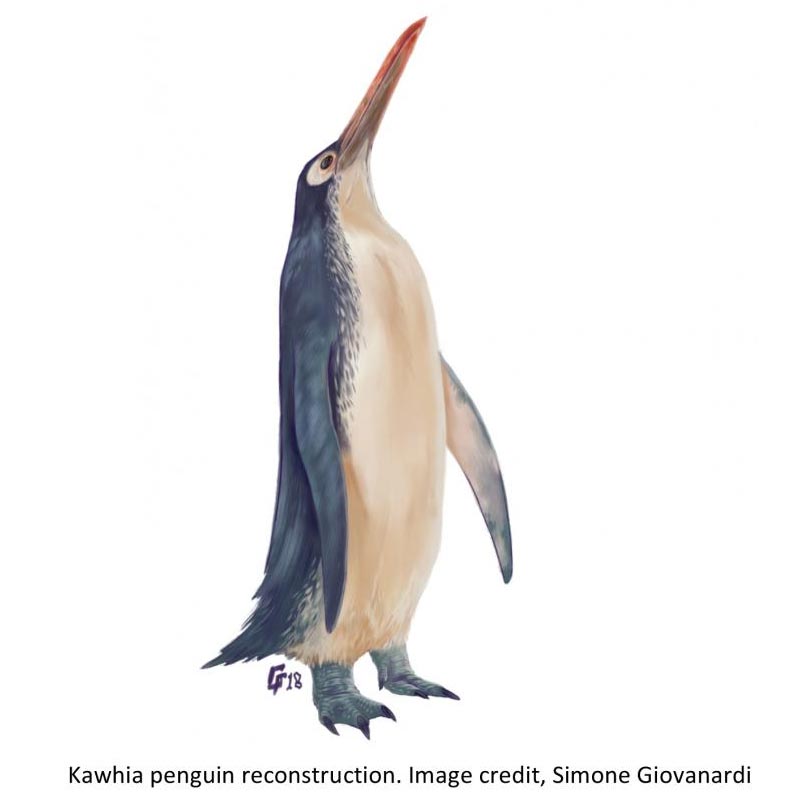
    New Zealand is a key area for understanding the diversity of the extinct penguins and has even revealed the existence of ‘giant’ penguin species (larger than living penguins). A new study describing a remarkably complete giant penguin skeleton from the Oligocene, Kawhia Harbour in the North Island of New Zealand was presented by Simone Giovanardi, Massey University Albany, Auckland, New Zealand, at this year’s annual meeting of the Society of Vertebrate Paleontology. Credit: Simone Giovanardi

    A new sphenisciform fossil from the north island of New Zealand further resolves the bauplan of extinct giant penguins.

    Penguins are descendants of seabirds that lost the ability to fly more than 60 million years ago in exchange for chasing the abundant food available in the ocean. New Zealand is a key area for understanding the diversity of the extinct penguins and has even revealed the existence of ‘giant’ penguin species (larger than living penguins). A new study describing a remarkably complete giant penguin skeleton from the Oligocene, Kawhia Harbour in the North Island of New Zealand was presented by Simone Giovanardi, Massey University Albany, Auckland, New Zealand, at this year’s annual meeting of the Society of Vertebrate Paleontology held this year in Brisbane, Australia.

    These giant penguins differed from their living descendants in the length of their front limbs and elongated beaks, perhaps suggesting differences in ecological roles when compared with living penguins. The preserved hindlimbs of the new North Island fossil are also significantly longer than all previously described specimens.

    Giovanardi adds, “The Kawhia giant penguin is mostly complete and largely articulated in life position, which helps a great deal with reconstructing the relatively long and slender body.” This specimen suggests a mixture of characteristics of an older body plan found in other Eocene-Oligocene giant penguins and the one found in the more derived giant penguin, Kairuku.

    To date, most of the giant penguins found in New Zealand have been discovered in the South Island. This fossil was found in an Oligocene silty mudstone from the North Island of New Zealand and currently represents the most complete pre-Pleistocene vertebrate reported from this region. Giovanardi concludes by stating, “The North Island of New Zealand has its own paleontological tale to tell.”

    About the Society of Vertebrate Paleontology

    Founded in 1940 by thirty-four paleontologists, the Society now has more than 2,300 members representing professionals, students, artists, preparators, and others interested in VP. It is organized exclusively for educational and scientific purposes, with the object of advancing the science of vertebrate paleontology.

    Never miss a breakthrough: Join the SciTechDaily newsletter.
    Follow us on Google and Google News.

    Extinction Fossils New Zealand Penguin
    Share. Facebook Twitter Pinterest LinkedIn Email Reddit

    Related Articles

    Clams Overrun Adriatic Waters As Predators Mysteriously Vanish

    Nature’s Warning: Early Signs in Marine Life Predicting the Next Mass Extinction

    Just 2 Inches: Tiny Fossil Rewrites Our Understanding of Saber-Toothed Cats

    Ancient Porcupine Discovery Solves Evolutionary Mystery 10 Million Years in the Making

    Fossil Records Unlock Secrets of Climate Change Extinction Risks

    Unlocking Prehistoric Secrets: Microfossils Shed New Light on Euglenoids’ Mysterious Past

    Uncovering the Secrets of Mass Extinction – What Happens to Ecology, Evolution, and Biodiversity?

    550 Million Years Ago – Researchers Shine New Light on Earth’s First Known Mass Extinction Event

    First Animals Formed Complex Ecological Communities Before the Cambrian Explosion

    Leave A Reply Cancel Reply

    • Facebook
    • Twitter
    • Pinterest
    • YouTube

    Don't Miss a Discovery

    Subscribe for the Latest in Science & Tech!

    Trending News

    “I Couldn’t Do It Anymore” – Antarctic Guides Quit Their Dream Jobs After Witnessing Tourism’s Damage

    Scientists Say Eating Less Protein May Help You Live Longer

    Scientists Solve a Long-Standing Mystery About Bird and Dinosaur Eggs

    Belly Fat and Low Vitamin D May More Than Double the Risk of Early Death

    Lost in Space: Rare Cosmic Flare Exposes a Wandering Black Hole Far From Its Galaxy’s Center

    Dark Matter May Be Leaving a Signal in Earth’s Atmosphere

    Scientists Discover a 300-Million-Year-Old Geological Time Capsule Inside Fossilized Wood

    Oral Weight Loss Pill Helps Patients Lose up to 12% of Body Weight

    Follow SciTechDaily
    • Facebook
    • Twitter
    • YouTube
    • Pinterest
    • Newsletter
    • RSS
    SciTech News
    • Biology News
    • Chemistry News
    • Earth News
    • Health News
    • Physics News
    • Science News
    • Space News
    • Technology News
    Recent Posts
    • Industrial Chicken Farming Is Supercharging the Spread of a Dangerous Foodborne Bacterium
    • Honeybee Queens May Pass Toxic Chemicals to the Next Generation
    • This Common Amino Acid May Help the Body Fight Cancer and Viruses
    • Schizophrenia’s Brain Damage May Start in One Key Region
    • A Simple Treatment Could Save Extremely Premature Babies From Blindness
    Copyright © 1998 - 2026 SciTechDaily. All Rights Reserved.
    • Science News
    • About
    • Contact
    • Editorial Board
    • Privacy Policy
    • Terms of Use

    Type above and press Enter to search. Press Esc to cancel.