
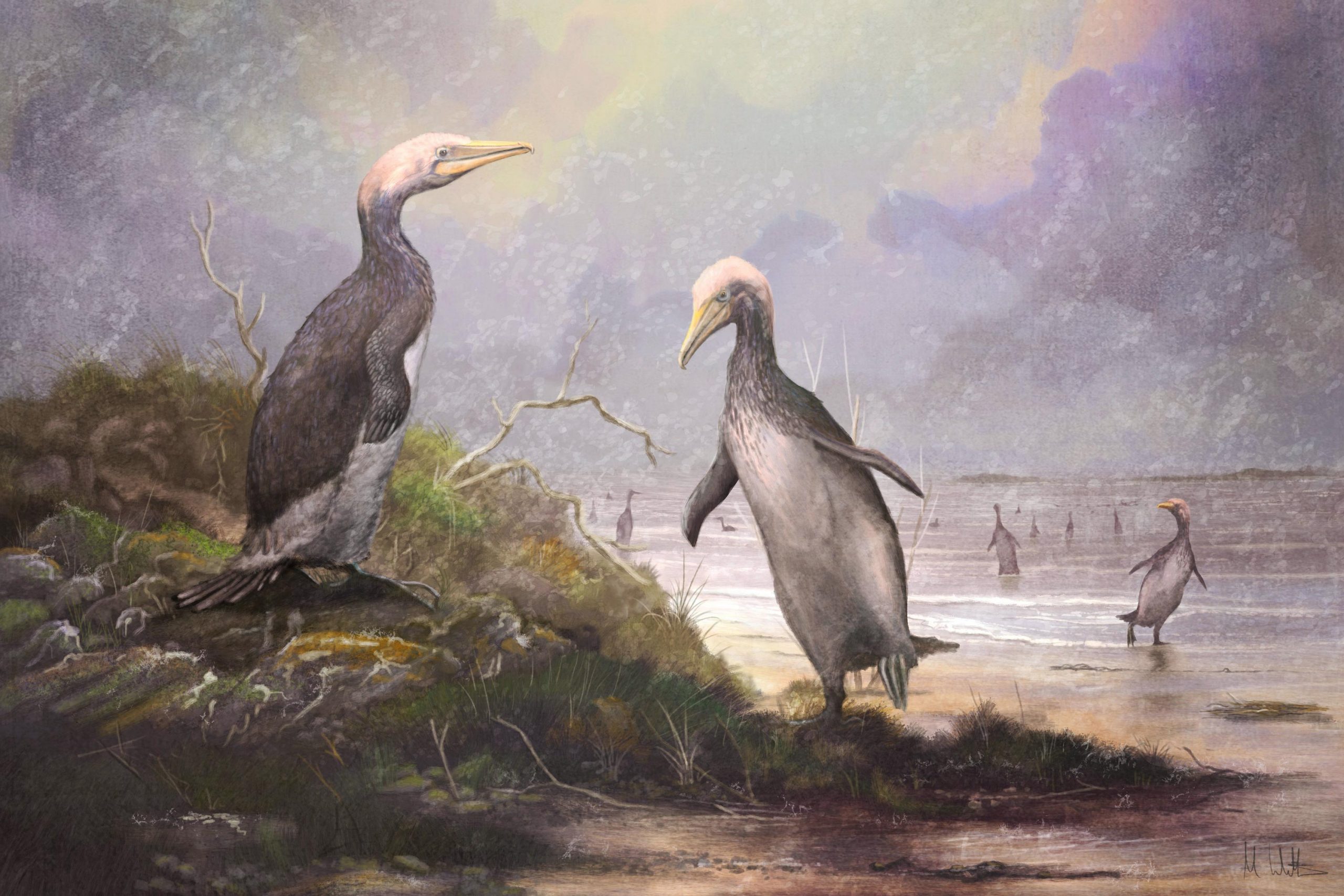
New Zealand’s monster penguins that lived 62 million years ago had doppelgangers in Japan, the USA and Canada, a study published today in the Journal of Zoological Systematics and Evolutionary Research has found.
Scientists have identified striking similarities between the penguins’ fossilized bones and those of a group of much younger Northern Hemisphere birds, the plotopterids.
These similarities suggest plotopterids and ancient penguins looked very similar and might help scientists understand how birds started using their wings to swim instead of fly.
Around 62 million years ago, the earliest known penguins swam in tropical seas that almost submerged the land that is now New Zealand. Paleontologists have found the fossilized bones of these ancient waddlers at Waipara, North Canterbury. They have identified nine different species, ranging in size from small penguins, the size of today’s Yellow-Eyed Penguin, to 1.6-meter-high (5.2-foot-high) monsters.
Plotopterids developed in the Northern Hemisphere much later than penguins, with the first species appearing between 37 and 34 million years ago. Their fossils have been found at a number of sites in North America and Japan. Like penguins, they used their flipper-like wings to swim through the sea. Unlike penguins, which have survived into the modern era, the last plotopterid species became extinct around 25 million years ago.
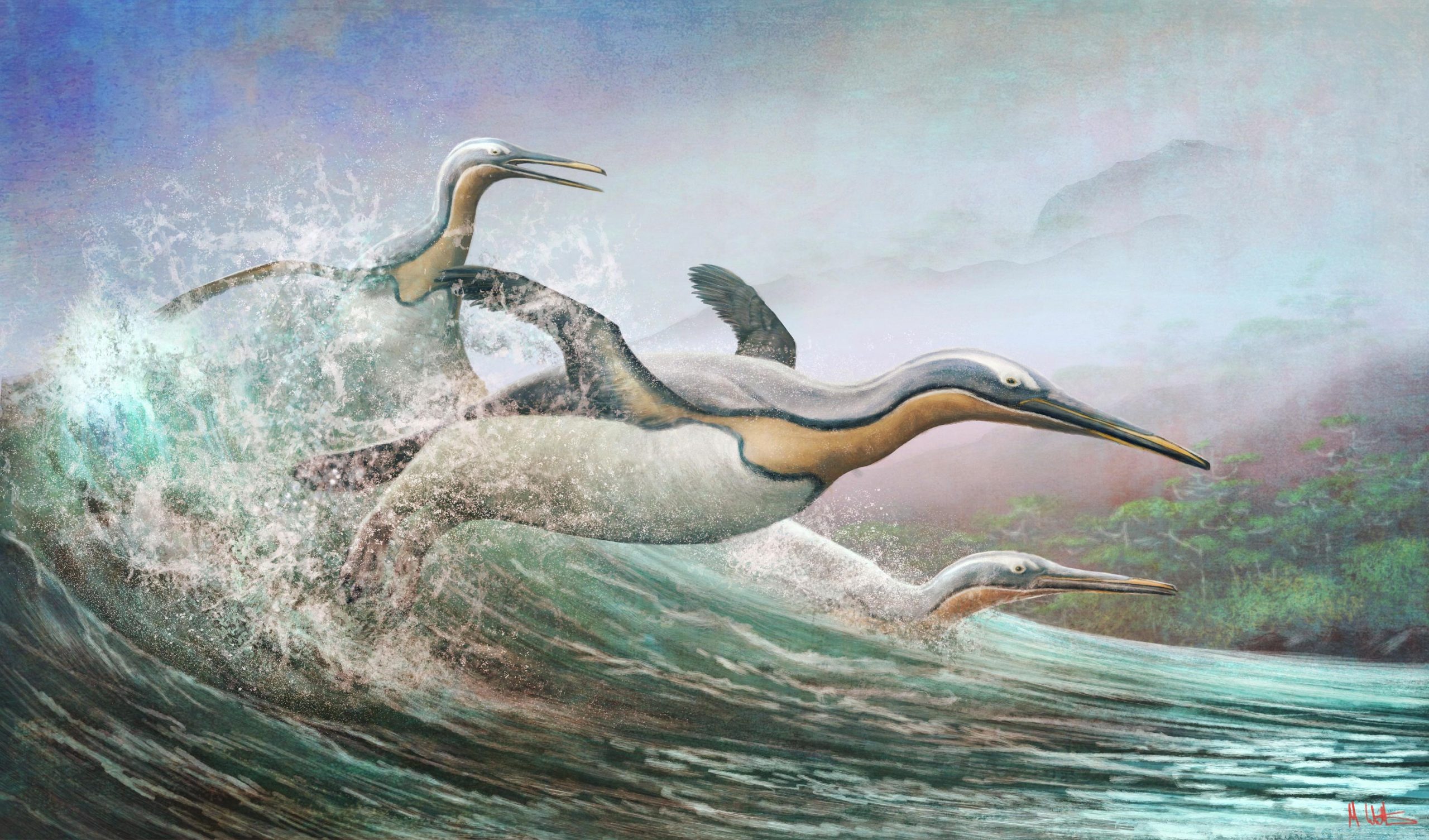
The scientists – Dr. Gerald Mayr of the Senckenberg Research Institute and Natural History Museum, Frankfurt; James Goedert of the Burke Museum of Natural History and Culture and University of Washington, USA; and Canterbury Museum Curators Dr. Paul Scofield and Dr. Vanesa De Pietri – compared the fossilized bones of plotopterids with fossil specimens of the giant penguin species Waimanu, Muriwaimanu and Sequiwaimanu from Canterbury Museum’s collection.
They found plotopterids and the ancient penguins had similar long beaks with slit-like nostrils, similar chest and shoulder bones, and similar wings. These similarities suggest both groups of birds were strong swimmers that used their wings to propel them deep underwater in search of food.
Some species of both groups could grow to huge sizes. The largest known plotopterids were over 2 meters (6.6 feet) long, while some of the giant penguins were up to 1.6 meters (5.2 feet) tall.
Despite sharing a number of physical features with penguins both ancient and modern, plotopterids are more closely related to boobies, gannets, and cormorants than they are to penguins.
“What’s remarkable about all this is that plotopterids and ancient penguins evolved these shared features independently,” says Dr. De Pietri. “This is an example of what we call convergent evolution, when distantly related organisms develop similar morphological traits under similar environmental conditions.”
Dr. Scofield says some large plotopterid species would have looked very similar to the ancient penguins. “These birds evolved in different hemispheres, millions of years apart, but from a distance you would be hard-pressed to tell them apart,” he says. “Plotopterids looked like penguins, they swam like penguins, they probably ate like penguins – but they weren’t penguins.”
Dr. Mayr says the parallels in the evolution of the bird groups hint at an explanation for why birds developed the ability to swim with their wings.
“Wing-propelled diving is quite rare among birds; most swimming birds use their feet. We think both penguins and plotodopterids had flying ancestors that would plunge from the air into the water in search of food. Over time these ancestor species got better at swimming and worse at flying.”
Fossils from New Zealand’s giant penguins, including Waimanu and Sequiwaimanu are currently on display alongside life-sized models of the birds in Canterbury Museum’s exhibition Ancient New Zealand: Squawkzilla and the Giants, extended until 16 August.
Reference: “Comparative osteology of the penguin-like mid Cenozoic Plotopteridae and the earliest true fossil penguins, with comment on the origins of wing-propelled diving” by Gerald Mayr, James L Goedert, Vanesa De Pietri and R Paul Scofield, 29 June 2020, Journal of Zoological Systematics and Evolutionary Research.
DOI: 10.1111/jzs.12400
This research was partly supported by the Royal Society of New Zealand’s Marsden Fund.
Never miss a breakthrough: Join the SciTechDaily newsletter.
Follow us on Google and Google News.