
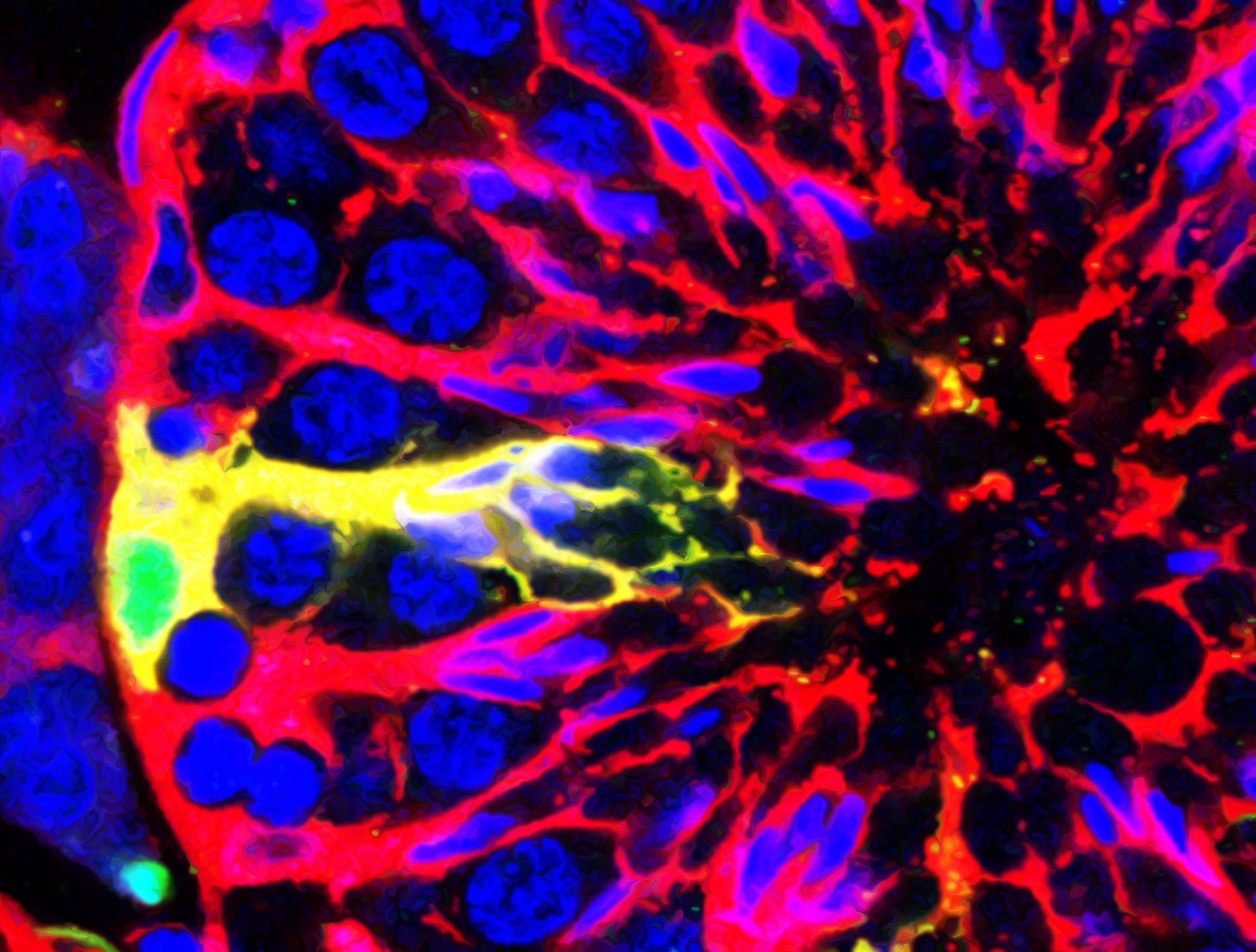
Reproductive Sciences experts at Cincinnati Children’s discover that the gene Cdc42 is required to support proper alignment and function of Sertoli cells.
Scientists at Cincinnati Children’s appear to have flipped another piece in the underexplored puzzle of male infertility.
In findings published on October 26, 2021, in Cell Reports, a team led by co-first authors Anna Heinrich, BS, Bidur Bhandary, PhD, and senior author Tony De Falco, PhD, sheds new light on how sperm production can go wrong when a certain gene fails to function at the right time.
“Gaining more understanding about how Cdc42 acts within the male reproductive system provides key information for using this gene as a potential biomarker for infertility or reduced testicular function,” De Falco says.
What’s a Sertoli Cell?
The study focuses on the function of Sertoli cells, which line up along the inside walls of long narrow tubes in the testes called seminiferous tubules, in which sperm production takes place. Sertoli cells, sometimes called “nurse cells,” act as docking stations that provide nutrients to developing sperm cells.
In experiments with mouse models, the team found that when the gene Cdc42 is missing or not functioning, it disrupts the polarity of Sertoli cells, meaning that some might be attached or oriented improperly inside the seminiferous tubules. The misaligned cells become less capable of supporting sperm cells, and some of the misaligned Sertoli cells die off themselves, all of which reduces the ability of the testes to produce an ongoing supply of sperm.
The scientists also learned that this disruption of sperm production occurs in mature adult testes, but not in juvenile testes.
Why Is This Discovery About Sertoli Cells Important?
Nearly 1 in 7 couples in the US is infertile. In many situations, male infertility plays a role. How many cases of infertility can be traced to malfunctioning Sertoli cells is not well-understood, but in theory, treatments that could improve Sertoli cell function would improve male sperm production.
Directly attempting to alter the Cdc42 gene is not likely to be an option, at least not for the short term. That’s because the Cdc42 gene plays many roles throughout the body.
“It would be difficult to target this gene specifically in the testis without affecting other organs, cell types, or cellular processes,” De Falco says.
Also, even if a treatment can be limited to Sertoli cells, any genetic variations that result would have a significant risk of being carried forward to future generations, including potentially unknown side effects.
“For these reasons, there must be a high bar set for regulating, testing, and validating the use of gene editing technologies in human patients,” De Falco says.
More likely: these learnings may support developing improved diagnostic tests to better identify specific causes of male infertility. Currently, diagnosis of Sertoli cell malfunction generally requires a biopsy. Potentially, if a non-invasive test could show that a child has a high risk of developing misaligned Sertoli cells in adulthood, the person could benefit from testicular or sperm biobanking.
Peripheral Nerve Research Provides Inspiration
While previous research in reproductive sciences had raised suspicions about the role of Cdc42 in fertility, the team credits a collaboration with the lab of Nancy Ratner, PhD, an expert in nerve tumors at Cincinnati Children’s, for a key step in advancing the work.
“Their lab had found that Cdc42 was required for peripheral neuron function, likely through regulating cell polarity,” De Falco says. “We proposed that Cdc42 mutation might also disrupt Sertoli cell function, since it is a highly polarized cell type similar to neurons. We were able to use the same mouse model they used, as it also happened to delete Cdc42 in Sertoli cells.”
Next Steps
De Falco’s team plans to conduct further research exploring cell polarity malfunctions in other types of cells involved in male fertility.
“For example, germ cells are also very polarized cells when they differentiate into sperm, with a head-and-tail morphology. It would be interesting to see if Cdc42 also regulates cell polarity for sperm cells as it does for Sertoli cells. We also would like to address whether cell polarity is critical for function in other testicular cell types, such as immune cells, vascular cells, and steroid-producing Leydig cells.”
Reference: “Cdc42 activity in Sertoli cells is essential for maintenance of spermatogenesis” by Anna Heinrich, Bidur Bhandary, Sarah J. Potter, Nancy Ratner and Tony DeFalco, 26 October 2021, Cell Reports.
DOI: 10.1016/j.celrep.2021.109885
Funding sources for this study include grants from the National Institutes of Health (R35GM119458 and R01HD094698) and internal funding from Cincinnati Children’s.
Never miss a breakthrough: Join the SciTechDaily newsletter.
Follow us on Google and Google News.