
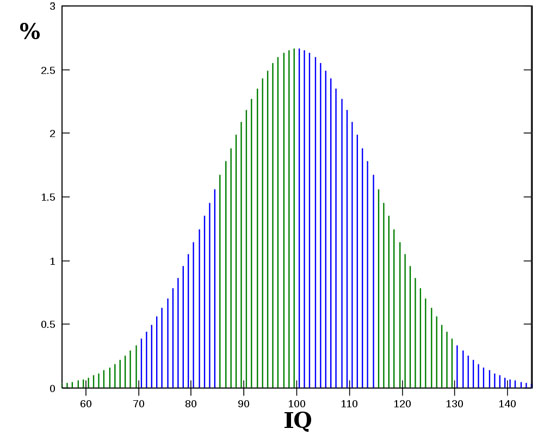
Researchers have found that group settings can alter the expression of IQ in certain people. The researchers gathered test subjects with similar baseline IQ scores and then placed them in small group settings to see how their cognitive capacity would be affected by perceptions of their status in that group. Using functional magnetic resonance imaging (fMRI), they were able to document the neural responses and found that women were more likely to experience negative changes.
Roanoke, VA – In the classic film 12 Angry Men, Henry Fonda’s character sways a jury with his quiet, persistent intelligence. But would he have succeeded if he had allowed himself to fall sway to the social dynamics of that jury?
Research led by scientists at the Virginia Tech Carilion Research Institute found that small-group dynamics — such as jury deliberations, collective bargaining sessions, and cocktail parties — can alter the expression of IQ in some susceptible people. “You may joke about how committee meetings make you feel brain dead, but our findings suggest that they may make you act brain dead as well,” said Read Montague, director of the Human Neuroimaging Laboratory and the Computational Psychiatry Unit at the Virginia Tech Carilion Research Institute, who led the study.
The scientists used functional magnetic resonance imaging (fMRI) to investigate how the brain processes information about social status in small groups and how perceptions of that status affect expressions of cognitive capacity.
“We started with individuals who were matched for their IQ,” said Montague. “Yet when we placed them in small groups, ranked their performance on cognitive tasks against their peers, and broadcast those rankings to them, we saw dramatic drops in the ability of some study subjects to solve problems. The social feedback had a significant effect.”
“Our study highlights the unexpected and dramatic consequences even subtle social signals in group settings may have on individual cognitive functioning,” said lead author Kenneth Kishida, a research scientist with the Virginia Tech Carilion Research Institute. “And, through neuroimaging, we were able to document the very strong neural responses that those social cues can elicit.”
The researchers recruited subjects from two universities and administered a standard test to establish baseline IQ. The results were not viewed until after a series of ranked group IQ tasks, during which test takers, in groups of five, received information about how their performances compared to those of the other group members.
Although the test subjects had similar baseline IQ scores — a mean of 126, compared to the national average of 100 — they showed a range of test performance results after the ranked group IQ tasks, revealing that some individuals’ expressed IQ was affected by signals about their status within a small group.
The researchers wanted to know what was happening in the brain during the observed changes in IQ expression. The subjects were divided into two groups based on the results of their final rank — the high performers, who scored above the median, and the low performers, who scored at or below the median. Two of every group of five subjects had their brains scanned using fMRI while they participated in the task.
Among the researchers’ findings:
- Dynamic responses occurred in multiple brain regions, especially the amygdala, the prefrontal cortex, and the nucleus accumbens — regions believed to be involved in emotional processing, problem solving, and reward and pleasure, respectively.
- All subjects had an initial increase in amygdala activation and diminished activity in the prefrontal cortex, both of which corresponded with a lower problem-solving ability.
- By the end of the task, the high-performing group showed a decreased amygdala activation and an increased prefrontal cortex activation, both of which were associated with an increased ability to solve more difficult problems.
- Positive changes in rank were associated with greater activity in the bilateral nucleus accumbens, which has traditionally been linked to learning and has been shown to respond to rewards and pleasure.
- Negative changes in rank corresponded with greater activity in the dorsal anterior cingulate cortex, consistent with a response to conflicting information.
- Neither age nor ethnicity showed a significant correlation with performance or brain responses. A significant pattern did emerge along gender lines, however. Although male and female participants had the same baseline IQ, significantly fewer women (3 of 13) were in the high-performing group and significantly more (10 of 13) fell into the low-performing group.
“We don’t know how much these effects are present in real-world settings,” Kishida said. “But given the potentially harmful effects of social-status assignments and the correlation with specific neural signals, future research should be devoted to what, exactly, society is selecting for in competitive learning and workplace environments. By placing an emphasis on competition, for example, are we missing a large segment of the talent pool? Further brain imaging research may also offer avenues for developing strategies for people who are susceptible to these kinds of social pressures.”
“This study tells us the idea that IQ is something we can reliably measure in isolation without considering how it interacts with social context is essentially flawed,” said coauthor Steven Quartz, a professor of philosophy in the Social Cognitive Neuroscience Laboratory of Caltech. “Furthermore, this suggests that the idea of a division between social and cognitive processing in the brain is really pretty artificial. The two deeply interact with each other.”
“So much of our society is organized around small-group interactions,” said Kishida. “Understanding how our brains respond to dynamic social interactions is an important area of future research. We need to remember that social dynamics affect not just educational and workplace environments, but also national and international policy-making bodies, such as the U.S. Congress and the United Nations.”
The research appears in the Jan. 23, 2012 issue of the journal Philosophical Transactions of the Royal Society B in the article, “Implicit signals in small group settings and their impact on the expression of cognitive capacity and associated brain responses,” by Kenneth Kishida; Dongni Yang, a former postdoctoral researcher in the Department of Neuroscience at Baylor College of Medicine; Karen Hunter Quartz, a director of research in the Graduate School of Education and Information Studies of the University of California, Los Angeles; Steven Quartz; and Read Montague, corresponding author, who is also a professor of physics at Virginia Tech. The research was supported by grants from the Wellcome Trust and the Kane Family Foundation to Montague and the National Institutes of Health to Montague and Kishida.
Never miss a breakthrough: Join the SciTechDaily newsletter.
Follow us on Google and Google News.
1 Comment
MAGA!