
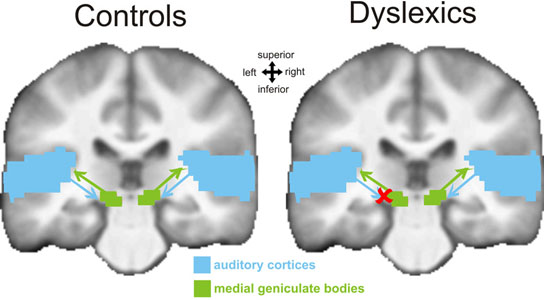
A team of scientists has taken a step forward in understanding the cause of dyslexia and for developing potential treatments by discovering a malfunction in a structure that transfers auditory information from the ear to the cortex in dyslexic adults.
To participate successfully in life, it is important to be able to read and write. Nevertheless, many children and adults have difficulties in acquiring these skills and the reason is not always obvious. They suffer from dyslexia which can have a variety of symptoms. Thanks to research carried out by Begoña Díaz and her colleagues at the Max Planck Institute for Human Cognitive and Brain Sciences in Leipzig, a major step forward has been made in understanding the cause of dyslexia. The scientists have discovered an important neural mechanism underlying dyslexia and shown that many difficulties associated with dyslexia can potentially be traced back to a malfunction of the medial geniculate body in the thalamus. The results provide an important basis for developing potential treatments.
People who suffer from dyslexia have difficulties with identifying speech sounds in spoken language. For example, while most children are able to recognize whether two words rhyme even before they go to school, dyslexic children often cannot do this until late primary school age. Those affected suffer from dyslexia their whole lives. However, there are also always cases where people can compensate for their dyslexia. “This suggests that dyslexia can be treated. We are therefore trying to find the neural causes of this learning disability in order to create a basis for improved treatment options,” says Díaz.
Between five and ten percent of the world’s children suffer from dyslexia, yet very little is known about its causes. Even though those affected do not lack intelligence or schooling, they have difficulties in reading, understanding, and explaining individual words or entire texts. The researchers showed that dyslexic adults have a malfunction in a structure that transfers auditory information from the ear to the cortex is a major cause of the impairment: the medial geniculate body in the auditory thalamus does not process speech sounds correctly. “This malfunction at a low level of language processing could percolate through the entire system. This explains why the symptoms of dyslexia are so varied,” says Díaz.
Under the direction of Katharina von Kriegstein, the researchers conducted two experiments in which several volunteers had to perform various speech comprehension tasks. When affected individuals performed tasks that required the recognition of speech sounds, as compared to recognizing the voices that pronounced the same speech, magnetic resonance tomography (MRT) recordings showed abnormal responses in the area around the medial geniculate body. In contrast, no differences were apparent between controls and dyslexic participants if the tasks involved only listening to the speech sounds without having to perform a specific task. “The problem, therefore, has nothing to do with sensory processing itself, but with the processing involved in speech recognition,” says Díaz. No differences could be ascertained between the two test groups in other areas of the auditory signaling path.
The findings of the Leipzig scientists combine various theoretical approaches, which deal with the cause of dyslexia and, for the first time, bring together several of these theories to form an overall picture. “Recognizing the cause of a problem is always the first step on the way to a successful treatment,” says Díaz. The researchers’ next project is now to study whether current treatment programs can influence the medial geniculate body in order to make learning to read easier for everyone in the long term.
Reference: “Dysfunction of the auditory thalamus in developmental dyslexia” by Begoña Díaz, Florian Hintz, Stefan J. Kiebel and Katharina von Kriegstein, 6 August 2012, Proceedings of the National Academy of Sciences.
DOI: 10.1073/pnas.1119828109
Never miss a breakthrough: Join the SciTechDaily newsletter.
Follow us on Google and Google News.
1 Comment
I’m quite shocked by this as my “dyslexia” is entirely visual. In fact the way I compensate for it is to speak the numbers out loud, once I’ve heard the rhythm and “shapes” of the sounds I have perfect recall and tested as a child to have auditory recall twice that of the average person (undoubtedly a result of years of compensation). I also have what one might call a perfect ear (ability to identify) for voices but nothing remotely like it for faces or visual memory. Without my ear for sound patterns I would be quite disabled.