
A NSF funded research team has reached a subglacial lake and retrieved water and sediment samples that may contain microscopic life that has been isolated from direct contact with the atmosphere for thousands of years.
In a first-of-its-kind feat of science and engineering, a National Science Foundation (NSF)-funded research team has successfully drilled through 800 meters (2,600 feet) of Antarctic ice to reach a subglacial lake and retrieve water and sediment samples that have been isolated from direct contact with the atmosphere for many thousands of years.
Scientists and drillers with the interdisciplinary Whillans Ice Stream Subglacial Access Research Drilling project (WISSARD) announced on January 28 local time (U.S. stations in Antarctica keep New Zealand time) that they had used a customized clean hot-water drill to directly obtain samples from the waters and sediments of subglacial Lake Whillans.
The samples may contain microscopic life that has evolved uniquely to survive in conditions of extreme cold and lack of light and nutrients. Studying the samples may help scientists understand not only how life can survive in other extreme ecosystems on Earth, but also on other icy worlds in our solar system.
The WISSARD teams’ accomplishment, the researchers said, “hails a new era in polar science, opening a window for future interdisciplinary science in one of Earth’s last unexplored frontiers.”
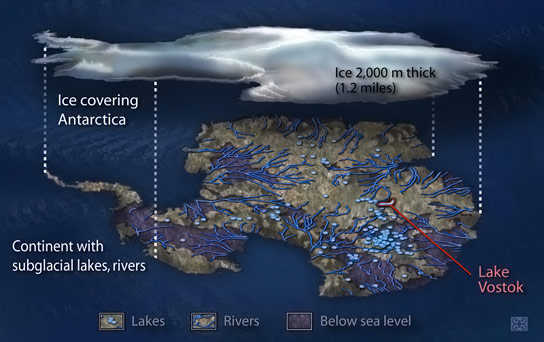
A massive ice sheet, almost two miles thick in places, covers more than 95 percent of the Antarctic continent. Only in recent decades have airborne and satellite radar and other mapping technologies revealed that a vast, subglacial system of rivers and lakes exists under the ice sheet. Lakes vary in size, with the largest being Vostok Subglacial Lake in the Antarctic interior that is comparable in size to Lake Ontario.
WISSARD targeted a smaller lake (1.2 square miles in area), where several lakes appear linked to each other and may drain to the ocean, as the first project to obtain clean, intact samples of water and sediments from a subglacial lake.
The achievement is the culmination of more than a decade of international and national planning and 3 1/2 years of project preparation by the WISSARD consortium of U.S. universities and two international contributors. There are 13 WISSARD principal investigators representing eight different U.S. institutions.
NSF, which manages the United States Antarctic Program, provided over $10 million in grants as part of NSF’s International Polar Year portfolio to support the WISSARD science and development of related technologies.
The National Aeronautics and Space Administration’s (NASA) Cryospheric Sciences Program, the National Oceanic and Atmospheric Administration (NOAA), and the private Gordon and Betty Moore Foundation also provided support for the project.
The interdisciplinary research team includes groups of experts in the following areas of science: life in icy environments, led by John Priscu, of Montana State University; glacial geology, led by Ross Powell, of Northern Illinois University; and glacial hydrology, led by Slawek Tulaczyk, of the University of California, Santa Cruz.
Sharing of expertise by the groups of disciplinary experts will allow the data collected to be cast in a systemic, global context.
The WISSARD team will now process the water and sediment samples they have collected in hopes of answering seminal questions related to the structure and function of subglacial microbial life, climate history, and contemporary ice-sheet dynamics.
Video surveys of the lake floor and measurements of selected physical and chemical properties of the waters and sediments will allow the team to further characterize the lake and its environs.
The approach to drilling was guided by recommendations in the 2007 National Research Council-sponsored report, “Exploration of Antarctic Subglacial Aquatic Environments: Environmental and Scientific Stewardship,” aimed to protect these unique environments from contamination.
A team of engineers and technicians directed by Frank Rack, of the University of Nebraska-Lincoln, designed, developed, and fabricated the specialized hot-water drill that was fitted with a filtration and germicidal UV system to prevent contamination of the subglacial environment and to recover clean samples for microbial analyses. In addition, the numerous customized scientific samplers and instruments used for this project were also carefully cleaned before being lowered into the borehole through the ice and into the lake.
Following their successful retrieval, the samples are now being carefully prepared for their shipment off the ice and back to laboratories for numerous chemical and biological analyses over the coming weeks and months.
Never miss a breakthrough: Join the SciTechDaily newsletter.
Follow us on Google and Google News.