
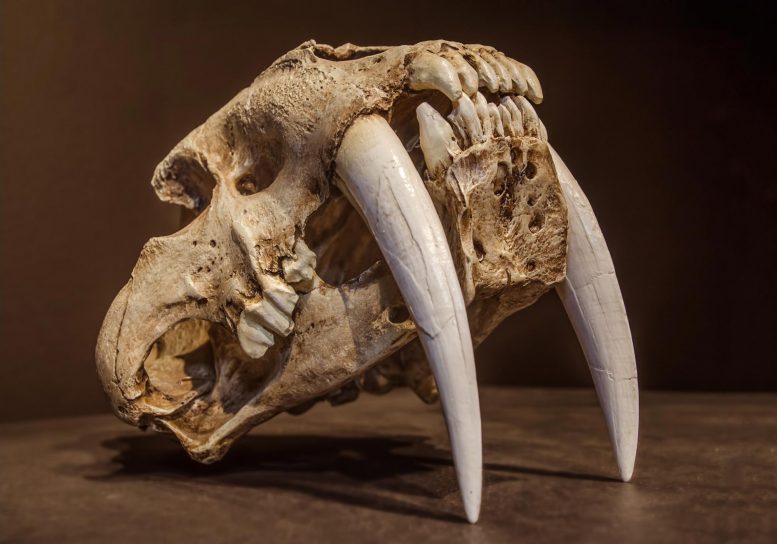
Scientists discovered a universal growth rule, the “power cascade,” explaining how pointed structures like teeth and claws develop in animals and plants using a predictable power-law shape.
Researchers have solved the missing piece of a 350-year-old puzzle of how the pointed body parts of many animals grow to form their shape — including teeth, horns, claws, beaks, animal shells, and even the thorns and prickles of plants.
An interdisciplinary team at Monash University discovered a new universal rule of biological growth that explains surprising similarities in the shapes of sharp structures across the tree of life, including teeth, horns, claws, beaks, animal shells, and even the thorns and prickles of plants.
Mathematical Rules in Biological Shape
Animals and plants often grow in specific patterns, like logarithmic spirals following the golden ratio. There are very simple processes that generate these patterns — a logarithmic spiral is produced when one side of a structure grows faster than another at a constant ratio. We can call these ‘rules of growth’, and they help us understand why organisms are certain shapes.
In the new study published recently in BMC Biology, the research team demonstrates a new rule called the ‘power cascade’ based on how the shape ‘cascades’ down a tooth following a power law.
When an elephant tusk grows longer, it grows wider at a very specific rate following a ‘power law’ — a mathematical pattern where there is a straight-line relationship between the logarithm of the tooth’s width and length. Power laws are found throughout nature, such as in the magnitudes of earthquakes, the sizes of cities, and the movement of the stock market.
A Universal Law Behind Teeth, Claws, Horns, and More
This pattern applies across many animals, in the teeth of giant sharks, Tyrannosaurus rex, mammoths, and even humans. Remarkably, this power law works for claws, hooves, horns, spider fangs, snail shells, antlers, and the beaks of mammals, birds, and dinosaurs. Beyond animals, the team also observed it in the thorns of the rose bush and lemon tree.
Associate Professor Alistair Evans in the School of Biological Sciences at Monash University led the research team.
“The diversity of animals, and even plants, that follow this rule is staggering,” Associate Professor Evans said.
“We were quite shocked that we found it almost everywhere we looked across the kingdoms of life — in living animals and those extinct for millions of years.”
The new pattern expands on the ideas of the polymath anatomist, physicist and mathematician Sir Christopher Wren, the designer of London’s St Paul’s Cathedral. In 1659, Wren suggested that a snail shell could be a cone twisted to be a logarithmic spiral. The new study shows that shells and other shapes such as teeth and horns are in fact the power cascade shape (called a ‘power cone’).
“This new rule is the missing piece of a 350-year-old puzzle of how animals and their parts grow,” Associate Professor Evans said.
Predicting Evolutionary and Even Mythical Forms
“Because so many structures follow this growth pattern, we can use it to predict the likely pattern of evolution. Whenever animals evolve teeth, horns, or claws, it seems most likely that they will be this shape. It even allows us to predict what mythical animals would look like if they follow the same patterns of nature.”
“Now we can know what the dragons from Game of Thrones and fantastic beasts of Harry Potter would look like,” Associate Professor Evans said.
Reference: “A universal power law for modelling the growth and form of teeth, claws, horns, thorns, beaks, and shells” by Alistair R. Evans, Tahlia I. Pollock, Silke G. C. Cleuren, William M. G. Parker, Hazel L. Richards, Kathleen L. S. Garland, Erich M. G. Fitzgerald, Tim E. Wilson, David P. Hocking and Justin W. Adams, 30 March 2021, BMC Biology.
DOI: 10.1186/s12915-021-00990-w
Never miss a breakthrough: Join the SciTechDaily newsletter.
Follow us on Google and Google News.