

A new study introduces a low-energy MRAM device using electric fields for data writing, contrasting with the high-energy demands of traditional RAM.
This method enhances data storage with reduced power, leveraging advanced multiferroic heterostructures for better performance.
Energy-Efficient MRAM Development
In recent years, new types of memory for computing devices have been developed to address the limitations of traditional random access memory (RAM). Magnetoresistive RAM (MRAM) stands out among these innovations, offering key benefits such as non-volatility, high speed, larger storage capacity, and greater durability. However, one major challenge remains: reducing energy consumption during data writing.
Researchers from Osaka University, in a study published in Advanced Science, have introduced a groundbreaking technology for MRAM that significantly lowers energy use during the writing process. This approach replaces the conventional current-based writing method with an electric-field-based system, reducing energy demands and positioning MRAM as a promising alternative to traditional RAM.
Comparing DRAM and MRAM Technologies
Conventional dynamic RAM (DRAM) devices have basic storage units consisting of transistors and capacitors. However, the stored data is volatile, meaning that energy input is required to retain the data. In contrast, MRAM uses magnetic states, such as the orientation of magnetization, to write and store data, enabling non-volatile data storage.
“As MRAM devices rely on a non-volatile magnetization state rather than a volatile charge state in capacitors, they are a promising alternative to DRAM in terms of their low power consumption in the standby state,” explains Takamasa Usami, lead author of the study.
Advanced MRAM Writing Techniques
The present MRAM devices generally require an electric current to switch the magnetization vectors of magnetic tunnel junctions, analogous to switching capacitor’s charge states in a DRAM device. However, a large electric current is needed to switch the magnetization vectors during the writing process. This results in inevitable Joule heating, leading to energy consumption.
Enhancing MRAM with Multiferroic Heterostructures
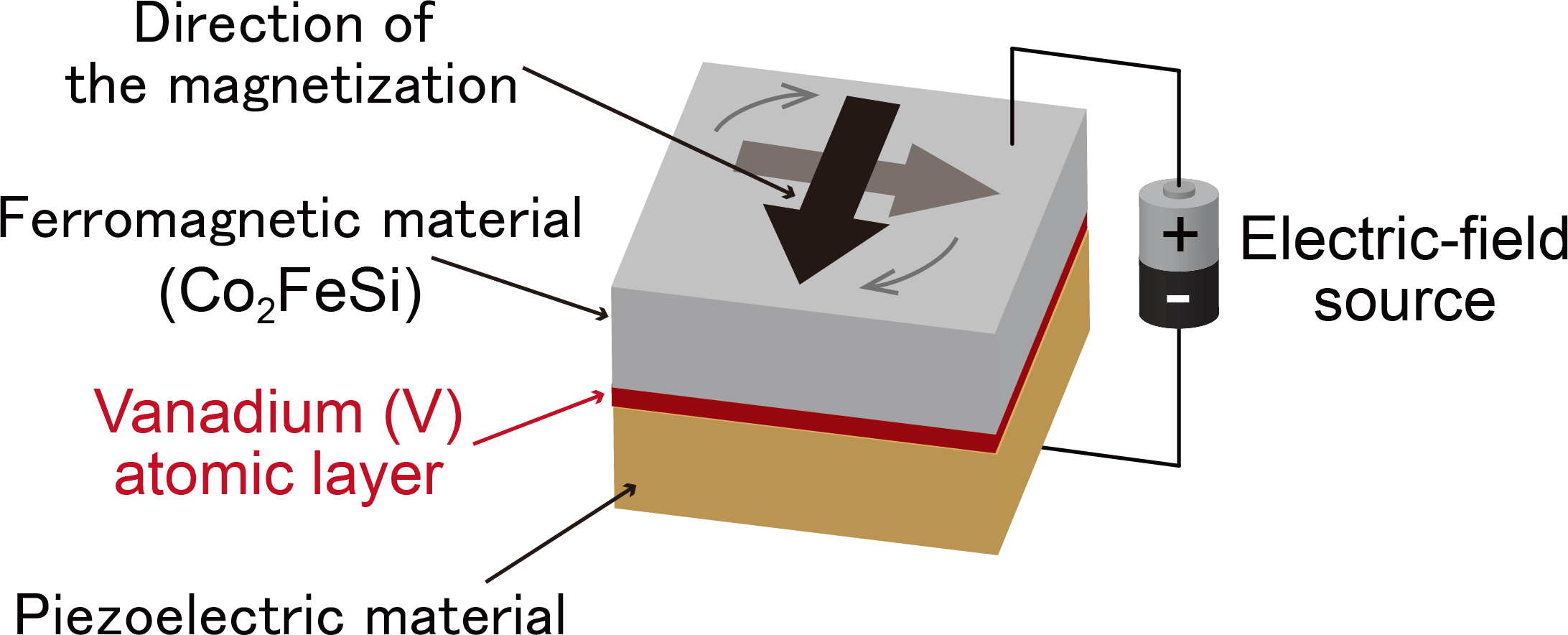
To address the problem, the researchers have developed a new component for electric field controlling of MRAM devices. The key technology is a multiferroic heterostructure with magnetization vectors that can be switched by an electric field (Fig. 1). The response of the heterostructure to an electric field is basically characterized in terms of the converse magnetoelectric (CME) coupling coefficient; larger values indicate a stronger magnetization response.
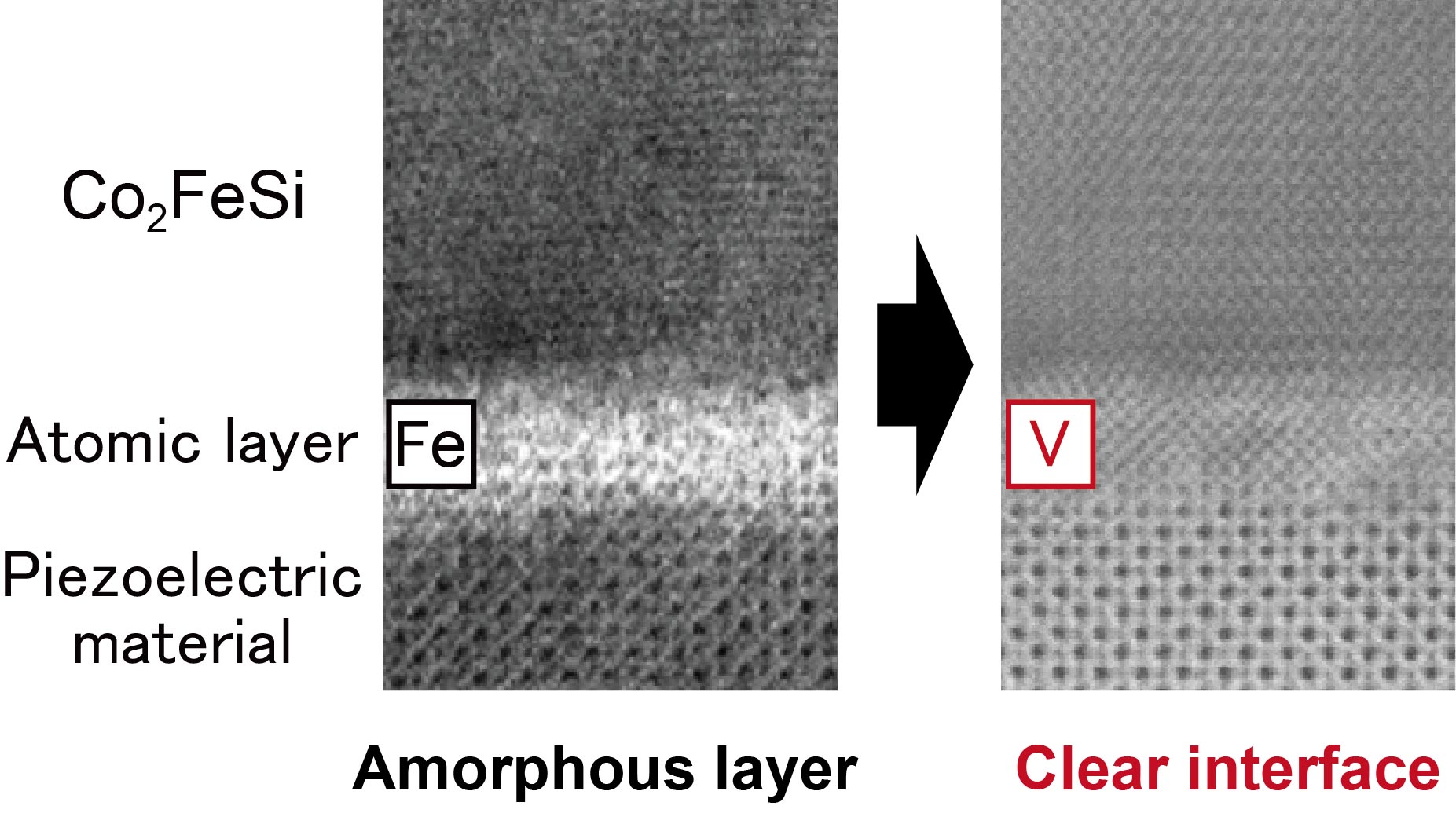
The researchers previously reported a multiferroic heterostructure with a large CME coupling coefficient over 10-5 s/m. However, structural fluctuations in parts of the ferromagnetic layer (Co2FeSi) made it challenging to achieve the desired magnetic anisotropy, hindering reliable electric-field operation. To improve the stability of this configuration, the researchers developed a new technology for an insertion of an ultra-thin vanadium layer between the ferromagnetic and piezoelectric layers. As shown in Fig. 2, a clear interface was achieved by inserting the vanadium layer, leading to the reliable control of the magnetic anisotropy in the Co2FeSi layer. Also, the CME effect reached a value larger than that achieved with similar devices that did not include a vanadium layer.
Results and Future Implications
The researchers also demonstrated that two different magnetic states can be reliably realized at zero electric field by changing the sweeping operation of the electric field. This means a non-volatile binary state can be intentionally achieved at zero electric field.
“Through precise control of the multiferroic heterostructures, two key requirements for implementing practical magnetoelectric (ME)-MRAM devices are satisfied, namely a non-volatile binary state with zero electric field, and a giant CME effect,” says Kohei Hamaya, senior author.
This research in spintronic devices could eventually be implemented on practical MRAM devices, enabling manufacturers to develop ME-MRAM, which is a low-power writing technology for a wide range of applications requiring persistent and safe memory.
Reference: “Artificial Control of Giant Converse Magnetoelectric Effect in Spintronic Multiferroic Heterostructure” by Takamasa Usami, Yuya Sanada, Shumpei Fujii, Shinya Yamada, Yu Shiratsuchi, Ryoichi Nakatani and Kohei Hamaya, 25 December 2024, Advanced Science.
DOI: 10.1002/advs.202413566
Never miss a breakthrough: Join the SciTechDaily newsletter.
Follow us on Google and Google News.