
New Research Reveals How Next-Generation Electronics Degrade Over Time
By observing Spintronic magnetic tunnel junctions in real-time, researchers found these devices fail at unexpectedly low temperatures, offering valuable insights for improving future electronic designs.
Next-Generation Electronics Degradation
A new study led by researchers at the University of Minnesota Twin Cities is providing new insights into how next-generation electronics, including memory components in computers, breakdown or degrade over time. Understanding the reasons for degradation could help improve efficiency of data storage solutions.
The research is published in ACS Nano, a peer-reviewed scientific journal and is featured on the cover of the journal.
Enhancing Data Storage with Spintronic Technology
Advances in computing technology continue to increase the demand for efficient data storage solutions. Spintronic magnetic tunnel junctions (MTJs)—nanostructured devices that use the spin of the electrons to improve hard drives, sensors, and other microelectronics systems, including Magnetic Random Access Memory (MRAM)—create promising alternatives for the next generation of memory devices.
MTJs have been the building blocks for the non-volatile memory in products like smartwatches and in-memory computing with a promise for applications to improve energy efficiency in AI.
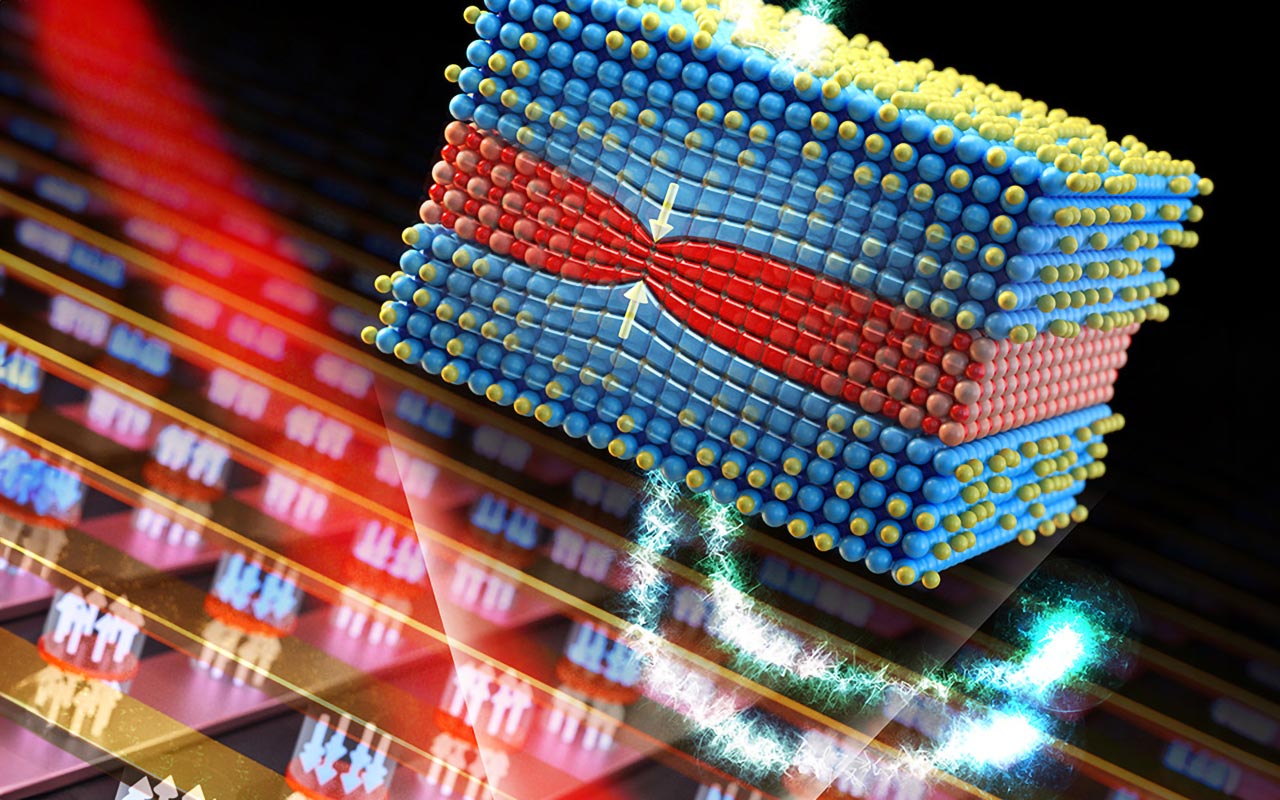
The recorded video shows the operation of a MTJ memory device and how the atomic structure of a critical thin layer in the middle degrades. Credit: Mkhoyan Lab, University of Minnesota
Observing Device Degradation in Real-Time
Using a sophisticated electron microscope, researchers looked at the nanopillars within these systems, which are extremely small, transparent layers within the device. The researchers ran a current through the device to see how it operates. As they increased the current, they were able to observe how the device degrades and eventually dies in real-time.
“Real-time transmission electron microscopy (TEM) experiments can be challenging, even for experienced researchers,” said Dr. Hwanhui Yun, first author on the paper and postdoctoral research associate in the University of Minnesota’s Department of Chemical Engineering and Material Sciences. “But after dozens of failures and optimizations, working samples were consistently produced.”
Breakthroughs in Understanding Electronic Failure
By doing this, they discovered that over time with a continuous current, the layers of the device get pinched and cause the device to malfunction. Previous research theorized this, but this is the first time researchers have been able to observe this phenomenon. Once the device forms a “pinhole” (the pinch), it is in the early stages of degradation. As the researchers continued to add more and more current to the device, it melts down and completely burns out.
“What was unusual with this discovery is that we observed this burn out at a much lower temperature than what previous research thought was possible,” said Andre Mkhoyan, a senior author on the paper and professor and Ray D. and Mary T. Johnson Chair in the University of Minnesota Department of Chemical Engineering and Material Sciences. “The temperature was almost half of the temperature that had been expected before.”
Implications for Future Electronics Design
Looking more closely at the device at the atomic scale, researchers realized materials that small have very different properties, including melting temperature. This means that the device will completely fail at a very different time frame than anyone has known before.
“There has been a high demand to understand the interfaces between layers in real time under real working conditions, such as applying current and voltage, but no one has achieved this level of understanding before,” said Jian-Ping Wang, a senior author on the paper and a Distinguished McKnight Professor and Robert F. Hartmann Chair in the Department of Electrical and Computer Engineering at the University of Minnesota.
“We are very happy to say that the team has discovered something that will be directly impacting the next generation microelectronic devices for our semiconductor industry,” Wang added.
The researchers hope this knowledge can be used in the future to improve design of computer memory units to increase longevity and efficiency.
Reference: “Uncovering Atomic Migrations Behind Magnetic Tunnel Junction Breakdown” by Hwanhui Yun, Deyuan Lyu, Yang Lv, Brandon R. Zink, Pravin Khanal, Bowei Zhou, Wei-Gang Wang, Jian-Ping Wang and K. Andre Mkhoyan, 20 August 2024, ACS Nano.
DOI: 10.1021/acsnano.4c08023
In addition to Yun, Mkhoyan, and Wang, the team included University of Minnesota Department of Electrical and Computer Engineering postdoctoral researcher Deyuan Lyu, research associate Yang Lv, former postdoctoral researcher Brandon Zink, and researchers from the University of Arizona Department of Physics.
This work was funded by SMART, one of seven centers of nCORE, a Semiconductor Research Corp. program sponsored by the National Institute of Standards and Technology (NIST); University of Minnesota Grant-in-Aid funding; National Science Foundation (NSF); and Defense Advanced Research Projects Agency (DARPA). The work was completed in collaboration with the University of Minnesota Characterization Facility and the Minnesota Nano Center.
Never miss a breakthrough: Join the SciTechDaily newsletter.
Follow us on Google and Google News.