
Close Menu
    Facebook X (Twitter) Instagram
    SciTechDaily
    • Biology
    • Chemistry
    • Earth
    • Health
    • Physics
    • Science
    • Space
    • Technology
    Facebook X (Twitter) Pinterest YouTube RSS
    SciTechDaily
    Home»Space»Rich Reservoir of Large Organic Molecules Near the Center of the Milky Way
    Space

    Rich Reservoir of Large Organic Molecules Near the Center of the Milky Way

    By ALMAOctober 21, 20213 Comments3 Mins Read
    Facebook Twitter Pinterest Telegram LinkedIn WhatsApp Email Reddit
    Share
    Facebook Twitter LinkedIn Pinterest Telegram Email Reddit
    ALMA Sgr B2
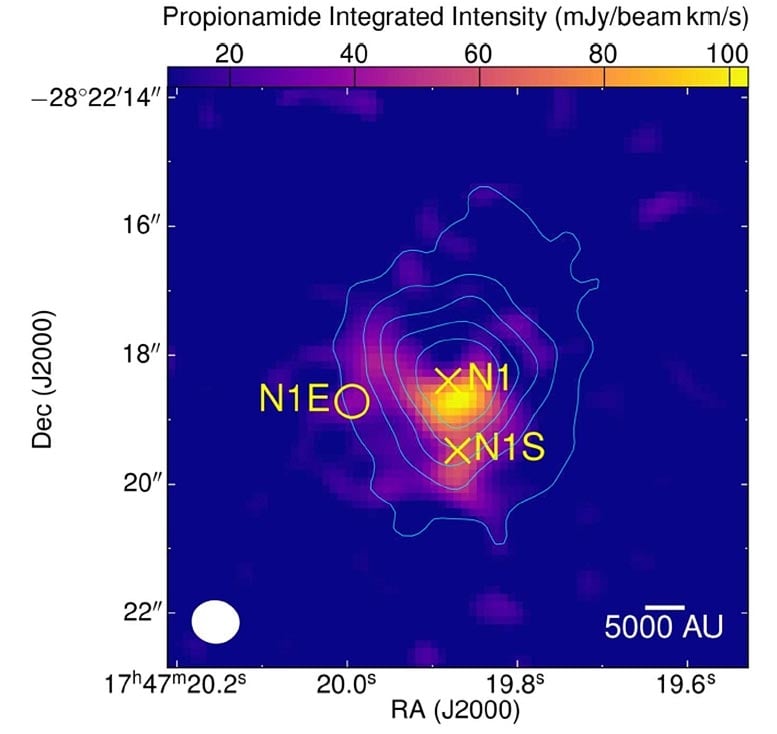
    ALMA image of a part of Sgr B2. Distributions of 13CH3CN and propionamide are shown in contours and color scale, respectively. A compact cloud of warm gas, called hot core Sgr B2 (N1), is located At the center of the observing region. Credit: Li et al. “Propionamide (C2H5CONH2): The Largest Peptide-like Molecule in Space,” The Astrophysical Journal, 919, 4. September 16, 2021. Copyright: AAS.

    ALMA has discovered propionamide, the largest peptide-like molecule in space, in the star-forming region Sgr B2.

    Proteins are polymers of amino acids joined together by the peptide bond -NHCO-. Peptide bonds are not only the ubiquity structures in proteins but also the characteristic structures for proteins. Molecules with peptide-like bonds are of particular interest to understand possible routes of protein formation in space. Among 240 molecules detected in space, only four molecules belong to peptide-like molecules.

    Sagittarius B2 (Sgr B2), the massive star-forming region located close to the Galactic Center, is known as one of the best hunting grounds for complex organic molecules in the interstellar medium. Many prebiotic molecules have been detected in Sgr B2. Observations using the Shanghai Tianma 65m (213ft) telescope have revealed widespread complex organic molecules around Sgr B2. However, the abundant emissions caused serious line-blending in Sgr B2 and made identifying new molecules in Sgr B2 particularly difficult.
    Galactic Center and Sagittarius B2
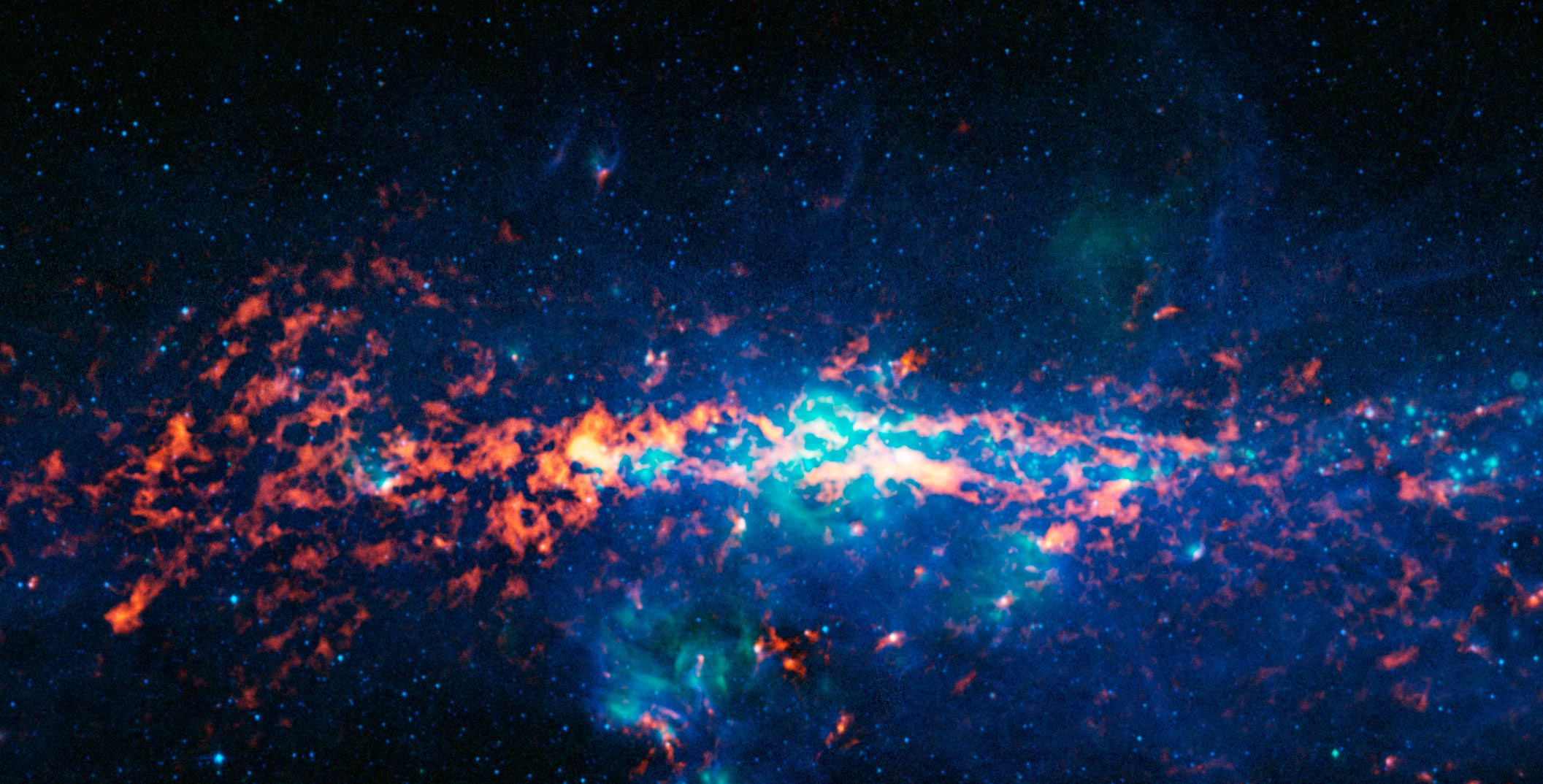
    Color-composite image of the Galactic Center and Sagittarius B2 as seen by the ATLASGAL survey. The center of the Milky Way is home to a supermassive black hole more than four million times the mass of our Sun. It is about 25,000 light-years from Earth. Sagittarius B2 (Sgr B2) is one of the largest clouds of molecular gas in the Milky Way. This dense region lies close to the Galactic Center and is rich in many different interstellar molecules. In this image, the ATLASGAL submillimeter-wavelength data are shown in red, overlaid on a view of the region in infrared light, from the Midcourse Space Experiment (MSX) in green and blue. Sagittarius B2 is the bright orange-red region to the middle left of the image, which is centered on the Galactic Center. Credit: ESO/APEX & MSX/IPAC/NASA

    Recently, an international group led by Juan Li from Shanghai Astronomical Observatory and Xing Lu from the National Astronomical Observatory of Japan, reported the detection of propionamide (C2H5CONH2) toward Sgr B2 for the first time with the Atacama Large Millimeter/submillimeter Array (ALMA). This is the largest peptide-like molecule detected in space.

    Based on the high resolution and high sensitivity ALMA data, they find a possible propionamide transition whose intensity and velocity are consistent with simulations. The detection of propionamide in Sgr B2 demonstrates that interstellar chemistry can reach sufficient levels of complexity to form relatively large peptide molecules and shows the possible growth of larger amide molecules from smaller ones in a massive star-forming process.

    Propionamide might also exist in massive star-forming regions in the Galactic disk, such as Orion KL. Future ALMA observations can reveal its presence.

    Reference: “Propionamide (C2H5CONH2): The Largest Peptide-like Molecule in Space” by Juan Li, Junzhi Wang, Xing Lu (吕行)3, Vadim Ilyushin4,5, Roman A. Motiyenko6, Qian Gou (勾茜)7, Eugene A. Alekseev4,5, Donghui Quan (全冬晖)8,9, Laurent Margulès6, Feng Gao (高峰)10,11, Frank J. Lovas12,13, Yajun Wu (吴亚军)1,2, Edwin Bergin14, Shanghuo Li (李尚活)15, Zhiqiang Shen (沈志强)1,2, Fujun Du (杜福君)16,17, Meng Li (李梦)7, Siqi Zheng (郑思琪)1,2,18, and Xingwu Zheng, 16 September 2021, The Astrophysical Journal.
    DOI: 10.3847/1538-4357/ac091c

    Never miss a breakthrough: Join the SciTechDaily newsletter.
    Follow us on Google and Google News.

    ALMA Astronomy Astrophysics
    Share. Facebook Twitter Pinterest LinkedIn Email Reddit

    Related Articles

    Astronomers Spot Stellar Eggs Near Center of the Milky Way Hatching Into Baby Stars

    Incredibly Powerful 900+ Mph Winds in Jupiter’s Atmosphere Measured for the First Time

    “Meteorological Beast in Our Solar System” – Powerful Stratospheric Winds Measured on Jupiter for the First Time

    Cosmic Cold Gas Pipelines Detected Feeding Early, Massive Galaxies

    Growing up Stardust: Astronomers Discover That Stars and Planets May Be Siblings

    Shocking Discovery As Astronomers Peer 12 Billion Years Into the Past – “Defies Our Understanding of Galaxy Formation”

    Observations of Molecular Gas in a Tidal Dwarf Galaxy Sheds Light on How Stars Form

    Distant Colliding Galaxy Dying Out As It Loses the Ability to Form Stars – Ejecting 10,000 Suns-Worth of Gas a Year

    Purported Phosphine – An Indicator of Life – On Venus More Likely to Be Ordinary Sulfur Dioxide

    3 Comments

    1. R Rytter on October 22, 2021 12:06 am

      Organic molecules near the center of The Milky Way sounds extremely interesting. What’ll be the next. Thank you for that article!

      Reply
    2. Paleochocolate on October 23, 2021 1:15 pm

      What the hell kind of headline is that?

      Reply
      • Mike O'Neill on October 24, 2021 9:07 pm

        Thanks for the note. There was a typo in the headline that has been fixed.

        Reply
    Leave A Reply Cancel Reply

    • Facebook
    • Twitter
    • Pinterest
    • YouTube

    Don't Miss a Discovery

    Subscribe for the Latest in Science & Tech!

    Trending News

    New “Nanozyme Hypothesis” Could Rewrite the Story of Life’s Origins

    Anatomy Isn’t Finished: The Human Body Still Holds Secrets

    “Pretty Close to Home”: The Hidden Earthquake Threat Beneath Seattle

    The Surprising Reason You Might Want To Sleep Without a Pillow

    Scientists Say This Natural Hormone Reverses Obesity by Targeting the Brain

    35-Million-Year-Old Mystery: Strange Arachnid Discovered Preserved in Amber

    Is AI Really Just a Tool? It Could Be Altering How You See Reality

    JWST Reveals a “Forbidden” Planet With a Baffling Composition

    Follow SciTechDaily
    • Facebook
    • Twitter
    • YouTube
    • Pinterest
    • Newsletter
    • RSS
    SciTech News
    • Biology News
    • Chemistry News
    • Earth News
    • Health News
    • Physics News
    • Science News
    • Space News
    • Technology News
    Recent Posts
    • Scientists Capture Hidden Electron Patterns Inside Quantum Materials
    • New Study Challenges Alzheimer’s Theories: It’s Not Just About Plaques
    • Scientists Discover Way To Treat Lung Cancer and Its Deadly Side Effect Together
    • Artificial Sweeteners May Harm Future Generations, Study Suggests
    • The Ocean Current Stronger Than All Rivers Changed Earth Forever
    Copyright © 1998 - 2026 SciTechDaily. All Rights Reserved.
    • Science News
    • About
    • Contact
    • Editorial Board
    • Privacy Policy
    • Terms of Use

    Type above and press Enter to search. Press Esc to cancel.