
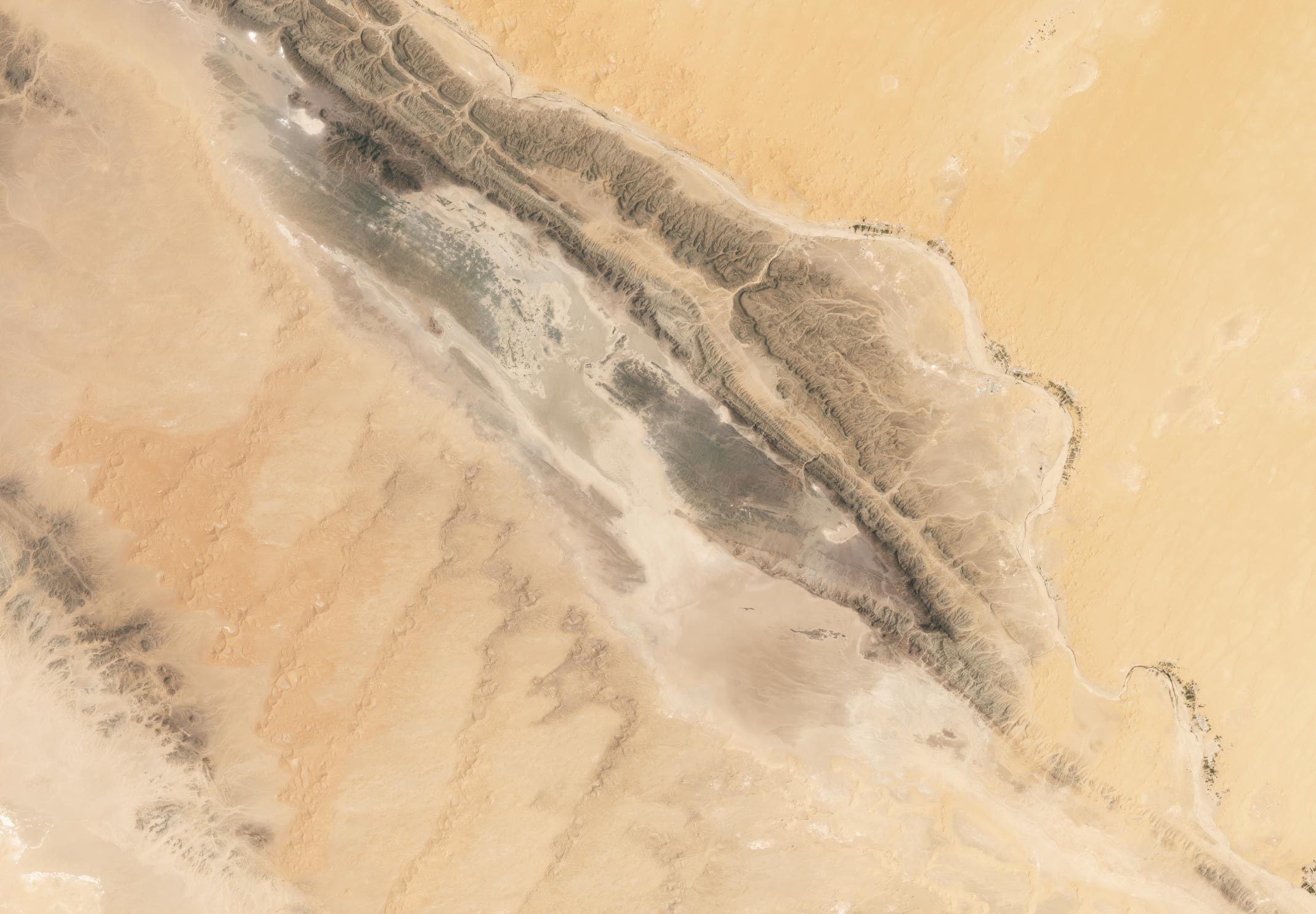

The Sahara Desert’s episodic refilling of lakes, such as Sebkha el Melah in 2024, illustrates its greener past and helps researchers study historical climate variations.
These insights into the Sahara’s climate history emphasize the complexity of predicting its future in a warming world.
The Ancient Green Sahara
Around 11,000 to 5,000 years ago, during the African Humid Period, the Sahara Desert was much wetter and greener than it is today. Geologic and archaeological evidence suggests that areas now covered in vast sand dunes were once home to vegetation, wetlands, and possibly even large lakes.
In September 2024, hints of this ancient, greener Sahara reemerged briefly after an extratropical cyclone brought heavy rainfall to parts of northern Africa. Runoff from the storm partially filled several normally dry, ephemeral lakes in the desert.
Capturing Change: Satellite Images of Sebkha el Melah
NASA’s Landsat 9 satellite captured an image (above, lower) of one such lake, Sebkha el Melah, in Algeria, on September 29, 2024, using its OLI-2 (Operational Land Imager-2) instrument. Located along the Ougarta Range and fed by the Oued Saoura, an intermittent river (also known as a wadi), the lake began filling in mid-September. A previous image from August 12 (above, upper) shows the lakebed covered in salt before the rainfall transformed the area.
As of October 16, water covered 191 square kilometers (74 square miles) to a depth of 2.2 meters (7.2 feet), and Sebkha el Melah was roughly one-third full, said Moshe Armon, a senior lecturer at the Hebrew University of Jerusalem. Armon calculated these values using satellite images of the water’s extent, like the one above, along with a three-dimensional map of the lake’s bathymetry based on ICESat-2 observations. Since June 2000, only two other rain events have resulted in larger lake volumes—one in 2008 and one in 2014, Armon said.
The Rarity and Significance of Lake Refill Events
The filling of a Sahara Desert lake is a “rare, largely undocumented, transient phenomenon,” noted Joëlle Rieder, a colleague of Armon’s, in a 2024 study that detailed the frequency of refilling events at the lake since 2000. This part of Algeria has few ground-based weather stations, so the researchers used rainfall data from NASA’s Integrated Multi-satellite Retrievals (IMERG) and ERA5 weather reanalysis data from the European Center for Medium-range Weather Forecasts (EMCWF) to study the meteorological conditions required to fill the lake.
Of the hundreds of rainfall events that affected Sebkha el Melah’s watershed since 2000, only six delivered enough water to start filling it. All of these involved long-lasting extratropical cyclones that produced especially heavy rainfall as moist tropical air was pushed up and over mountains, a process called orographic lift.
Satellite observations indicate that when Sebkha el Melah fills, the water can stick around. After it filled in 2008, it took until 2012 to dry completely. “If we don’t get any more rain events, a 2.2-meter depth, like we have now, would take about a year to evaporate completely,” Armon said.
The Historical Perspective on Desert Lake Fillings
Armon and other scientists track lake-filling episodes in part because questions remain about both the region’s past and future. Despite evidence indicating that the Sahara was wetter during the African Humid Period, just how wet remains a matter of scientific debate. To help resolve it, scientists look to desert lakes, like Sebkha el Melah, because they function a bit like giant “rain gauges” that provide clues about past precipitation patterns, explained Armon.
One of the challenges for researchers who study this topic is that models that simulate prior climate conditions struggle to reproduce the rainfall required to fill as many Saharan lakes as geologists believe were present during the African Humid Period. This has led some researchers to suggest that either the Sahara wasn’t actually as rainy and verdant as paleoclimate experts think or that the models are missing something, explained Armon.
“We’re proposing a third option: that extreme rain events, like the one in September in the northwestern Sahara, might have been more frequent in the past,” said Armon. “Given how long it takes lakes to dry up, these events could have been common enough to keep lakes partially filled over long periods—even years or decades—without frequent rainfall.”
Climate Projections and Uncertainties for the Sahara
It’s generally accepted by paleoclimatologists that small orbital variations called Milankovitch cycles were key drivers of the African Humid Period because they would have caused slight changes in the distribution of solar radiation and shifts in the strength and position of the North African monsoon. Less clear is whether and how much the Sahara might green and support long-lasting lakes in future centuries and millennia as the impacts of greenhouse gas emissions and climate change are layered onto the cyclical effects of the Milankovitch cycles.
Projections from the Intergovernmental Panel on Climate Change (IPCC) indicate that while parts of the Sahara may receive more rainfall as global temperatures increase, other parts may receive less. “But the uncertainties in these projections are larger than the projected changes,” said Armon. “What’s going to happen in the Sahara remains very unclear, but we hope that we’ll eventually develop a better understanding of the Sahara’s future by studying these lake-filling events.”
NASA Earth Observatory images by Michala Garrison, using Landsat data from the U.S. Geological Survey.
Never miss a breakthrough: Join the SciTechDaily newsletter.
Follow us on Google and Google News.
17 Comments
Lookout Israeli mosha has undoubtedly notified the Israeli government and they may want that land now
Interesting !
I don’t believe in human-induced “global warming”. What about all the constant volcanic eruptions w/all their high sulfuric content & other pollutants. That is tremendously more pollutants in Earth’s atmosphere than man produces (and a few women). Am I not correct, or just plain looney?
indeed
Yes, these natural events can be tracked in ice samples and geologic studies as periodic events. The science of gathering data on changes to our atmosphere demonstrates a massive rise in carbon dioxide production–far above naturally occuring events. This is what should concern us all, whether we believe the scientists or the ideologues.
Humans have an impact in ADDITION to that from volcanic activity. Which is why despite the fact the earth has been warming, (we are actually in an interracial period of an ice age) the rate has STARKLY accelerated since th industrial revolution.
You re in Denial.
We create endless CO2 all day and add more methane as well
Yes Volcanos produce on occasion but humans are slow n staedy all the time
Loony, plainly
If climate change isn’t man made, then they have no agenda. If they have no agenda, they can’t control you.
Uh-h-h-h-h – …there are no particles. Add that.
Global warming is a scam to give dems billions to stay in power
You re in Denial
Looknat the poles n melted glaciers all over
Pull your head out of your own ass one day
Take a look at ice levels around the world
You re in Denial
Looknat the poles n melted glaciers all over
Pull your head out of your own ass one day
so are melting glaciers a result of or a driver of climate change?
I think we, as humans, do impact the environment just as other life on earth does. The change to greener methods is desirable but the debate has been hijacked by the alarmists.
The next environmental disaster, which will be much larger than that created by fossil fuels, will be the scarcely discussed massive impact of disposing of batteries. I’m sure many will say there will be recycling but you need to think about recycling rates now and that will give an idea of how much will ‘slip through the net’
Climate prediction models are usually wrong and many climate scientists admit that the models are inaccurate
the bottom line is get rid of science and we will reach a natural balance, just as long as me and mine survive.
Why give science the job of fixing the problem when they are the creators. And that is the dilemma.
The alarmist train is full of the gullible leaving the station soon, got your ticket?
Some organisations should work with lakhs of people to recover our earth
Am also working to recover earth
Every day one percent
Omg.. stupid people everywhere.. 🙄
Landsat satellites (7, 8, and 9 currently) are owned and operated by the US Geological Survey (USGS) which is part of the Department of Interior. They are not NASA satellites.