
Close Menu
    Facebook X (Twitter) Instagram
    SciTechDaily
    • Biology
    • Chemistry
    • Earth
    • Health
    • Physics
    • Science
    • Space
    • Technology
    Facebook X (Twitter) Pinterest YouTube RSS
    SciTechDaily
    Home»Earth»Unusual “Volcano Track” Clouds Investigated
    Earth

    Unusual “Volcano Track” Clouds Investigated

    By Adam Voiland, NASA Earth ObservatoryJune 23, 2020No Comments3 Mins Read
    Facebook Twitter Pinterest Telegram LinkedIn WhatsApp Email Reddit
    Share
    Facebook Twitter LinkedIn Pinterest Telegram Email Reddit
    South Sandwich Islands
    Click image for full view. South Sandwich Islands

    In 2008, atmospheric scientist Santiago Gassó authored a study that highlighted abnormally bright trails of clouds around remote peaks in the South Sandwich Islands. The unusual looking clouds were caused by volcanoes emitting sulfur dioxide and other gases and particles that interacted with passing clouds and made them brighter and more lasting than the surrounding clouds.

    More than a decade later, NASA and University of Maryland scientist is still tracking and learning from these “volcano track” clouds over the South Atlantic Ocean. In 2020, he watched several of them during a period of sustained activity on Mount Michael. For two weeks in mid-May, NASA satellites observed volcano tracks nearly every day.

    On some days, wide tracks extended for hundreds of kilometers from the volcano. But on most days, the tracks were thin and faint, indicating that the volcanic activity was not especially intense. Degassing of sulfur dioxide and other gases is routine on Mount Michael, which has a persistent lava lake roiling deep inside its central crater. On May 30, 2020, the Moderate Resolution Imaging Spectroradiometer (MODIS) on NASA’s Terra satellite captured this false-color image of a volcano track near Mount Michael. Waves clouds and Von Kármán vortices are visible downwind of neighboring islands.
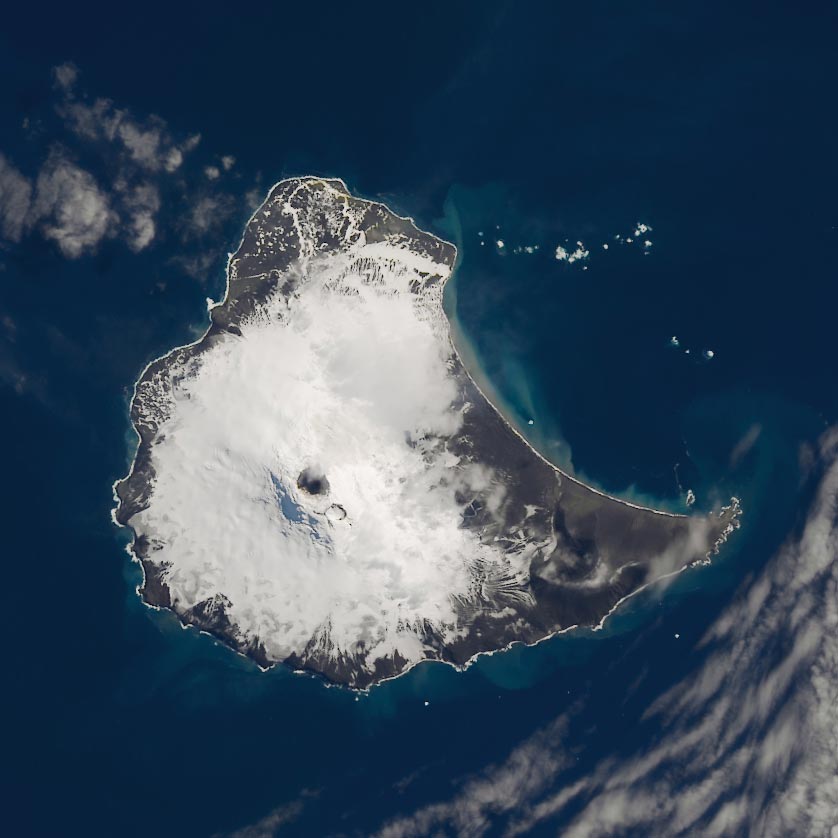
    Mount Michael
    Mount Michael

    Cloud brightening—the technical term is the Twomey effect—is something scientists have observed for decades. Clouds with extra particles from volcanoes have more and smaller cloud droplets than normal clouds. This means there are more surfaces to reflect light, making volcanically “polluted” clouds appear brighter than others. The same process produces bright ship track clouds over the ocean, except in that case the extra particles come from ship exhaust.

    While faint volcano tracks can be difficult to see in natural-color imagery, near-infrared light can help. “When I look for volcano tracks with MODIS, I use the 3-6-7 band combination because it includes near-infrared channels that are particularly sensitive to changes in droplet size, a direct result of the volcanic particles entering the cloud,” explained Gassó. “That way the volcano track jumps out without me having to squint much.”

    The many active volcanoes, abundant cloud cover, routinely fierce winds of the “Roaring Forties” — plus the laws of fluid dynamics—often make for unusually beautiful swirls, patterns, and waves in the air above the South Sandwich islands.

    The island chain has also proven to be an ideal natural laboratory for science. “There is a lot of interest in how human-caused pollution affects clouds on a global scale and how it is affecting the climate. But in other areas of the world, it can be difficult to tell if cloud brightening is caused by shifts in meteorology or the presence of pollution particles,” said Gassó. “With the volcano tracks from the South Sandwich Islands, there is no question at all. The brightening is from volcanic ‘pollution,’ and that is really useful for developing models that can quantify how this cloud brightening effect works on a global scale.”

    NASA Earth Observatory image by Joshua Stevens, using MODIS data from NASA EOSDIS/LANCE and GIBS/Worldview.

    Never miss a breakthrough: Join the SciTechDaily newsletter.
    Follow us on Google and Google News.

    Clouds NASA NASA Earth Observatory Popular Volcano Weather
    Share. Facebook Twitter Pinterest LinkedIn Email Reddit

    Related Articles

    Unraveling the Science Behind Mysterious Hole-Punch Clouds

    Ten Years After the Tsunami: One of the Hardest Hit Coastal Cities in Japan Is Still Working to Recover

    Satellite View: Extreme Winter Weather Causes U.S. Blackouts

    Mysterious Hovering Clouds Spotted Over the Transantarctic Mountains

    “Smoking Mountain” – An Outburst From Popocatépetl Volcano in Mexico

    La Niña: The Cooler Sister Returns

    Excessive Rainfall in China: Three Gorges Dam and Other Yangtze River Dams Spill Water

    Young Volcanic Island Nishinoshima Belches Ash and Lava As It Grows in the Pacific

    “Godzilla” Dust Cloud Described As “Amazing” by NASA Astronaut Aboard Space Station

    Leave A Reply Cancel Reply

    • Facebook
    • Twitter
    • Pinterest
    • YouTube

    Don't Miss a Discovery

    Subscribe for the Latest in Science & Tech!

    Trending News

    AI Could Detect Early Signs of Alzheimer’s in Under a Minute – Far Before Traditional Tests

    What if Dark Matter Has Two Forms? Bold New Hypothesis Could Explain a Cosmic Mystery

    This Metal Melts in Your Hand – and Scientists Just Discovered Something Strange

    Beef vs. Chicken: Surprising Results From New Prediabetes Study

    Alzheimer’s Breakthrough: Scientists Discover Key Protein May Prevent Toxic Protein Clumps in the Brain

    Quantum Reality Gets Stranger: Physicists Put a Lump of Metal in Two Places at Once

    Scientists May Have Found the Key to Jupiter and Saturn’s Moon Mystery

    Scientists Uncover Brain Changes That Link Pain to Depression

    Follow SciTechDaily
    • Facebook
    • Twitter
    • YouTube
    • Pinterest
    • Newsletter
    • RSS
    SciTech News
    • Biology News
    • Chemistry News
    • Earth News
    • Health News
    • Physics News
    • Science News
    • Space News
    • Technology News
    Recent Posts
    • Ancient “Rock” Microbes May Reveal How Complex Life Began
    • Hidden “Trade Winds” Inside Cells Could Explain Cancer Spread
    • Humans Owe Their Eyes to a Tiny One-Eyed “Cyclops”
    • Researchers Capture Quantum Interference in One of Nature’s Rarest Atoms
    • Ancient DNA Reveals Irish Goats Have a 3,000-Year-Old Lineage Still Alive Today
    Copyright © 1998 - 2026 SciTechDaily. All Rights Reserved.
    • Science News
    • About
    • Contact
    • Editorial Board
    • Privacy Policy
    • Terms of Use

    Type above and press Enter to search. Press Esc to cancel.