
Close Menu
    Facebook X (Twitter) Instagram
    SciTechDaily
    • Biology
    • Chemistry
    • Earth
    • Health
    • Physics
    • Science
    • Space
    • Technology
    Facebook X (Twitter) Pinterest YouTube RSS
    SciTechDaily
    Home»Earth»Sharkcano! – NASA Satellite Catches Submarine Eruption of Kavachi Volcano
    Earth

    Sharkcano! – NASA Satellite Catches Submarine Eruption of Kavachi Volcano

    By Sara E. Pratt, NASA Earth ObservatoryMay 24, 20221 Comment3 Mins Read
    Facebook Twitter Pinterest Telegram LinkedIn WhatsApp Email Reddit
    Share
    Facebook Twitter LinkedIn Pinterest Telegram Email Reddit
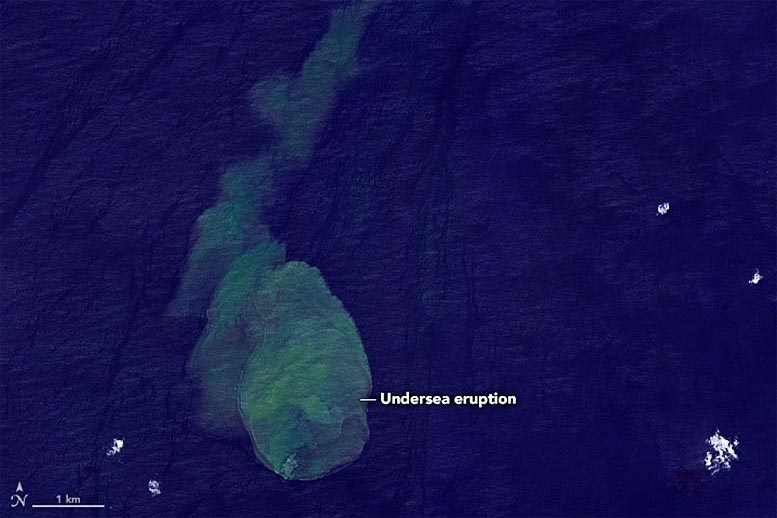
    Eruption of Kavachi Volcano May 2022 Zoom
    May 14, 2022. A plume of discolored water being emitted by Kavachi Volcano.

    Kavachi Volcano in the Southwest Pacific Solomon Islands—where hammerhead sharks prowl—has entered an active phase of eruption.

    The Solomon Islands’ Kavachi Volcano is one of the most active submarine volcanoes in the Pacific Ocean. According to the Smithsonian Global Volcanism Program, the volcano entered an eruptive phase in October 2021. Now, satellite data shows discolored water around Kavachi on several days in April and May 2022.

    The image above, acquired on May 14, 2022, by the Operational Land Imager-2 (OLI-2) on Landsat 9, shows a plume of discolored water being emitted from the submarine volcano, which lies about 24 kilometers (15 miles) south of Vangunu Island (shown below).

    Eruption of Kavachi Volcano May 2022 Annotated
    May 14, 2022. Kavachi Volcano, which is about 15 miles south of Vangunu Island, emitted a plume of discolored water.

    Composition of Discolored Water Plumes

    Previous research has shown such plumes of superheated, acidic water usually contain particulate matter, volcanic rock fragments, and sulfur. A 2015 scientific expedition to the volcano found two species of sharks, including hammerheads, living in the submerged crater. The researchers also found microbial communities that thrive on sulfur.

    The presence of the sharks in the crater raised “new questions about the ecology of active submarine volcanoes and the extreme environments in which large marine animals can exist,” the scientists wrote in a 2016 Oceanography article, “Exploring the ‘Sharkcano’.”

    Prior to this recent activity, large eruptions were observed at Kavachi in 2014 and 2007. The volcano erupts nearly continuously, and residents of nearby inhabited islands often report visible steam and ash. The island is named for a sea god of the Gatokae and Vangunu peoples, and it is sometimes also referred to as Rejo te Kvachi, or “Kavachi’s Oven.”

    Formation and Geological Characteristics of Kavachi

    Since its first recorded eruption in 1939, Kavachi has created ephemeral islands on several occasions. But the islands, up to a kilometer long, have been eroded and washed away by wave action. The summit of the volcano is currently estimated to lie 20 meters (65 feet) below sea level; its base lies on the seafloor at a depth of 1.2 kilometers (0.75 miles).

    Kavachi formed in a tectonically active area—a subduction zone lies 30 kilometers (18 miles) to the southwest. The volcano produces lavas that range from basaltic, which is rich in magnesium and iron, to andesitic, which contains more silica. It is known for having phreatomagmatic eruptions in which the interaction of magma and water cause explosive eruptions that eject steam, ash, volcanic rock fragments, and incandescent bombs.

    NASA Earth Observatory images by Joshua Stevens, using Landsat data from the U.S. Geological Survey.

    Never miss a breakthrough: Join the SciTechDaily newsletter.
    Follow us on Google and Google News.

    NASA NASA Earth Observatory Popular Volcano
    Share. Facebook Twitter Pinterest LinkedIn Email Reddit

    Related Articles

    Massive Tonga Volcano Plume Reached the Mesosphere – 36 Miles Into the Atmosphere

    Island Obliterated: Dramatic Changes at Hunga Tonga-Hunga Ha’apai

    Hunga Tonga Island Obliterated – NASA Satellites Capture Massive Blast

    A Wolf Awakens in the Galápagos Islands at Night

    Mount Michael, Volcano Track or Plume? 1,000-Meter-Tall Active Stratovolcano Puts On a Show

    Volcanic Eruption Continues at La Palma – Effects Being Felt From Above and Below

    “Smoking Mountain” – An Outburst From Popocatépetl Volcano in Mexico

    Young Volcanic Island Nishinoshima Belches Ash and Lava As It Grows in the Pacific

    Unusual “Volcano Track” Clouds Investigated

    1 Comment

    1. Ronald Sechler on May 26, 2022 2:00 pm

      Volcanos erupt and the earth cracks and breaks all to allow mantle material to flow out onto the surface of the earth, above and bellow the sea. The earth is growing and expanding, because the earth has a solid crust and the mantle is becoming less and less dense, requiring more and more room to expand. The active geology is caused by the earth’s active fission core. While this is not what any of us have been taught, it is a theory that explains the life of the earth, and answers the questions that are being asked today.

      Reply
    Leave A Reply Cancel Reply

    • Facebook
    • Twitter
    • Pinterest
    • YouTube

    Don't Miss a Discovery

    Subscribe for the Latest in Science & Tech!

    Trending News

    Enormous Prehistoric Insects Puzzle Scientists

    Scientists Develop Bioengineered Chewing Gum That Could Help Fight Oral Cancer

    After 37 Years, the World’s Longest-Running Soil Warming Experiment Uncovers a Startling Climate Secret

    NASA Satellite Captures First-Ever High-Res View of Massive Pacific Tsunami

    ADHD Isn’t Just a Deficit: Study Reveals Powerful Hidden Strengths

    Scientists Discover Stem Cells That Could Regrow Teeth and Bone

    Early Cannabis Use May Stall Key Brain Skills in Teens

    Popular Vitamin D Supplement Has “Previously Unknown” Negative Effect, Study Finds

    Follow SciTechDaily
    • Facebook
    • Twitter
    • YouTube
    • Pinterest
    • Newsletter
    • RSS
    SciTech News
    • Biology News
    • Chemistry News
    • Earth News
    • Health News
    • Physics News
    • Science News
    • Space News
    • Technology News
    Recent Posts
    • Darwin’s Islands Still Evolving: Giant Daisies Rewrite the Rules of Evolution
    • Ancient Document Confirms “Legendary” African King Actually Existed
    • First-of-Its-Kind Discovery: Homer’s Iliad Found Embedded in a 1,600-Year-Old Egyptian Mummy
    • Beyond Inflammation: Scientists Uncover New Cause of Persistent Rheumatoid Arthritis
    • Cancer-Like Mutations Found in the Brain May Be Driving Alzheimer’s Disease
    Copyright © 1998 - 2026 SciTechDaily. All Rights Reserved.
    • Science News
    • About
    • Contact
    • Editorial Board
    • Privacy Policy
    • Terms of Use

    Type above and press Enter to search. Press Esc to cancel.