
Close Menu
    Facebook X (Twitter) Instagram
    SciTechDaily
    • Biology
    • Chemistry
    • Earth
    • Health
    • Physics
    • Science
    • Space
    • Technology
    Facebook X (Twitter) Pinterest YouTube RSS
    SciTechDaily
    Home»Space»GASS 3505: A Hydrogen Rich, Passive Galaxy
    Space

    GASS 3505: A Hydrogen Rich, Passive Galaxy

    By Harvard-Smithsonian Center for AstrophysicsNovember 15, 2016No Comments3 Mins Read
    Facebook Twitter Pinterest Telegram LinkedIn WhatsApp Email Reddit
    Share
    Facebook Twitter LinkedIn Pinterest Telegram Email Reddit
    Hydrogen Rich Passive Galaxy GASS-3505
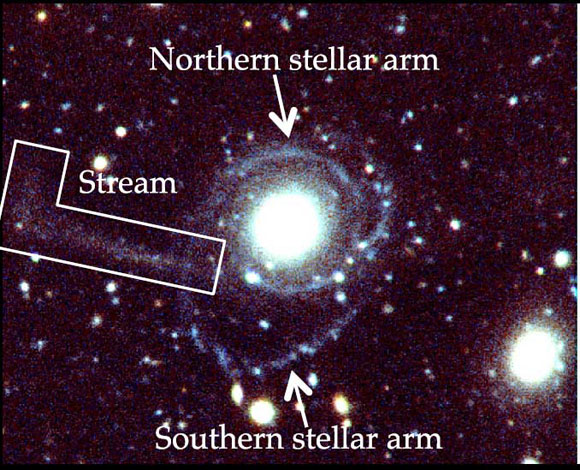
    A deep optical image of the gas-rich galaxy GASS 3505 which in at radio wavelengths shows a ring of neutral hydrogen gas, probably a result of accretion (there is a faint streamer seen to the left in this image).

    New research from the Harvard-Smithsonian Center for Astrophysics reveals that the star formation in GASS 3505 is very weak, less than about 0.1 solar masses per year.

    Cold gas in the form of neutral hydrogen atoms provides the reservoir for star formation in galaxies from the distant to the nearby Universe. Understanding how it accretes onto galaxies is of crucial importance because fresh supplies of gas fuel the ongoing star-forming. In the most popular version, accretion onto the galaxy occurs along cosmic filaments, and at least in more massive galaxies is heated by shocks in the process; in smaller galaxies, the infalling material stays relatively cool. Since galaxies in the early universe are smaller, it is thought that this cold process of growth is more typical for them as well.

    Astronomers studying accretion need to look at nearby galaxies both because they are brighter and because they have distinguishable spatial features such as tails, bridges, ringlike structures, warped discs, or lopsidedness that could result from accumulating gas. The GALEX Arecibo SDSS Survey (GASS) is a multi-wavelength, deep survey designed specifically to search for galaxies rich in atomic hydrogen. CfA astronomer Sean Moran and five colleagues searched GASS to select one object, GASS 3505, that has nearly ten billion solar masses of atomic hydrogen and a round, relatively unstructured appearance in the optical. The team followed up with deep radio maps of the hydrogen emission using the Jansky Very Large Array.

    The astronomers found that the cold gas is distributed in a ring around the galaxy about one hundred and sixty thousand light-years in diameter, within which extremely inefficient star formation is happening (about ten times less than the Milky Way’s value). The ring, it turns out, is connected to a complex stream of material that is a signature for infall and accretion; the stream is a reminder of how important faint morphological features are in understanding a galaxy’s evolution. The scientists, among other analyses, perform computer simulations of a merger that helps to explain the activity of GASS 3505, with slight discrepancies identifying the possible presence of some additional activity still to be confirmed and identified. Future surveys with a new generation of radio telescopes will be able to study these gas-rich systems at cosmological distances.

    Reference: “GASS 3505: The Prototype of HI-Excess, Passive Galaxies” by K. Geréb, B. Catinella, L. Cortese, K. Bekki, S. M. Moran and D. Schiminovich,  14 July 2016, MNRAS.
    DOI: 10.1093/mnras/stw1675
    arXiv: 1607.01446

    Never miss a breakthrough: Join the SciTechDaily newsletter.
    Follow us on Google and Google News.

    Astronomy Astrophysics Cosmology Galaxy Harvard-Smithsonian Center for Astrophysics
    Share. Facebook Twitter Pinterest LinkedIn Email Reddit

    Related Articles

    CfA Scientists Measure the Rate of Expansion of the Universe

    New Study Challenges Planck Results

    Centaurus a Hides a Gaseous Spiral at Its Core

    Rapid Star Formation Observed in the Phoenix Cluster

    Examining the Dust Absorption of Active Galactic Nuclei

    Dark Matter Filament in Galaxy Supercluster Directly Measured

    Calculations Show the Ideal Time to Study the Cosmos

    Using Infrared Images from Hubble & Spitzer, Scientists Discover 25 Distant Galaxies

    Origins of Type Ia Supernovae

    Leave A Reply Cancel Reply

    • Facebook
    • Twitter
    • Pinterest
    • YouTube

    Don't Miss a Discovery

    Subscribe for the Latest in Science & Tech!

    Trending News

    New Research Shows Vitamin B12 May Hold the Key to Healthy Aging

    These Simple Daily Habits Can Quickly Improve Blood Pressure and Heart Risk Factors

    A Common Nutrient May Play a Surprising Role in Anxiety

    Doing This After 9 p.m. Could Double Your Risk of Gut Issues

    Scientists Discover How Coffee Impacts Memory, Mood, and Gut Health

    Why Did the Neanderthals Disappear? Scientists Reveal Humans Had a Hidden Advantage

    Physicists Propose Strange Experiment Where Time Goes Quantum

    Magnesium Magic: New Drug Melts Fat Even on a High-Fat, High-Sugar Diet

    Follow SciTechDaily
    • Facebook
    • Twitter
    • YouTube
    • Pinterest
    • Newsletter
    • RSS
    SciTech News
    • Biology News
    • Chemistry News
    • Earth News
    • Health News
    • Physics News
    • Science News
    • Space News
    • Technology News
    Recent Posts
    • This New Memory Technology Could Make Devices Last Months on One Charge
    • Scientists Turn Cancer’s Own Bacteria Against It in Breakthrough Therapy
    • Cannabis Can Make You Remember Things That Never Happened
    • Doctors Are Surprised by What This Vaccine Is Doing to the Heart
    • Quantum Breakthrough Turns Simple Forces Into Powerful New Interactions
    Copyright © 1998 - 2026 SciTechDaily. All Rights Reserved.
    • Science News
    • About
    • Contact
    • Editorial Board
    • Privacy Policy
    • Terms of Use

    Type above and press Enter to search. Press Esc to cancel.