
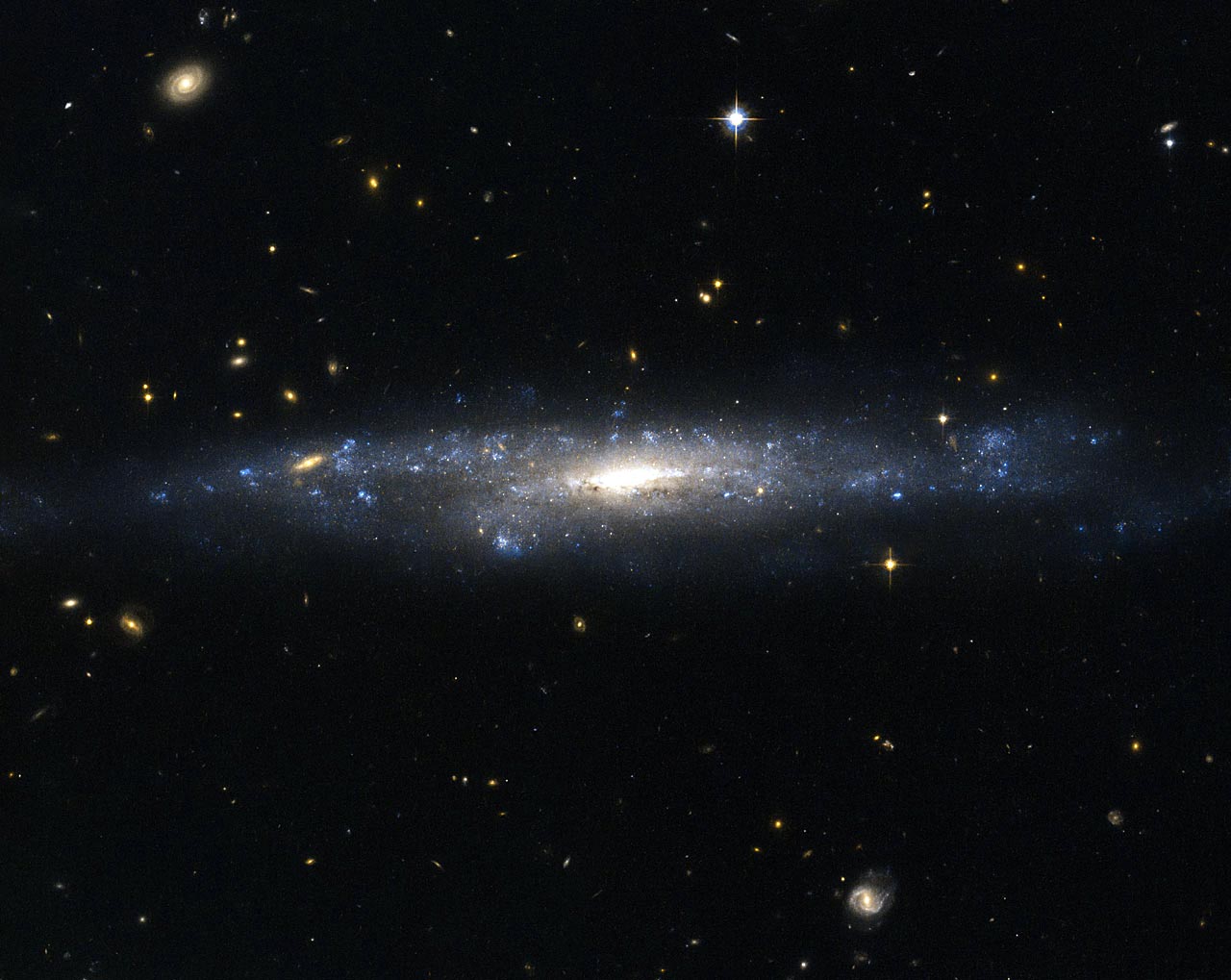
A study by Scuola Internazionale Superiore di Studi Avanzati (SISSA) provides important information on its composition and on its interaction with luminous matter.
They are called low-surface-brightness galaxies and it is thanks to them that important confirmations and new information have been obtained on one of the largest mysteries of the cosmos: dark matter. “We have found that disc galaxies can be represented by a universal relationship. In particular, in this study we analyzed the so-called Low-Surface-Brightness (LSB) galaxies, a particular type of galaxy with a rotating disc called this way because they have a low-density brightness “says Chiara di Paolo, astrophysicist at SISSA and lead author of a study recently published in MNRAS together with Paolo Salucci (astrophysicist at SISSA) and Erkurt Adnan (Istanbul University).
The researchers analyzed the speed at which the stars and gases that compose the galaxies subject matter of the study rotate, noting that the LSBs also have a very homogenous behavior. This result consolidates several clues on the presence and behavior of dark matter, opening up new scenarios on its interactions with bright matter.
Lights and shadows on matter
It is there but you cannot see it. Dark matter appears to account for approximately 90% of the mass of the Universe; it has effects that can be detected on the other objects present in the cosmos, and yet it cannot be observed directly because it does not emit light (at least for the way in which it has been searched for to date). One of the methods for studying it is that of rotation curves of the galaxies, systems that describe the trend of the speed of stars based on their distance from the center of the galaxy. The variations observed are connected to the gravitational interactions due to the presence of stars and to the dark component of matter. Consequently, the rotation curves are a good way to have information on the dark matter based on its effects on what it is possible to observe. In particular, the analysis of the rotation curves can be conducted individually or on groups of galaxies that share similar characteristics according to the universal rotation curve (URC) method.
The novelty of the research lies in having applied the URC method for the first time, already used for other types of galaxies, to a large sample of low-surface-brightness galaxies, obtaining similar results. “We have compared rotation curves of various LSB galaxies finding that there is no discontinuity but gradual and ordered variations starting from the small to the large. Something similar was also observed for spiral galaxies,” explains Salucci, the other author of the study: “This method was applied for the first time in 1996, and to date it has shown that all disc, spiral, dwarf and now also the LSB galaxies can be represented by a universal relationship. This means that we are able to express an ordered trend through a formula which, keeping account of very few parameters, describes how dark matter and luminous matter are distributed”.
New possible scenarios
As it often happens in scientific research, the study has revealed further surprising and unexpected results. “We have discovered relationships of scale between the properties of the stellar disc and those of the dark matter halo, for example a relationship between the dimensions of the stellar discs and the dimensions of the internal region with a constant density of the dark matter halo” explains Chiara Di Paolo. “Furthermore, by comparing the relationships found in the LSB with those obtained in different types of galaxies, we have found that they are all almost coincidental. And it has been a great surprise to verify that galaxies with a very different morphology and history show the same relationships between the properties of dark matter and those of luminous matter”. This result, together with some specific features of LSB galaxies, opens up a new series of scenarios including that of the existence of another type of direct interaction, in addition to the gravitational one, between the two types of matter that form galaxies. A fascinating idea to be verified by new observations.
Reference: “The universal rotation curve of low surface brightness galaxies – IV. The interrelation between dark and luminous matter” by Chiara Di Paolo, Paolo Salucci, Adnan Erkurt, 26 September 2019, Monthly Notices of the Royal Astronomical Society.
DOI: 10.1093/mnras/stz2700
Never miss a breakthrough: Join the SciTechDaily newsletter.
Follow us on Google and Google News.
5 Comments
Regarding Dark Matter, there may be a String Theory explanation. As you may know, quantum mechanics requires that strings must be formed as pairs in the quantum foam – a string and an anti-string – that immediately annihilate each other. Quantum mechanics also requires both the string and anti-string to be surrounded by “jitters” that reduce their monstrous vibrating energies. What if this jitter remains for a fraction of an instant after their string/anti-string annihilations? This temporary jitter would be seen by us as matter for that instant before it too returns to the foam. That’s why we never see it – the “mass” lasts only for that instant but is repeated over and over and over, all over. Specifics on this can be found in my YouTube at https://www.youtube.com/watch?v=24WyRKT8t4w
Some general observations: String theory is relativistic, so I have no problem with that. But a “foam” model would break relativity, and we have some pretty nifty constraints from physics down to Planck scales as well as the 1097 supernova observations telling us that ain’t gonna happen.
Also, “virtual particles” involved in such quantum fluctuations and mediating interactions between fields are not resonant quasistable (or stable) ripples as particles are, they are non-resonant, “off shell”, with complex “masses”. [ https://profmattstrassler.com/articles-and-posts/particle-physics-basics/virtual-particles-what-are-they/ ]
Mostly, this has nothing to do with the article topic of axion strings.
“1097 supernova” = 1987 supernova.
Oops, no axion strings, I was looking at the next article tab, where strings were at least mentioned. So this was even worse misplaced, as pair formation would not affect gravity more than it already does and is accounted for in GR itself as regards interaction strengths.
Dark matter have being hinted by gravity but it doesn’t obliged to anyone have gravity only functions. On contrary, whole it’s concept is too function-driven for us to capture it yet. As in role playing game, where we expecting a certain class of characters have certain group of functions. Dm is whole new game, not your tank.