
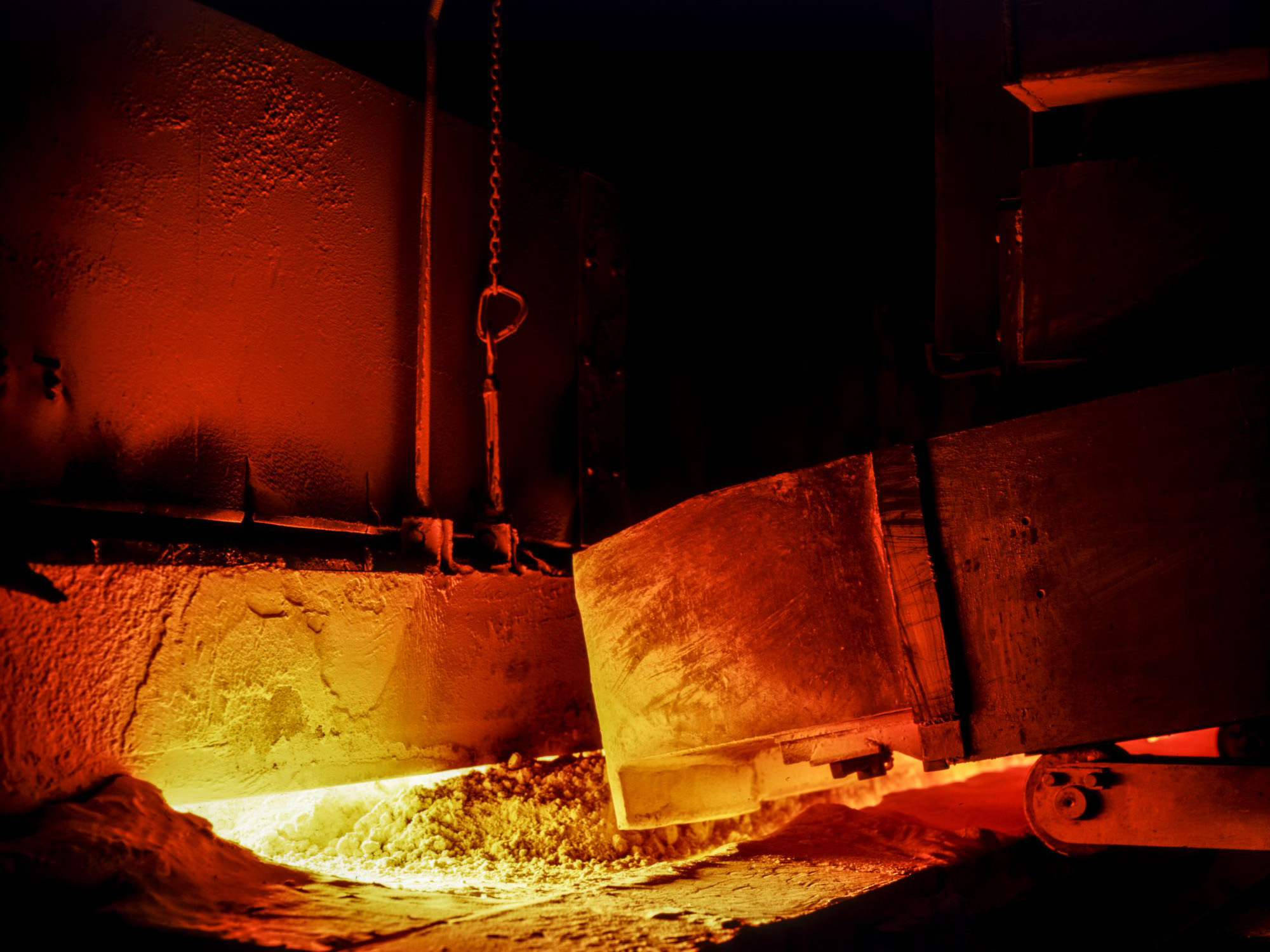
Stanford research reveals that the cost-effective thermal properties of “firebricks” make them an ideal solution for energy storage, potentially accelerating the global transition to renewable energy at a low cost.
According to recent research led by Stanford and published in PNAS Nexus, a technology that dates back to the Bronze Age could provide a swift and affordable method to support the United Nations’ objective of reaching net zero emissions by 2050.
The technology involves assembling heat-absorbing bricks in an insulated container, where they can store heat generated by solar or wind power for later use at the temperatures required for industrial processes. The heat can then be released when needed by passing air through channels in the stacks of “firebricks,” thus allowing cement, steel, glass, and paper factories to run on renewable energy even when wind and sunshine are unavailable.
These systems, which several companies have recently begun to commercialize for industrial heat storage, are a form of thermal energy storage. The bricks are made from the same materials as the insulating bricks that lined primitive kilns and iron-making furnaces thousands of years ago. To optimize for heat storage instead of insulation, the materials are combined in different amounts.
Batteries can store electricity from renewable sources and provide electricity to generate heat on demand. “The difference between firebrick storage and battery storage is that the firebricks store heat rather than electricity and are one-tenth the cost of batteries,” said lead study author Mark Z. Jacobson, a professor of civil and environmental engineering in the Stanford Doerr School of Sustainability and School of Engineering. “The materials are much simpler too. They are basically just the components of dirt.”
High heat storage
Many industries require high-temperature heat for manufacturing. Temperatures in factories need to reach at least 1,300 degrees Celsius (nearly 2,400 degrees Fahrenheit) to produce cement, and 1,000 C (about 1,800 F) or hotter for glass, iron, and steelmaking. Today, about 17% of all carbon dioxide emissions worldwide stem from burning fossil fuels to produce heat for industrial processes, according to Jacobson and co-author Daniel Sambor’s calculations. Generating industrial heat from renewable sources could all but eliminate these emissions.
“By storing energy in the form closest to its end use, you reduce inefficiencies in energy conversion,” said Sambor, a postdoctoral scholar in civil and environmental engineering. “It’s often said in our field that ‘if you want hot showers, store hot water, and if you want cold drinks, store ice’; so this study can be summarized as ‘if you need heat for industry, store it in firebricks.’”
Substantial savings
The researchers set out to examine the impact of using firebricks to store most industrial process heat in 149 countries in a hypothetical future where each country has transitioned to wind, geothermal, hydropower, and solar for all energy purposes. The 149 countries are responsible for 99.75% of global carbon dioxide emissions from fossil fuels. “Ours is the first study to examine a large-scale transition of renewable energy with firebricks as part of the solution,” Jacobson said. “We found that firebricks enable a faster and lower-cost transition to renewables, and that helps everyone in terms of health, climate, jobs, and energy security.”
The team used computer models to compare costs, land needs, health impacts, and emissions involved in two scenarios for a hypothetical future where 149 countries in 2050 are using renewables for all energy purposes. In one scenario, firebricks provide 90% of industrial process heat. In the other, there’s zero adoption of firebricks or other forms of thermal energy storage for industrial processes. In the no-firebrick scenario, the researchers assumed heat for industrial processes would come instead from electric furnaces, heaters, boilers, and heat pumps, with batteries used to store electricity for those technologies.
The researchers found the scenario with firebricks could cut capital costs by $1.27 trillion across the 149 countries compared with the scenario with no firebrick storage, while reducing demand for energy from the grid and the need for energy storage capacity from batteries.
Clean energy, cleaner air
Solutions for accelerating the transition to clean energy are also connected to human health. Previous research has shown that air pollution from burning fossil fuels causes millions of early deaths each year. “Every bit of combustion fuels we replace with electricity reduces that air pollution,” Jacobson said. “And because there is a limited amount of money to transition at a high speed, the lower the cost to the overall system, the faster we can implement it.”
Jacobson has spent his career understanding air pollution and climate problems and developing energy plans for countries, states, and cities to solve these problems. But his focus on firebricks is relatively new, inspired by a desire to identify effective solutions that could be adopted quickly.
“Imagine if we propose an expensive and difficult method of transitioning to renewable electricity – we’d have very few takers. But, if this will save money compared with a previous method, it will be implemented more rapidly,” he said. “What excites me is that the impact is very large, whereas a lot of technologies that I’ve looked at, they have marginal impacts. Here I can see a substantial benefit at low cost from multiple angles, from helping to reduce air pollution mortality to making it easier to transition the world to clean renewables.”
Reference: “Effects of firebricks for industrial process heat on the cost of matching all-sector energy demand with 100% wind–water–solar supply in 149 countries” by Mark Z Jacobson, Daniel J Sambor, Yuanbei F Fan and Andreas Mühlbauer, 10 July 2024, PNAS Nexus.
DOI: 10.1093/pnasnexus/pgae274
The study was funded by the Engineer Research and Development Center.
Never miss a breakthrough: Join the SciTechDaily newsletter.
Follow us on Google and Google News.
3 Comments
There is no climate crisis, except in the minds of the same dumbed-down folk who fell for that other ongoing psyop, the Covid crisis.
The real crisis is the politicisation of science in the service of a globalist agenda epitomised by the UN Sustainable Development programme and the Great Reset, designed to consign the masses to serfdom under a technocratic elite.
Psyop? Really? Please try to separate science from whatever mythology you’re basing these comments on….
What science?