

22q11.2 deletion syndrome (22q) raises schizophrenia risk through skull malformations linked to the Tbx1 gene, affecting cerebellar development. This highlights how non-brain factors like bone defects can influence neurological disorders.
The chromosomal disorder 22q11.2 deletion syndrome (22q) has emerged as one of the strongest risk factors for schizophrenia. Scientists at St. Jude Children’s Research Hospital identified malformed regions of the cerebellum in both laboratory models and patients with 22q, attributing these malformations to improper skull formation.
Additionally, the researchers linked the skull malformation to the loss of a single gene: Tbx1. This research highlights that neurological disorders can arise from sources outside the nervous system, such as defects in skull development. The findings were published in Nature Communications.
Schizophrenia develops in about 30% of people with 22q. In addition, the large region of the genome that is affected in 22q is conserved among many animals, making 22q ideal for studying the genetic basis of schizophrenia in laboratory models. This provided the corresponding author, Stanislav Zakharenko, MD, PhD, St. Jude Department of Developmental Neurobiology, a launchpad to study the syndrome and explore its link to neurological development.
Gene removal blocks skull pocket from forming
Previous work from Zakharenko found that the deletion of only one 22q gene, Dgcr8, disrupts the flow of auditory information from a lower brain region called the thalamus to the auditory cortex, where sounds are interpreted. This region of the brain is also associated with auditory hallucinations, which are a hallmark symptom of schizophrenia. The researchers called this breakdown in information flow “thalamocortical disruption.”
“Although thalamocortical disruption occurs late in development, which is consistent with the onset of schizophrenia symptoms, it stays and doesn’t go away. However, hallucinations are transient in nature — they come and go,” Zakharenko said. “It seemed that this was just one of the hits that triggered symptoms. The question is: What is the other hit?”
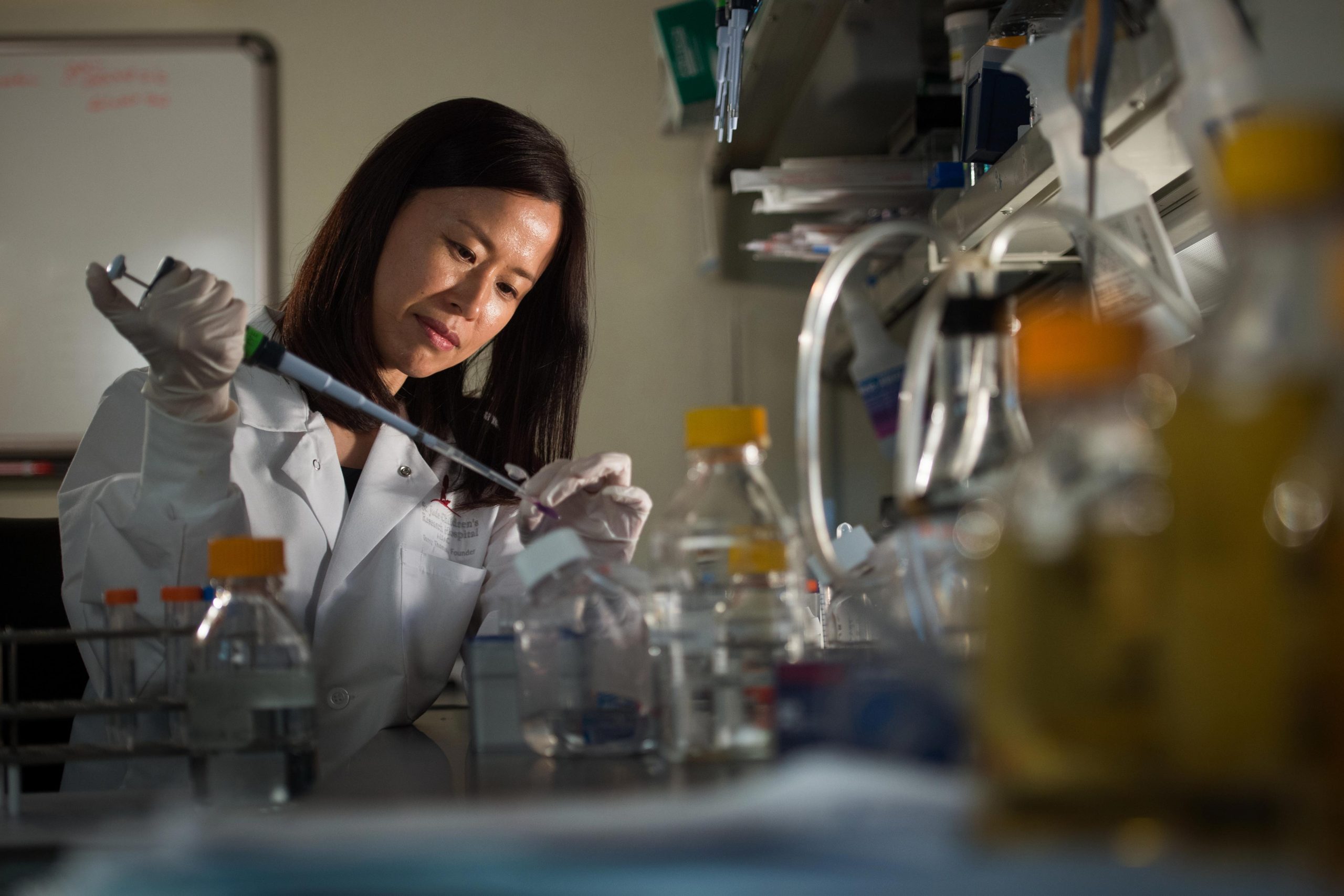
The researchers noticed a part of the brain, the cerebellum, malformed in 22q animal models, specifically, the cerebellum’s small lobules called the flocculus and paraflocculus. Most neurodevelopmental disorders arise from defects in genes that play a role in the brain, but the 22q gene the researchers linked to this malformation, Tbx1, was unexpected.
“What is interesting about Tbx1 is that it is not very well expressed in the brain, especially adolescent or adult brain,” Zakharenko said. “Rather, it’s expressed in the surrounding tissues, namely bone, cartilage, and vasculature tissues. It is very unlikely that Tbx1 directly affects the brain at all.”
Instead, removing Tbx1 has an indirect but significant effect on brain development. Bone formation relies on immature osteoblast cells correctly growing into mature osteocytes. Tbx1 removal disrupted this cycle, resulting in an underdeveloped pocket in the skull which normally houses the flocculus and paraflocculus. For a neurological syndrome, the findings are strikingly unusual — with no pocket in the skull for these structures to develop, they appear substantially smaller than normal. The reduction of the flocculus and paraflocculus was validated through magnetic resonance imaging studies of dozens of patients with 22q and a comparative control group.
Misshapen skull removes cerebellum’s checks and balances
Zakharenko’s team studied the flocculus and paraflocculus’ role in the brain to better understand how their malformation could influence behavior. “We found that the neural circuits within the flocculus and paraflocculus are dysfunctional,” explained Zakharenko.
The regions also control a reflex that ensures stable vision during head movements and is crucial for face recognition. The researchers found that this reflex is impaired in 22q. This may be a valuable lead for schizophrenia research because patients with schizophrenia have a deficit in face recognition.
The paraflocculus is also connected to the auditory cortex. However, the details of such connectivity are unclear. Zakharenko hopes future research will more clearly reveal the links between 22q and schizophrenia. More specifically, he hopes that future research will illuminate how the paraflocculus affects the function of the auditory cortex and provide us with the second hit that leads to hallucinations.
“In my mind, it’s like a stepping stone. We hope to follow this chain of events from the malformed skull to the underdeveloped flocculus and paraflocculus to the auditory cortex dysfunction,” Zakharenko said. “This would be extraordinary because it all started with a bone.”
Reference: “Tbx1 haploinsufficiency leads to local skull deformity, paraflocculus and flocculus dysplasia, and motor-learning deficit in 22q11.2 deletion syndrome” by Tae-Yeon Eom, J. Eric Schmitt, Yiran Li, Christopher M. Davenport, Jeffrey Steinberg, Audrey Bonnan, Shahinur Alam, Young Sang Ryu, Leena Paul, Baranda S. Hansen, Khaled Khairy, Stephane Pelletier, Shondra M. Pruett-Miller, David R. Roalf, Raquel E. Gur, Beverly S. Emanuel, Donna M. McDonald-McGinn, Jesse N. Smith, Cai Li, Jason M. Christie, Paul A. Northcott and Stanislav S. Zakharenko, 5 December 2024, Nature Communications.
DOI: 10.1038/s41467-024-54837-3
The study was supported by grants from the National Cancer Institute at the National Institutes of Health (R01 CA261898, R01 CA216354, R21 CA261833, U24 CA55727, U01 CA195547 and Cancer Center Support [CORE] Grant CA21765), and the American Lebanese Syrian Associated Charities (ALSAC), the fundraising and awareness organization of St. Jude.
Never miss a breakthrough: Join the SciTechDaily newsletter.
Follow us on Google and Google News.
11 Comments
It makes sense seeing as osteomyelitis in the skull can cause personality changes, but I can’t help but think that it sounds like “reverse phrenology.”
Yeah. I immediately thought about people in charge, in the future, using this bit of information to harm large swaths of society
It certainly does, but just because it sounds like it comes from a bunk school of thought doesn’t change the data. Phrenology was mostly about proving how Europeans were superior to everyone else based on their arbitrary assignation of traits to skull characteristics. The research discussed in the article comes from a different mindset entirely: what influence does the skull have on mental development (or some such hypothesis). I don’t think they had a specific outcome they wanted to legitimize, that wouldn’t be in line with the scientific process or with medical ethics.
Skull shape and EMF sensation? Its only safe when the world is right!
Those gene mutations and ect. The things that are being experienced by someone with schitzofrenia are caused by fake scientists. Real scientists don’t lie the give true and real facts and finding. Degenerative scientist and disturbed peoplewhich are really Demons, the other life among who whistles blowers have recently spoken about and had a hearing on the matter have been tormenting,and harassing,assaulting and oppressing for a long time and they’re gonna be brought to Justice!
That’s deep. Justice is lifting the veil. We were created with a soul and gifted with a divine connection of eternal life. luminous energy flow will never die. Life always tells a story. Medicine always reverses in order to heal.
Very interesting! Surprisingly , this makes so much sense. Schizophrenia runs in my family ( brother, mother, grandmother , and 2 or 3 aunts), so I am always looking for more information . My brother once told me in one of his saner moments that it’s like a TV on in the background inside his head all the time and he never knows if he should focus on what they are telling him or to try to ignore it, which is sometimes impossible . I read somewhere that relatives of schizophrenics often have sensitivity to auditory stimuli, which I’ve also found true, so I’m really looking forward to reading more about this connection.
Food for thought. 200 years ago, people with paranoid skitsophernia were treated differently because their was no diagnosis that came with a stigma. this is by design. think of the ramifications of that. Huge. curious? reach out – let me know what you think
Face recognition genetic link?
I have a son with 22q and while I didn’t test for having it, I have struggled all my life with a face recognition issue that I have tried to determine if is a social response (not looking at people) or something else, but truly It takes me a while to get to know people and tell them apart if they are at all similar. I do a lot of looking at behavior, dress, and other habits to recognize people and so can’t always tell actors apart because they play different roles acting and dressing so different in each one.
If this is true, then the skull could be surgically expanded to normal size as the child develops
To CK
It would be great to know if this has been done and if it works. Would there be an age barrier/difference? And would the brain take advantage of the new area and be able to develop into it?