
Close Menu
    Facebook X (Twitter) Instagram
    SciTechDaily
    • Biology
    • Chemistry
    • Earth
    • Health
    • Physics
    • Science
    • Space
    • Technology
    Facebook X (Twitter) Pinterest YouTube RSS
    SciTechDaily
    Home»Biology»Scientists Clever, Controversial New Plan to Help Save Endangered Rhinos
    Biology

    Scientists Clever, Controversial New Plan to Help Save Endangered Rhinos

    By University of OxfordNovember 8, 20191 Comment3 Mins Read
    Facebook Twitter Pinterest Telegram LinkedIn WhatsApp Email Reddit
    Share
    Facebook Twitter LinkedIn Pinterest Telegram Email Reddit
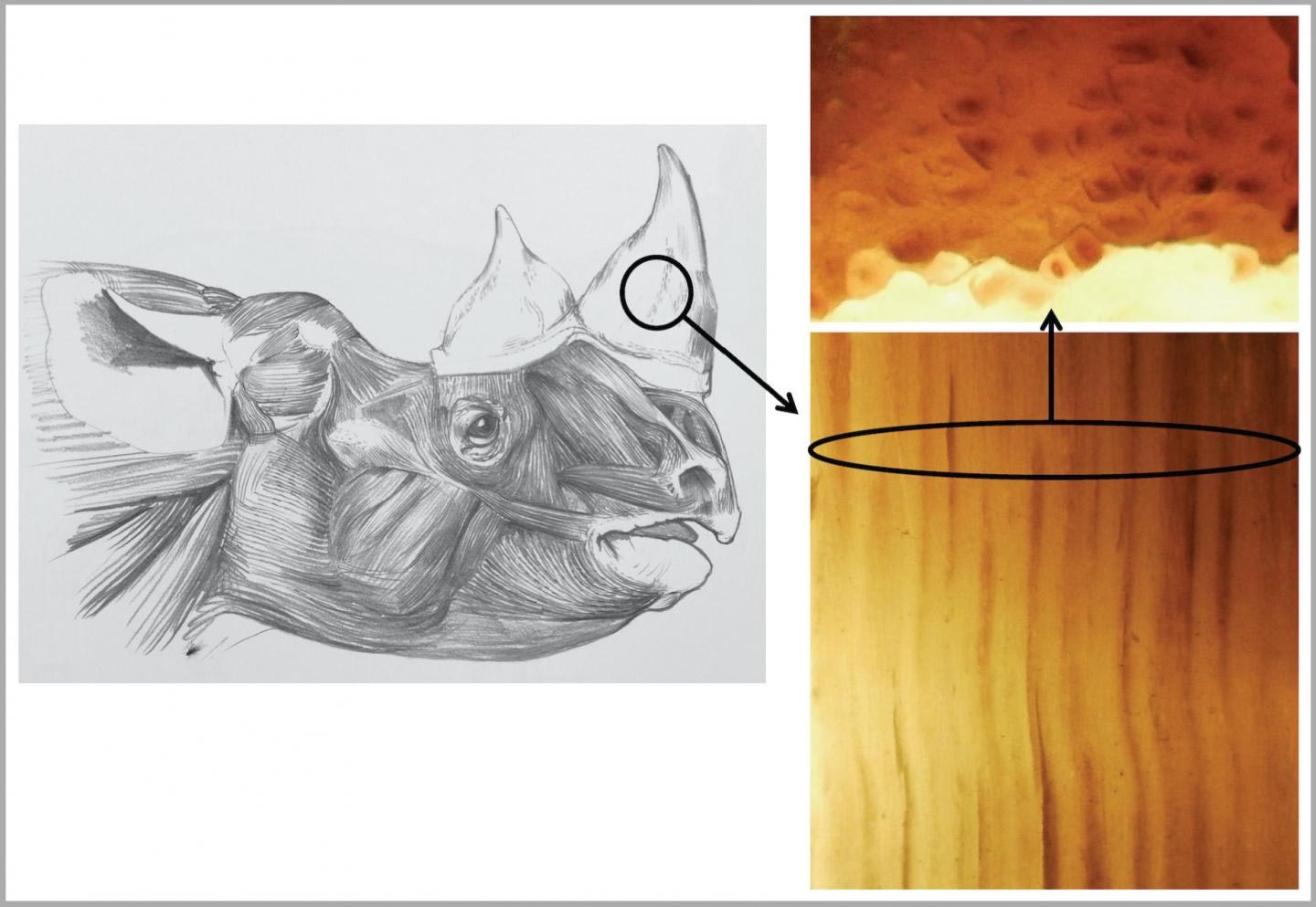
    Head of Browse (or Black) Rhino
    Drawn to life picture of head of Browse (or Black) Rhino. To the right both length and cross sections of slivers of its horn.
    Credit: Jonathan Kingdon

    Published today in Scientific Reports scientists hope their method will provide a blueprint to create credible fakes that could eventually flood a market that has decimated the wild rhino population.

    In Chinese medicine rhino horn is believed to have many benefits, including working as an aphrodisiac. In reality, the sellers are often cutting the horn with ground-up Viagra. Whatever the exact hidden blend may be, the undimmed demand for rhino horn continues to drive poaching with devastating effect for the few populations left in the wild.

    This study aims to provide a way to confuse and thus hopefully diminish the demand for real rhino horns by showing a way to a vastly cheaper copy that can be used to infiltrate the market.

    The horn of the rhinoceros is not a horn in the traditional sense like the horn of a cow or the nail of a hoof, though it does share some material properties. The rhino’s horn is actually a tuft of hair that grows, tightly packed and glued together by exudates from sebaceous glands, on the nose of the animal.

    In this proof of concept, the scientists bundled together the tail hairs of the rhino’s near relative, the horse, and glued them together with a bespoke matrix of regenerated silk to mimic the collagenous component of the real horn. This approach allowed them to fabricate sample structures that were confusingly similar to real rhino horns in look, feel, and properties. Analytical studies demonstrated similarities in composition and properties with natural and faux horns.

    Co-lead author, Professor Fritz Vollrath, from the University of Oxford’s Department of Zoology, said: ‘It appears from our investigation that it is rather easy as well as cheap to make a bio-inspired hornlike material that mimics the rhino’s extravagantly expensive tuft of nose hair. We leave it to others to develop this technology further with the aim to confuse the trade, depress prices, and thus support rhino conservation.’

    Rhino survival is critically challenged by the trade in its horn and other horn substitutes are being developed in the hope to undermine the market in this much sought-after – if generally banned commodity. The authors of this study believe that it is important that plausible copies should be simple to produce while being very similar in both structure and chemical composition. And tail hairs from horses, glued together with a silk-based filler, seem to fulfill this condition. Importantly, this bio-composite is easily molded into a rhino horn copy with a microstructure that, when cut and polished, is remarkably similar to that of the real horn.

    ###

    Reference: “Creating artificial Rhino Horns from Horse Hair” by Ruixin Mi, Z. Z. Shao and F. Vollrath, 8 November 2019, Scientific Reports.
    DOI: 10.1038/s41598-019-52527-5

    Co-author, Ruixin Mi, from the Department of Macromolecular Science, Fudan University, said: ‘Our study demonstrates that materials science can contribute to fundamental issues in biology and conservation. The fundamental structure of the rhino horn is a highly evolved and tough fiber-reinforced bio-composite and we hope that our attempts to copy it will not only undermine the trade in rhino horn but might also find uses as a novel bio-inspired material.’

    Never miss a breakthrough: Join the SciTechDaily newsletter.
    Follow us on Google and Google News.

    Crime Endangered Environment University of Oxford Zoology
    Share. Facebook Twitter Pinterest LinkedIn Email Reddit

    Related Articles

    New Critically Endangered Killifish Species Discovered in Kenya’s Ancient Forest

    Ghost Frog Found: Scientists Stumble Upon Species Missing Since 1902

    Rediscovered After 60 Years: The Bizarre Egg-Laying Mammal of the Cyclops Mountains

    Forgotten Species Go Extinct Twice: Exploring the Phenomenon of Societal Extinction

    Island Gigantism and Dwarfism: Evolutionary “Island Rule” Confirmed

    Zoonosis Threat: Urgent Call for More Effective Wildlife Trade Legislation in Wake of COVID-19

    Where the Wild Things Are: Scientists Map and Forecast Apex Predator Populations at Unprecedented Scale

    Hunger Encourages Risk-Taking – Study Results Involving Over 100 Animal Species Compared

    Ancient Parasites Unlock Secrets of Human History

    1 Comment

    1. Bonnie Davis on November 8, 2019 10:50 am

      Brilliant!

      Reply
    Leave A Reply Cancel Reply

    • Facebook
    • Twitter
    • Pinterest
    • YouTube

    Don't Miss a Discovery

    Subscribe for the Latest in Science & Tech!

    Trending News

    One of the Universe’s Largest Stars May Be Getting Ready To Explode

    Scientists Discover Enzyme That Could Supercharge Ozempic-Like Weight Loss Drugs

    Popular Sweetener Linked to DNA Damage – “It’s Something You Should Not Be Eating”

    Ancient “Rock” Microbes May Reveal How Complex Life Began

    Researchers Capture Quantum Interference in One of Nature’s Rarest Atoms

    “A Plague Is Upon Us”: The Mass Death That Changed an Ancient City Forever

    Scientists Discover Game-Changing New Way To Treat High Cholesterol

    This Small Change to Your Exercise Routine Could Be the Secret to Living Longer

    Follow SciTechDaily
    • Facebook
    • Twitter
    • YouTube
    • Pinterest
    • Newsletter
    • RSS
    SciTech News
    • Biology News
    • Chemistry News
    • Earth News
    • Health News
    • Physics News
    • Science News
    • Space News
    • Technology News
    Recent Posts
    • Scientists Prove There Are Just Six Degrees of Separation in a Social Network
    • Bee Bacteria Could Fix a Major Flaw in Plant-Based Milk
    • Scientists Discover a Surprising Way To Make Bread Healthier and More Nutritious
    • Natural Compounds Boost Bone Implant Success While Killing Bacteria and Cancer Cells
    • After 60 Years, Scientists Uncover Unexpected Brain Effects of Popular Diabetes Drug Metformin
    Copyright © 1998 - 2026 SciTechDaily. All Rights Reserved.
    • Science News
    • About
    • Contact
    • Editorial Board
    • Privacy Policy
    • Terms of Use

    Type above and press Enter to search. Press Esc to cancel.